

10 Dollars (independence) – Singapore
Non-circulating coins
Commemoration: 10th anniversary of independence
Series: Singapore Independence
Singapore
Context

Material
References
KM: #Click to copy to clipboard15
Numista: #26486
Value
Exchange value: 10 SGD = $7.92
Bullion value: $45.07
Obverse
Description:
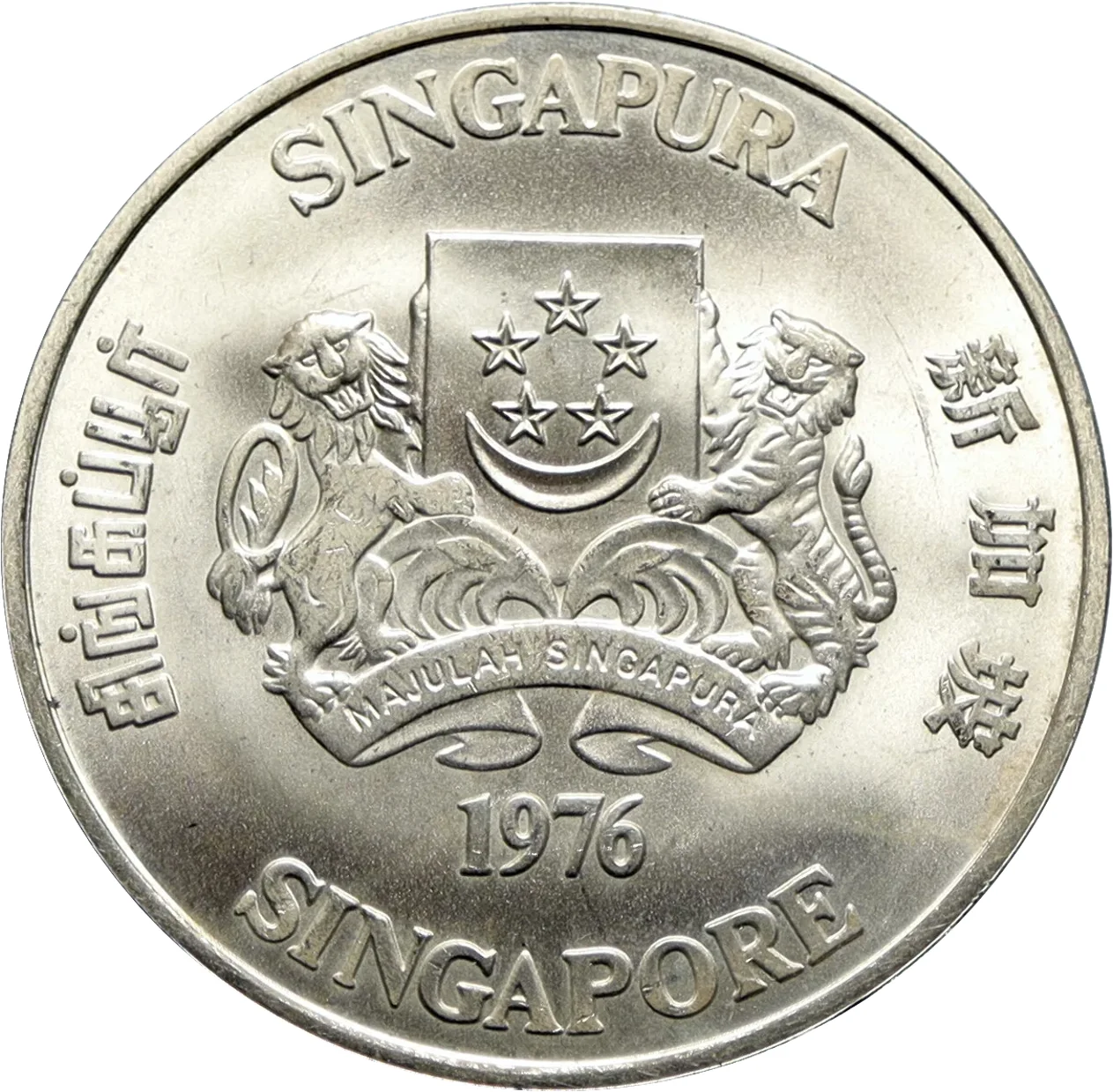
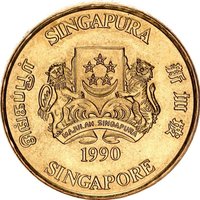
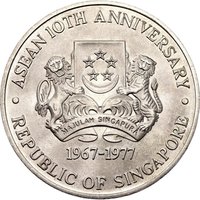
Singapore's Coat of Arms with supporters, encircled by "SINGAPORE" in four languages, with the date below.
Inscription:
SINGAPURA
சிங்கப்பூர்
MAJULAH SINGAPURA
新加坡
SINGAPORE
1976
சிங்கப்பூர்
MAJULAH SINGAPURA
新加坡
SINGAPORE
1976
Translation:
SINGAPORE
SINGAPORE
ONWARD SINGAPORE
SINGAPORE
SINGAPORE
1976
SINGAPORE
ONWARD SINGAPORE
SINGAPORE
SINGAPORE
1976
Reverse
Description:
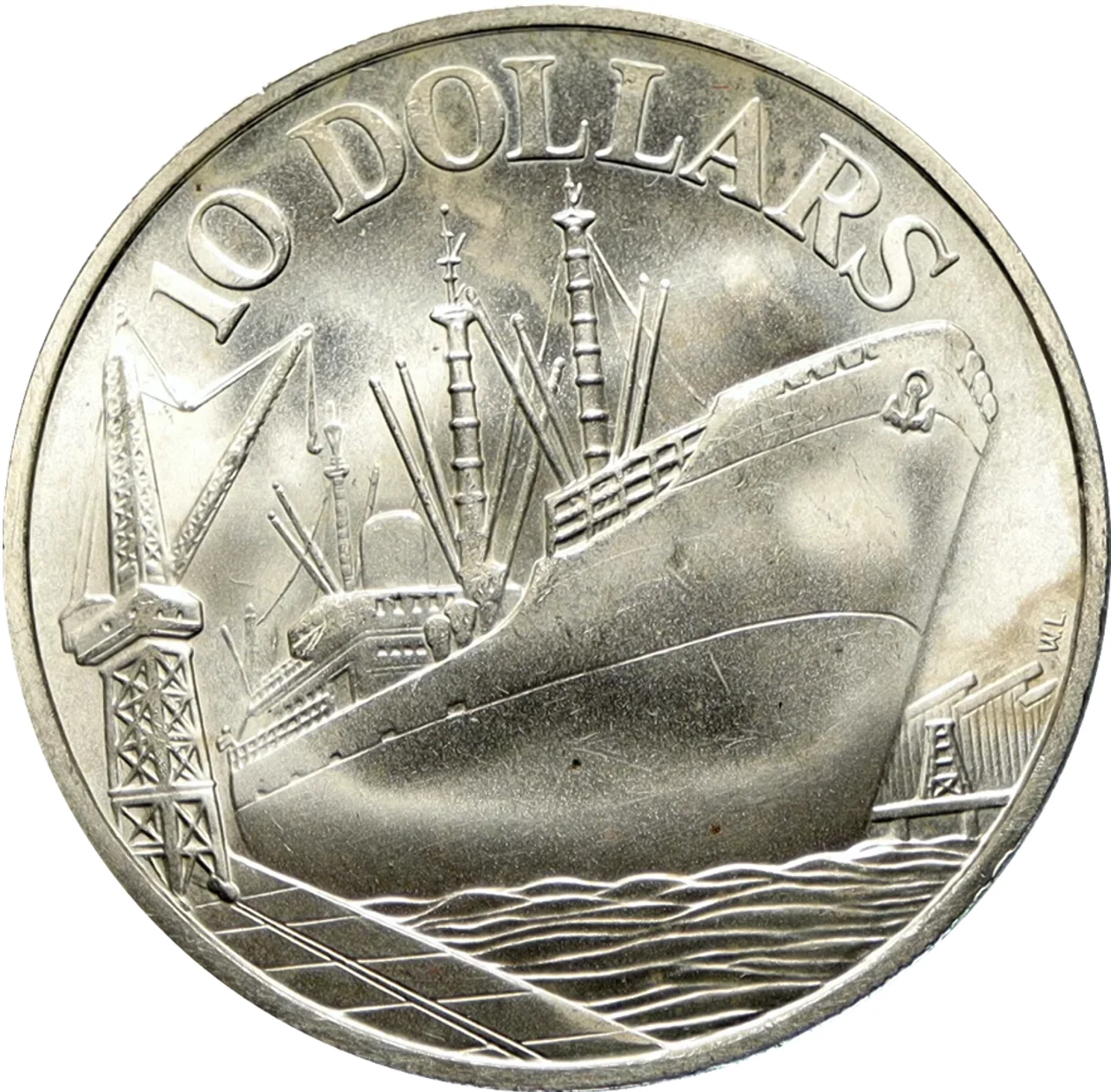
Freighter at a wharf, with its name above and the designer's initials (WL for William Lee) to the right.
Inscription:
10 DOLLARS
WL
WL
Designer: William Lee
Edge
Reeded
Categories
| Transportation> Watercraft |
Mints
| Name | Mark |
|---|---|
| Singapore Mint | — |
| Singapore Mint | (sm) |
Mintings
| Year | Mint Mark | Mintage | Quality | Collection |
|---|---|---|---|---|
| 1976 | — | 150,000 | ||
| 1976 | sm | 10,000 | Proof | |
| 1977 | — | 150,000 | ||
| 1977 | sm | 10,000 | Proof |
Historical background
In 1976, Singapore's currency situation was characterized by a period of stability and strategic consolidation under the managed float of the Singapore dollar. Just five years earlier, in 1971, the currency had been pegged to the British pound, but the breakdown of the Bretton Woods system and sterling's own volatility necessitated a change. By 1973, the Monetary Authority of Singapore (MAS) had shifted to a managed float regime, pegging the Singapore dollar to a undisclosed trade-weighted basket of currencies of its major trading partners. This pragmatic policy, focused on controlling inflation and ensuring export competitiveness, was firmly in place by 1976 and proving effective.
The economy in 1976 was robust, recovering strongly from the 1974-75 global oil crisis recession. This growth, driven by continued industrialization and foreign investment, underpinned confidence in the currency. The MAS's primary focus was not on interest rate targeting (as in many Western nations) but on managing the exchange rate as the main tool for monetary policy. This approach successfully kept inflation in check—a critical achievement—while allowing the currency to appreciate gradually to mitigate imported inflation, all without harming the vital export sector.
Internationally, 1976 saw the Singapore dollar establishing itself as a stable and credible currency within the region. The government's consistent budget surpluses, high national savings, and growing foreign reserves provided a solid foundation for this credibility. While not yet a global financial hub of today's stature, Singapore's prudent fiscal and monetary management, exemplified by its currency regime, was laying the essential groundwork for its future transformation into a major international financial centre. The system established in the early 1970s and matured by 1976 remains the cornerstone of Singapore's monetary policy to this day.
The economy in 1976 was robust, recovering strongly from the 1974-75 global oil crisis recession. This growth, driven by continued industrialization and foreign investment, underpinned confidence in the currency. The MAS's primary focus was not on interest rate targeting (as in many Western nations) but on managing the exchange rate as the main tool for monetary policy. This approach successfully kept inflation in check—a critical achievement—while allowing the currency to appreciate gradually to mitigate imported inflation, all without harming the vital export sector.
Internationally, 1976 saw the Singapore dollar establishing itself as a stable and credible currency within the region. The government's consistent budget surpluses, high national savings, and growing foreign reserves provided a solid foundation for this credibility. While not yet a global financial hub of today's stature, Singapore's prudent fiscal and monetary management, exemplified by its currency regime, was laying the essential groundwork for its future transformation into a major international financial centre. The system established in the early 1970s and matured by 1976 remains the cornerstone of Singapore's monetary policy to this day.
Series: Singapore Independence

🌟 Uncommon