

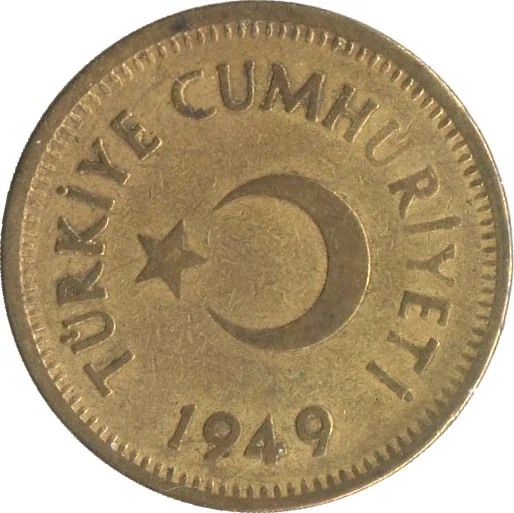

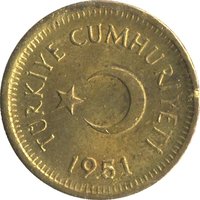
Obverse
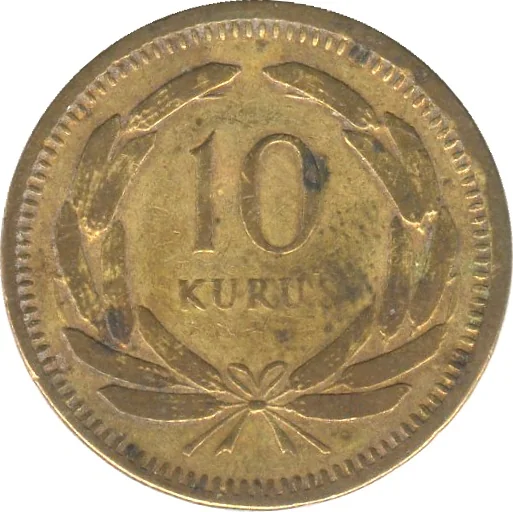
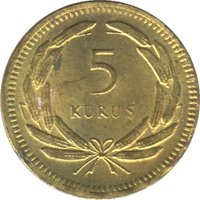
Reverse
Edge
Mintings
| Year | Mint Mark | Mintage | Quality | Collection |
|---|---|---|---|---|
| 1949 | — | 27,000,000 | ||
| 1951 | — | 6,200,000 | ||
| 1955 | — | 10,090,000 | ||
| 1956 | — | 9,910,000 |
Historical background
In 1949, Turkey's currency situation was characterized by the challenges of post-war economic adjustment and the early strains of transitioning to a multi-party political system. The Turkish lira, which had remained relatively stable during World War II under a strict state-controlled economy, faced mounting pressure as the government of President İsmet İnönü began to liberalize trade and ease wartime controls. A significant overvaluation of the lira became apparent, sustained by complex multiple exchange rate systems and stringent capital controls that distorted the economy, discouraged exports, and fueled a growing black market for foreign currency.
The core issue was a severe shortage of foreign exchange reserves, particularly U.S. dollars, needed to pay for vital imports of machinery and manufactured goods for development. Turkey's traditional agricultural exports were struggling to earn enough hard currency, leading to a persistent balance of payments deficit. This economic bind occurred amidst a pivotal geopolitical shift, as Turkey aligned itself with the West at the start of the Cold War, seeking inclusion in the Marshall Plan and membership in international institutions like the IMF and OECD.
Consequently, 1949 was a year of decisive external intervention and preparation for a major devaluation. Under guidance and pressure from the United States and the IMF, which were providing crucial aid, the Turkish government laid the groundwork for a dramatic economic policy shift. This culminated in the landmark devaluation of September 1949, where the lira was devalued by over 50% against the dollar, moving from TL 2.80 to TL 5.30 per USD. This painful but necessary adjustment aimed to correct the exchange rate imbalance, boost export competitiveness, and integrate Turkey more fully into the Western-led Bretton Woods monetary system.
The core issue was a severe shortage of foreign exchange reserves, particularly U.S. dollars, needed to pay for vital imports of machinery and manufactured goods for development. Turkey's traditional agricultural exports were struggling to earn enough hard currency, leading to a persistent balance of payments deficit. This economic bind occurred amidst a pivotal geopolitical shift, as Turkey aligned itself with the West at the start of the Cold War, seeking inclusion in the Marshall Plan and membership in international institutions like the IMF and OECD.
Consequently, 1949 was a year of decisive external intervention and preparation for a major devaluation. Under guidance and pressure from the United States and the IMF, which were providing crucial aid, the Turkish government laid the groundwork for a dramatic economic policy shift. This culminated in the landmark devaluation of September 1949, where the lira was devalued by over 50% against the dollar, moving from TL 2.80 to TL 5.30 per USD. This painful but necessary adjustment aimed to correct the exchange rate imbalance, boost export competitiveness, and integrate Turkey more fully into the Western-led Bretton Woods monetary system.
🌱 Very Common