

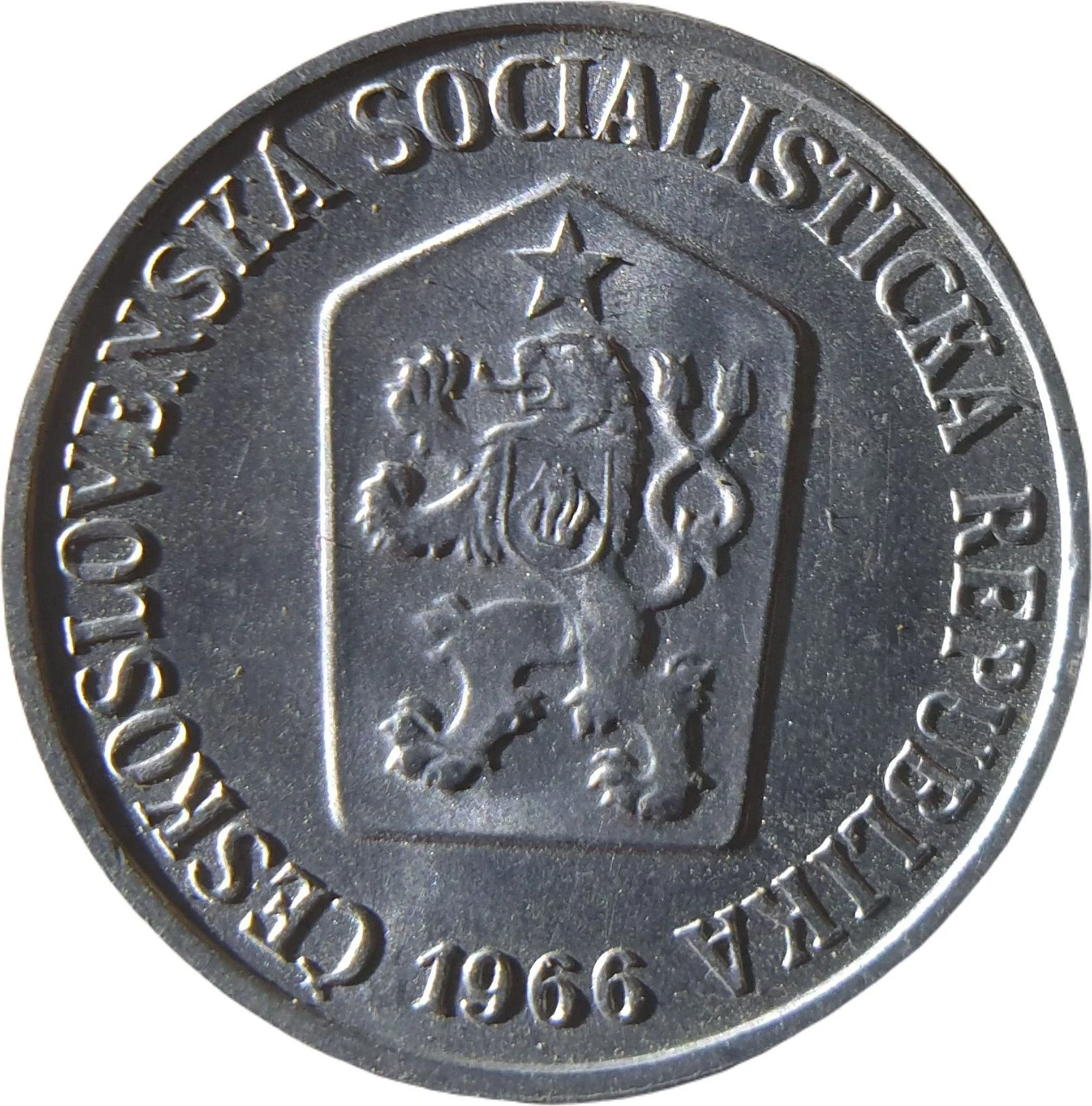

10 haléřů / halierov – Czechoslovakia
Add to wishlist
Context
Years: 1961–1971
Issuer: Czechoslovakia
Period:
(1960—1990)
Currency:
(1953—1992)
Demonetization: 31 December 1977
Total mintage: 559,203,600
Material

References
KM: #
Numista: #2645
Value
Exchange value: 0.10 CSK
Obverse
Description:
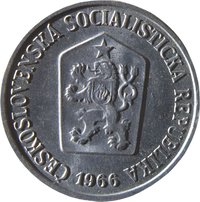
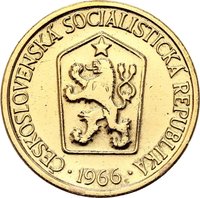
Czech lion with socialist shield, date beneath.
Inscription:
ČESKOSLOVENSKÁ SOCIALISTICKÁ REPUBLIKA
1968
1968
Translation:
Czechoslovak Socialist Republic
1968
1968
Script: Latin
Engraver: Andrej Peter
Reverse
Edge
Reeded
Categories
| Symbols> Coat of Arms |
| Symbol> Wreath |
Mints
| Name | Mark |
|---|---|
| Kremnica | — |
Mintings
| Year | Mint Mark | Mintage | Quality | Collection |
|---|---|---|---|---|
| 1961 | — | 314,480,000 | ||
| 1962 | — | — | ||
| 1963 | — | 3,600 | ||
| 1964 | — | — | ||
| 1965 | — | — | ||
| 1966 | — | — | ||
| 1966 | — | — | Proof | |
| 1967 | — | 46,990,000 | ||
| 1968 | — | 37,275,000 | ||
| 1969 | — | 80,000,000 | ||
| 1970 | — | 50,005,000 | ||
| 1971 | — | 30,450,000 |
Historical background
In 1961, Czechoslovakia implemented a significant currency reform that was, in reality, a state-orchestrated confiscation of savings aimed at resetting the struggling planned economy. Officially presented as a measure to combat black-market speculation and stabilize the currency, the reform abruptly invalidated the existing Czechoslovak koruna (Kčs) and introduced new banknotes at an exchange rate of 10:1 for cash holdings up to a small limit. Larger personal cash savings and enterprise funds were converted at drastically worse rates, such as 50:1 or even written off entirely, effectively wiping out a substantial portion of the population's monetary assets overnight.
The context for this drastic move was the deep-seated economic crisis of the early 1960s, marking the failure of the ambitious Third Five-Year Plan. The economy was plagued by severe shortages, declining industrial productivity, and a growing disparity between the amount of money in circulation and the availability of consumer goods. The 1961 reform was a blunt attempt to destroy this excess purchasing power, or "inflationary overhang," and to forcibly reassert state control over economic activity. It followed the pattern of a similar, even harsher confiscatory reform in 1953.
The social and political consequences were profound. The action, prepared in absolute secrecy, triggered widespread public anger and a profound loss of trust in the communist regime. Spontaneous protests erupted in several industrial cities, most notably in Plzeň, where workers occupied the streets around the Škoda factory. While these were swiftly suppressed by police, the reform left a lasting scar on the social contract, embedding deep-seated economic cynicism among citizens and contributing to the pressures that would later fuel the reform movement of the Prague Spring in 1968.
The context for this drastic move was the deep-seated economic crisis of the early 1960s, marking the failure of the ambitious Third Five-Year Plan. The economy was plagued by severe shortages, declining industrial productivity, and a growing disparity between the amount of money in circulation and the availability of consumer goods. The 1961 reform was a blunt attempt to destroy this excess purchasing power, or "inflationary overhang," and to forcibly reassert state control over economic activity. It followed the pattern of a similar, even harsher confiscatory reform in 1953.
The social and political consequences were profound. The action, prepared in absolute secrecy, triggered widespread public anger and a profound loss of trust in the communist regime. Spontaneous protests erupted in several industrial cities, most notably in Plzeň, where workers occupied the streets around the Škoda factory. While these were swiftly suppressed by police, the reform left a lasting scar on the social contract, embedding deep-seated economic cynicism among citizens and contributing to the pressures that would later fuel the reform movement of the Prague Spring in 1968.
🌱 Very Common