

1 Koruna – Czechoslovakia
Context
Years: 1957–1960
Issuer: Czechoslovakia 
Period:
(1948—1960)
Currency:
(1953—1992)
Demonetization: 30 September 1993
Total mintage: 137,000,000
Material
References
KM: #Click to copy to clipboard46
Numista: #2015
Value
Exchange value: 1 CSK
Obverse
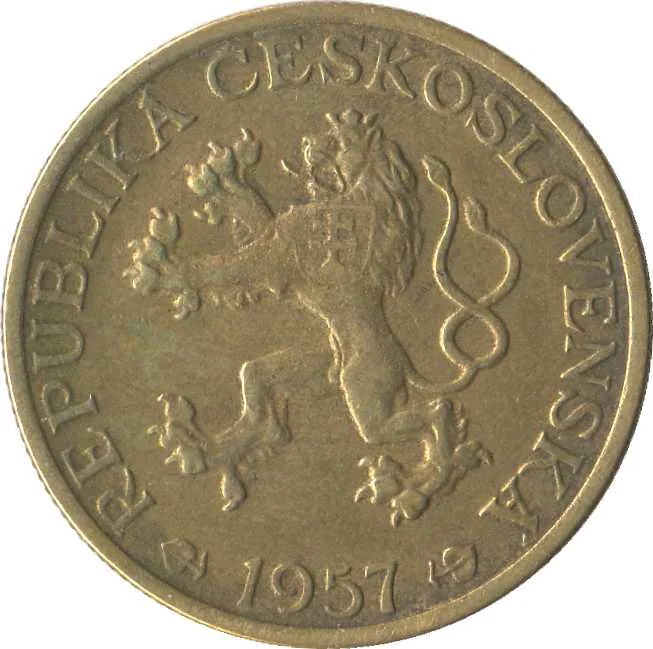
Description:
Czech lion, Slovak shield.
Inscription:
REPUBLIKA ČESKOSLOVENSKÁ
1957
1957
Translation:
REPUBLIC OF CZECHOSLOVAKIA
1957
1957
Script: Latin
Engraver: Marie Uchytilová-Kučová
Reverse
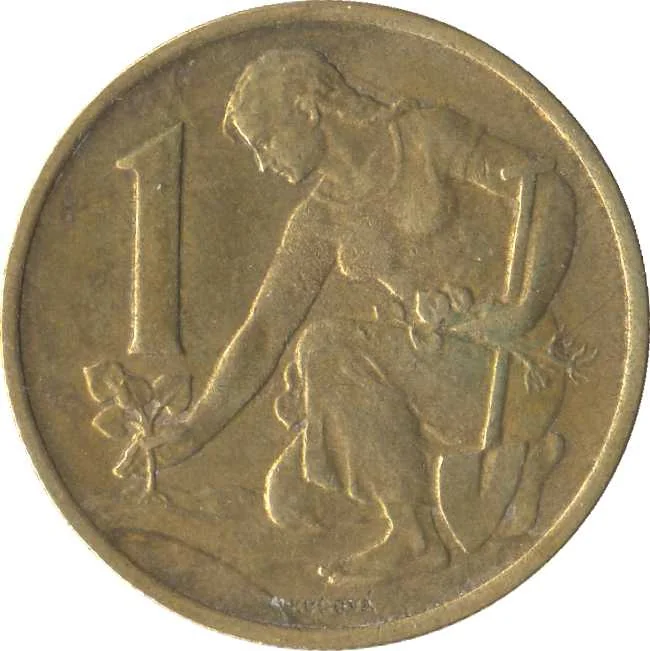
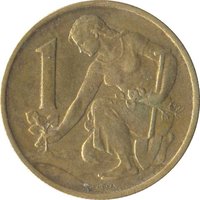
Description:
A woman planting a linden sprig, signed below.
Inscription:
1
M·KUČOVÁ
M·KUČOVÁ
Translation:
M. Kučová
Script: Latin
Language: Slovak
Engraver: Marie Uchytilová-Kučová
Edge
Reeded
Mints
| Name | Mark |
|---|---|
| Kremnica | — |
Mintings
| Year | Mint Mark | Mintage | Quality | Collection |
|---|---|---|---|---|
| 1957 | — | 137,000,000 | ||
| 1958 | — | — | ||
| 1959 | — | — | ||
| 1960 | — | — |
Historical background
In 1957, Czechoslovakia operated under a strict, centrally planned economy with a non-convertible currency, the Czechoslovak koruna (Kčs). The state maintained an official exchange rate set by the government, which was artificially high and did not reflect economic reality. This system was characterized by a complex dual monetary environment: one for domestic transactions and a separate, heavily controlled regime for foreign trade, utilizing different exchange rates or a system of "clearing accounts" with other Eastern Bloc countries. For ordinary citizens, access to hard Western currencies was virtually impossible, and the black market for dollars or Deutschmarks flourished, offering rates many times higher than the official one, highlighting the vast disparity between the state's valuation and the currency's actual worth.
The currency situation was intrinsically linked to the failures of the planned economy. Chronic shortages of consumer goods, combined with a general surplus of koruna in circulation due to a lack of investment opportunities, created suppressed inflationary pressures—a phenomenon known as a "monetary overhang." People had money but little to spend it on, undermining the incentive to work and distorting the entire economic system. The state responded not with market reforms but with further administrative controls, periodic currency reforms (the most devastating being in 1953), and a focus on fulfilling quantitative production targets for heavy industry rather than addressing consumer needs or currency convertibility.
Internationally, Czechoslovakia's currency was embedded within the Soviet-led Council for Mutual Economic Assistance (Comecon). Trade with fellow socialist states was conducted through bilateral agreements and a virtual accounting unit, the "transferable ruble," which further insulated the economy from global market forces. By 1957, despite some internal discussions about economic efficiency following the 1956 uprisings in Poland and Hungary, the Czechoslovak leadership remained ideologically committed to the rigid Stalinist model. Therefore, the currency situation remained stagnant, serving as a tool for state control and a symbol of the economy's isolation, with no significant reforms undertaken until the tentative and ill-fated changes of the 1960s.
The currency situation was intrinsically linked to the failures of the planned economy. Chronic shortages of consumer goods, combined with a general surplus of koruna in circulation due to a lack of investment opportunities, created suppressed inflationary pressures—a phenomenon known as a "monetary overhang." People had money but little to spend it on, undermining the incentive to work and distorting the entire economic system. The state responded not with market reforms but with further administrative controls, periodic currency reforms (the most devastating being in 1953), and a focus on fulfilling quantitative production targets for heavy industry rather than addressing consumer needs or currency convertibility.
Internationally, Czechoslovakia's currency was embedded within the Soviet-led Council for Mutual Economic Assistance (Comecon). Trade with fellow socialist states was conducted through bilateral agreements and a virtual accounting unit, the "transferable ruble," which further insulated the economy from global market forces. By 1957, despite some internal discussions about economic efficiency following the 1956 uprisings in Poland and Hungary, the Czechoslovak leadership remained ideologically committed to the rigid Stalinist model. Therefore, the currency situation remained stagnant, serving as a tool for state control and a symbol of the economy's isolation, with no significant reforms undertaken until the tentative and ill-fated changes of the 1960s.
🌱 Very Common