

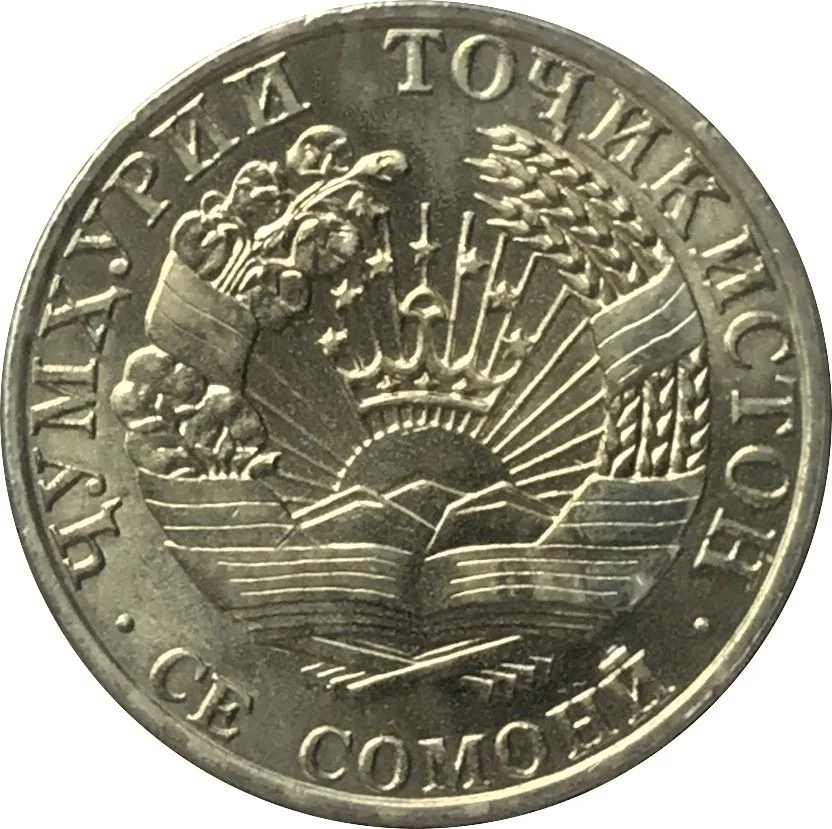
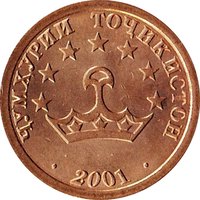
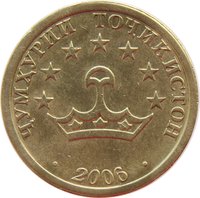
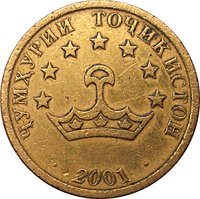
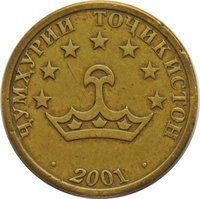
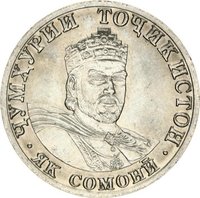
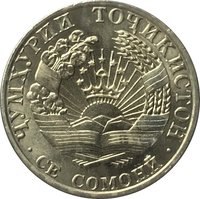
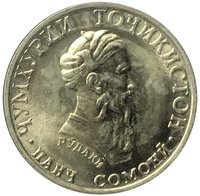
Obverse
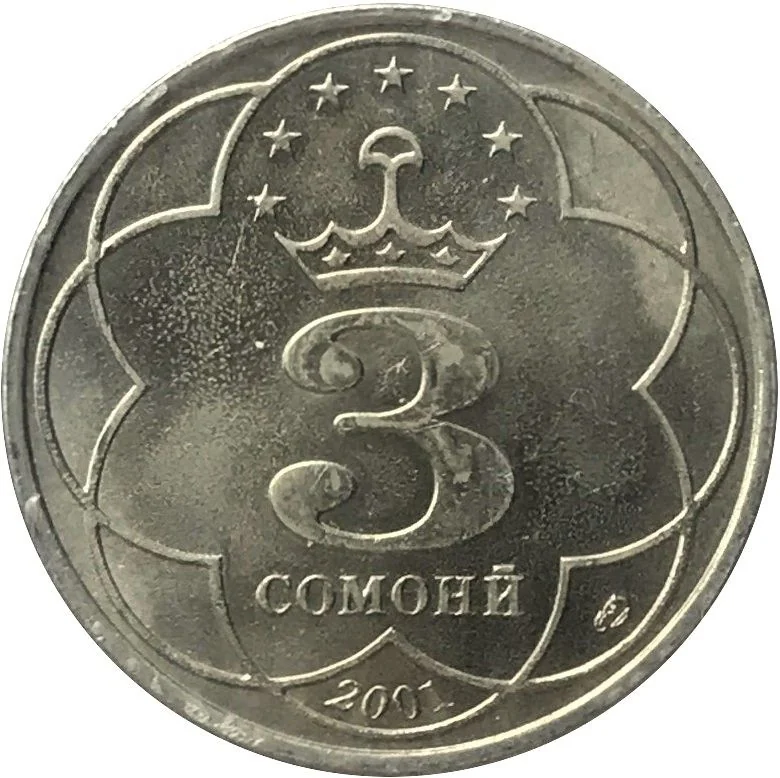
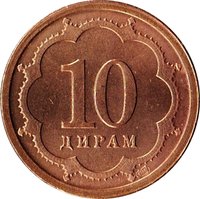
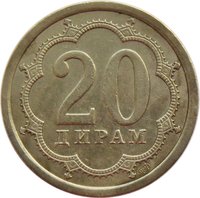
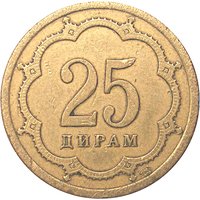
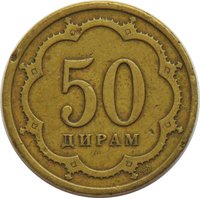
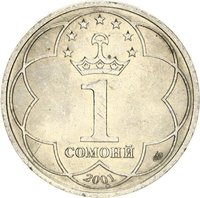
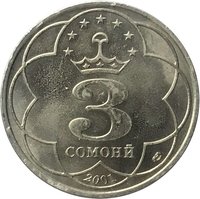
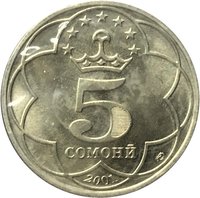
Reverse
Edge
Mints
| Name | Mark |
|---|---|
| Saint Petersburg | — |
Mintings
| Year | Mint Mark | Mintage | Quality | Collection |
|---|---|---|---|---|
| 2001 | СПМД | — | ||
| 2001 | СПМД | — | Proof |
Historical background
In 2001, Tajikistan’s currency situation was characterized by profound instability and transition, a direct legacy of the 1992-1997 civil war. The national currency, the Tajikistani ruble (which replaced the Soviet ruble in 1995), suffered from hyperinflation and severe devaluation. The economy was heavily dollarized, with the US dollar serving as the preferred store of value and medium for large transactions, undermining confidence in the domestic currency. This period was marked by a fragile banking system, widespread poverty, and an economy dependent on remittances and international aid, leaving the National Bank of Tajikistan with limited tools to enact effective monetary policy.
A pivotal change occurred on October 30, 2000, when the government introduced a new currency, the somoni, to replace the Tajikistani ruble at a rate of 1 somoni = 1,000 rubles. While the reform officially began in late 2000, its full implementation and consequences unfolded throughout 2001. The redenomination aimed to simplify transactions, restore national prestige, and signal a break from the turbulent past. However, in 2001, the somoni remained a nascent and vulnerable currency, facing ongoing pressures from fiscal deficits, a weak export base (largely cotton and aluminum), and the continued shadow economy.
The year 2001 was also significantly shaped by external geopolitical events. Following the September 11 attacks, Tajikistan’s strategic importance increased dramatically as it became a key partner for coalition forces in neighboring Afghanistan. This led to an influx of international assistance and heightened engagement from Western financial institutions. While this attention promised future stability and potential investment, the immediate currency situation in 2001 was one of cautious stabilization, with authorities grappling to establish the somoni's credibility while managing the deep-rooted structural problems of a post-conflict economy.
A pivotal change occurred on October 30, 2000, when the government introduced a new currency, the somoni, to replace the Tajikistani ruble at a rate of 1 somoni = 1,000 rubles. While the reform officially began in late 2000, its full implementation and consequences unfolded throughout 2001. The redenomination aimed to simplify transactions, restore national prestige, and signal a break from the turbulent past. However, in 2001, the somoni remained a nascent and vulnerable currency, facing ongoing pressures from fiscal deficits, a weak export base (largely cotton and aluminum), and the continued shadow economy.
The year 2001 was also significantly shaped by external geopolitical events. Following the September 11 attacks, Tajikistan’s strategic importance increased dramatically as it became a key partner for coalition forces in neighboring Afghanistan. This led to an influx of international assistance and heightened engagement from Western financial institutions. While this attention promised future stability and potential investment, the immediate currency situation in 2001 was one of cautious stabilization, with authorities grappling to establish the somoni's credibility while managing the deep-rooted structural problems of a post-conflict economy.
🌱 Fairly Common