

5 rupees (Universal Adult Franchise) – Sri Lanka
Add to wishlist
Circulating commemorative coins
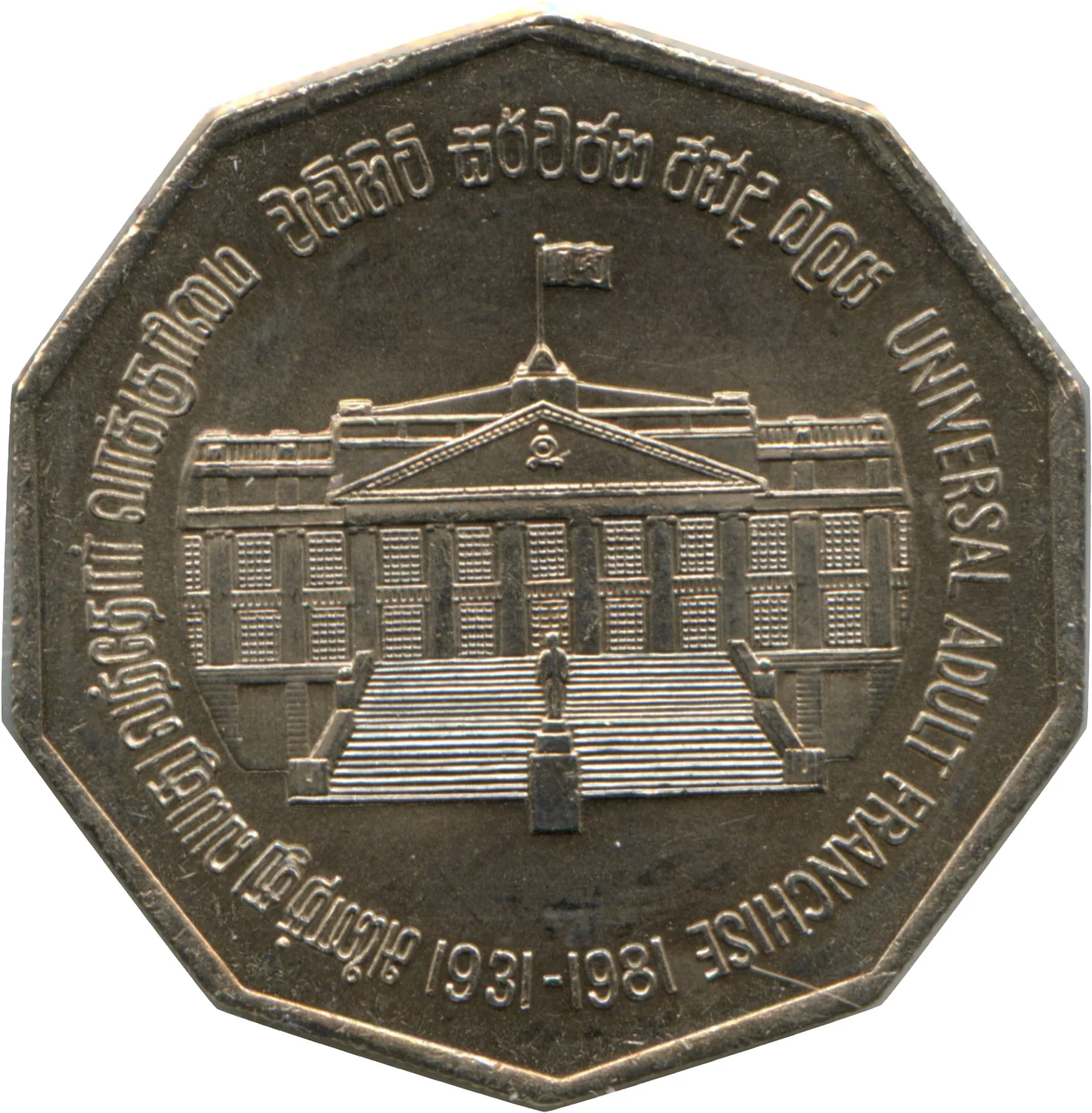
Commemoration: 50 years of Right to election - Universal Adult Franchise
Sri Lanka
Context
Material
Diameter: 30 mm
Weight: 9.6 g
Thickness: 1.8 mm
Shape: Decagonal
Composition: Copper-nickel
Technique: Milled
Alignment: Medal alignment
flip
References
KM: #
Numista: #9958
Value
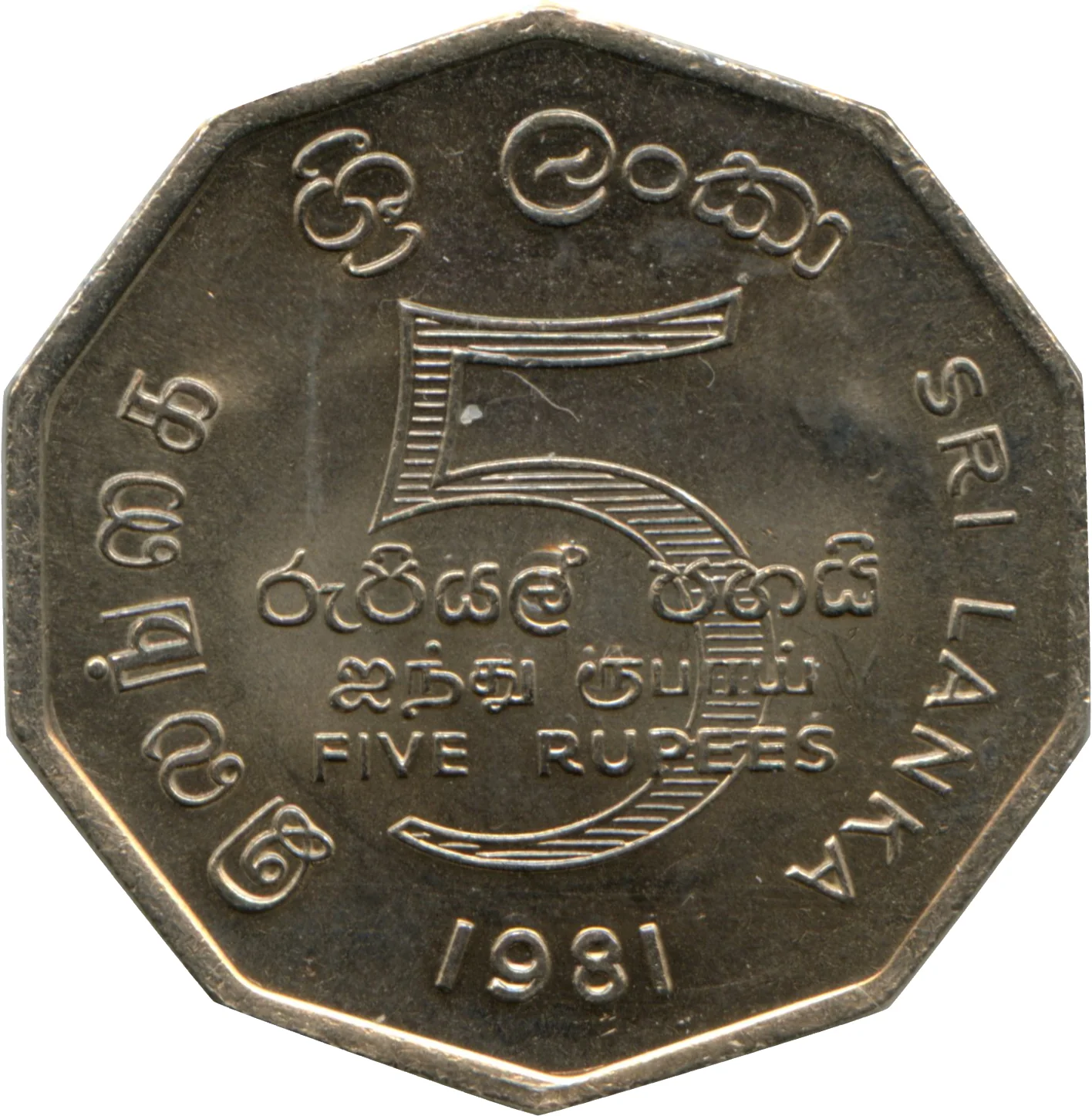
Exchange value: 5 LKR
Obverse
Description:
Colombo's Old Parliament Building.
Inscription:
UNIVERSAL ADULT FRANCHISE
1931-1981
1931-1981
Reverse
Edge
Segmented reeding
Mints
| Name | Mark |
|---|---|
| Royal Mint | — |
Mintings
| Year | Mint Mark | Mintage | Quality | Collection |
|---|---|---|---|---|
| 1981 | — | 2,000,000 |
Historical background
In 1981, Sri Lanka's currency situation was characterised by a tightly controlled exchange rate regime under a fixed parity system, managed by the Central Bank of Ceylon. The official exchange rate was pegged to a basket of currencies, though it was effectively anchored to the British Pound Sterling and the US Dollar. This period followed the economic liberalisation policies initiated in 1977, which had moved the country away from the previous socialist-inspired closed economy. A significant feature was the existence of a dual exchange rate system: the official rate for government and essential imports, and a more depreciated "secondary rate" for other transactions, designed to conserve scarce foreign reserves.
The economy was under pressure from twin deficits—fiscal and current account—driven by large public investment projects and high import demand following liberalisation. While tourism and remittance inflows were growing, they were insufficient to offset the trade deficit. Consequently, foreign exchange reserves were under strain, leading to the perpetuation of exchange controls and import restrictions on certain goods. The black market for foreign currency, particularly US Dollars, was active, with premiums reflecting the underlying pressure on the rupee that the official pegs could not fully suppress.
Overall, 1981 represented a period of transition and tension within Sri Lanka's monetary framework. The government was attempting to maintain stability through a fixed peg to foster confidence and control inflation, but this came at the cost of depleting reserves and creating distortions. The currency management of the time laid bare the challenges of balancing liberalisation with stability, a prelude to the more severe balance of payments crises that would emerge later in the decade, ultimately leading to a floatation and substantial devaluation of the rupee in the 1990s.
The economy was under pressure from twin deficits—fiscal and current account—driven by large public investment projects and high import demand following liberalisation. While tourism and remittance inflows were growing, they were insufficient to offset the trade deficit. Consequently, foreign exchange reserves were under strain, leading to the perpetuation of exchange controls and import restrictions on certain goods. The black market for foreign currency, particularly US Dollars, was active, with premiums reflecting the underlying pressure on the rupee that the official pegs could not fully suppress.
Overall, 1981 represented a period of transition and tension within Sri Lanka's monetary framework. The government was attempting to maintain stability through a fixed peg to foster confidence and control inflation, but this came at the cost of depleting reserves and creating distortions. The currency management of the time laid bare the challenges of balancing liberalisation with stability, a prelude to the more severe balance of payments crises that would emerge later in the decade, ultimately leading to a floatation and substantial devaluation of the rupee in the 1990s.
🌱 Fairly Common