

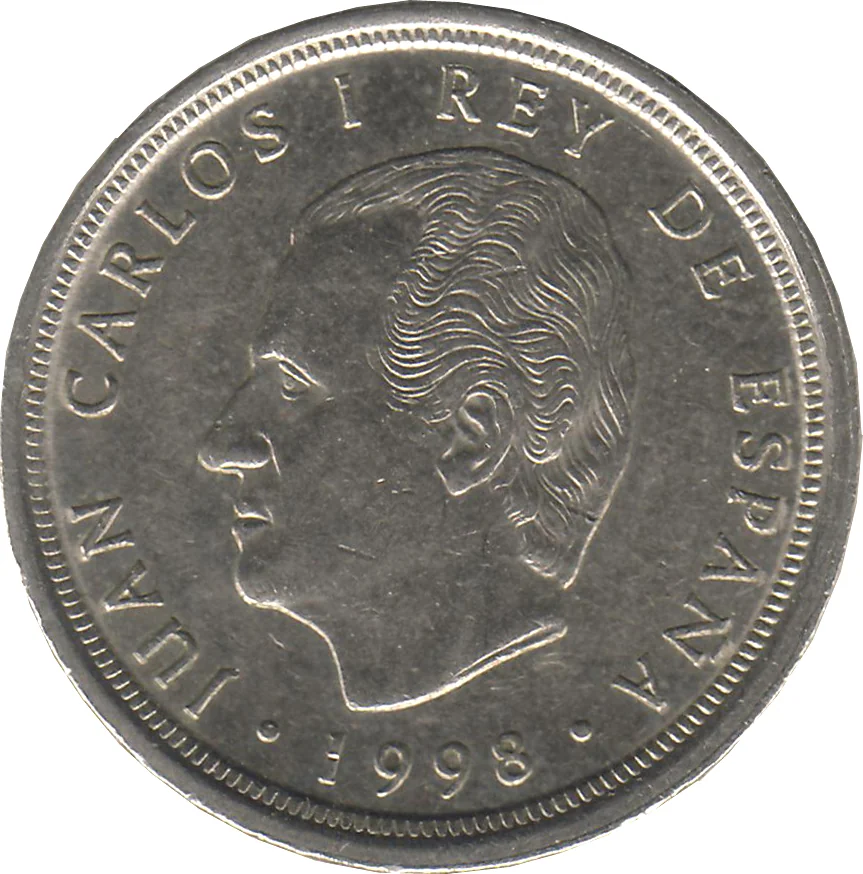
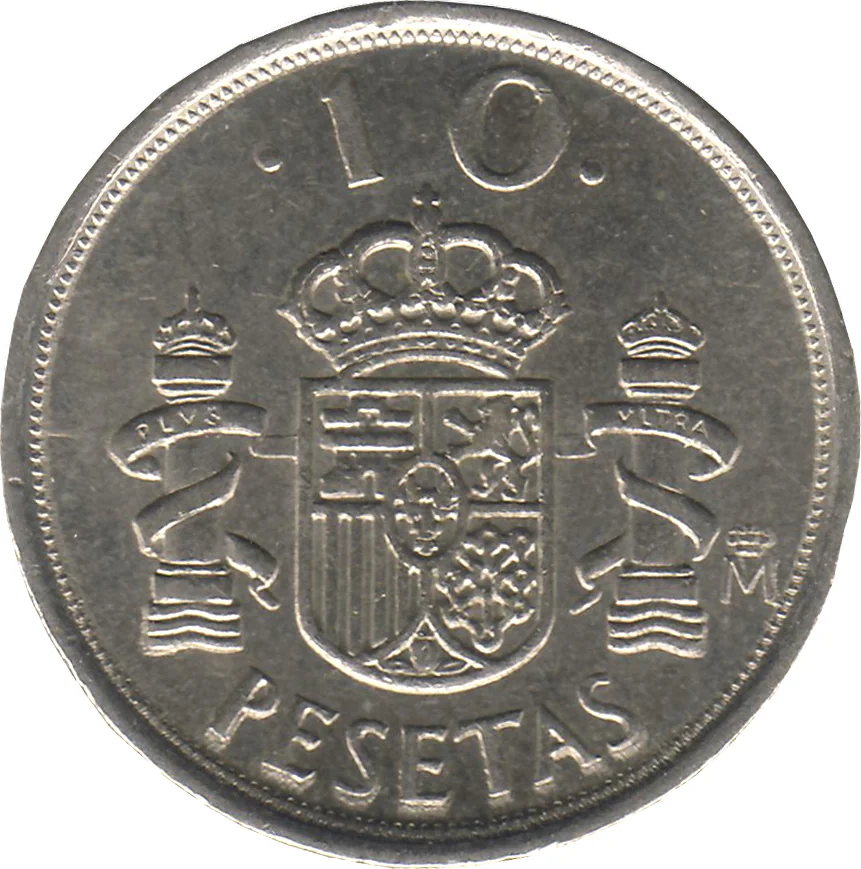
10 pesetas – Spain
Add to wishlist
Spain
Context
Years: 1998–2000
Issuer: Spain
Ruler: Juan Carlos I
Currency:
(1868—2001)
Demonetization: 28 February 2002
Total mintage: 19,920,000
Material
References
KM: #
Numista: #9954
Value
Exchange value: 10 ESP
Inflation-adjusted value: 18.88 ESP
Obverse
Reverse
Edge
Reeded
Categories
| Mythology |
| Symbols> Coat of Arms |
Mints
| Name | Mark |
|---|---|
| Royal Mint of Madrid | (M) |
Mintings
| Year | Mint Mark | Mintage | Quality | Collection |
|---|---|---|---|---|
| 1998 | M | 14,965,000 | ||
| 1999 | M | 2,125,000 | ||
| 2000 | M | 2,830,000 |
Historical background
In 1998, Spain was in the final, decisive phase of its journey toward adopting the euro, a process driven by its commitment to the European Union's Economic and Monetary Union (EMU). The country's currency, the peseta, was operating within the Exchange Rate Mechanism (ERM II), which pegged it to a narrow band against the Deutsche Mark and other European currencies. This period was characterized by strict fiscal discipline and economic convergence, as Spain worked diligently to meet the Maastricht Treaty criteria on inflation, interest rates, budget deficits, and public debt to qualify for the first wave of the single currency.
The macroeconomic context was one of robust growth and falling unemployment, following a painful but successful period of restructuring in the early 1990s. The government, led by Prime Minister José María Aznar, maintained a policy of austerity and liberalization, which bolstered investor confidence and ensured Spain comfortably met the convergence targets. Consequently, in May 1998, Spain was officially confirmed as one of the eleven founding members of the eurozone. For the remainder of the year, the peseta existed in a state of "legal limbo"—its exchange rate irrevocably fixed (at 166.386 pesetas to the euro) but still circulating as the nation's physical cash.
Thus, 1998 was a year of transition and anticipation rather than monetary crisis. The currency situation was stable and entirely focused on the technical and logistical preparations for the euro's launch on January 1, 1999. While accounting, financial markets, and electronic payments would switch to the new currency at the start of 1999, the peseta would remain in people's wallets as legal tender alongside euro banknotes and coins only after their physical introduction on January 1, 2002. The period was therefore marked by a quiet certainty, with the historic role of the peseta nearing its end.
The macroeconomic context was one of robust growth and falling unemployment, following a painful but successful period of restructuring in the early 1990s. The government, led by Prime Minister José María Aznar, maintained a policy of austerity and liberalization, which bolstered investor confidence and ensured Spain comfortably met the convergence targets. Consequently, in May 1998, Spain was officially confirmed as one of the eleven founding members of the eurozone. For the remainder of the year, the peseta existed in a state of "legal limbo"—its exchange rate irrevocably fixed (at 166.386 pesetas to the euro) but still circulating as the nation's physical cash.
Thus, 1998 was a year of transition and anticipation rather than monetary crisis. The currency situation was stable and entirely focused on the technical and logistical preparations for the euro's launch on January 1, 1999. While accounting, financial markets, and electronic payments would switch to the new currency at the start of 1999, the peseta would remain in people's wallets as legal tender alongside euro banknotes and coins only after their physical introduction on January 1, 2002. The period was therefore marked by a quiet certainty, with the historic role of the peseta nearing its end.
Series: 1998 Spain circulation coins
🌱 Common