

1 Riksdaler – Sweden
Sweden
Context

Material
References
KM: #Click to copy to clipboard613
Numista: #99335
Value
Bullion value: $84.86
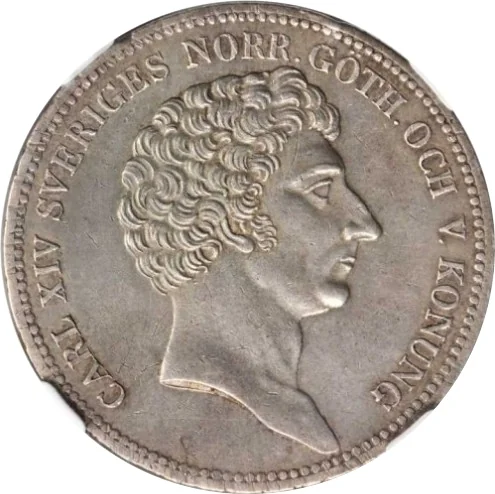
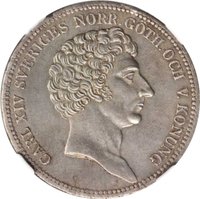
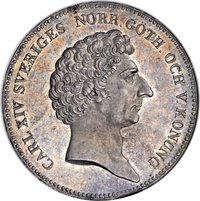
Obverse
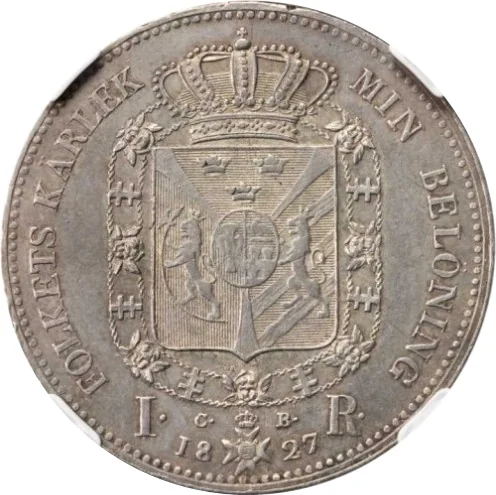
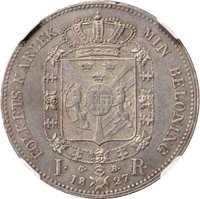
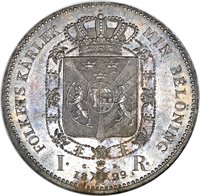
Reverse
Description:
Shield flanked by crowned lions of Norway and Sweden, topped with three crowns and the Bernadotte arms. The Seraphim Order chain with nine angel heads encircles the shield, dividing the date and mintmark. The king's motto appears along the rim.
Inscription:
FOLKETS KÄRLEK MIN BELÖNING
I. R.
C. B.
18 27
I. R.
C. B.
18 27
Translation:
The People's Love My Reward
I. R.
C. B.
18 27
I. R.
C. B.
18 27
Script: Latin
Language: Swedish
Edge
Lettered
Legend:
534 8/9 TROYSKA ASS FINSILFER
Categories
| Symbols> Coat of Arms |
Mintings
| Year | Mint Mark | Mintage | Quality | Collection |
|---|---|---|---|---|
| 1827 | CB | — |
Historical background
In 1827, Sweden was operating under a complex and strained monetary system, a legacy of decades of war finance and economic turmoil. The nation was officially on a silver standard following the 1776 Riksdalers reform, but the reality was a chaotic mix of overvalued paper money and undervalued silver coin. The primary unit was the Riksdaler Riksmynt, a paper currency issued by the central bank, the Riksens Ständers Bank (precursor to the Riksbank). However, its value had been severely degraded; a substantial gap existed between the face value of the paper Riksdaler and its actual value in silver Riksdaler Specie, leading to a dual-currency system that hampered trade and created uncertainty.
This instability was a direct result of the Napoleonic Wars, during which Sweden, like many European states, suspended convertibility to fund its military efforts. The resulting inflation and currency depreciation had never been fully rectified. By 1827, the paper money in circulation was not freely convertible into silver, and public confidence in it remained low. Consequently, domestic commerce often relied on a cumbersome calculation of exchange between the two "types" of Riksdaler, while international trade required the use of scarce silver coins or foreign currency, creating inefficiency and hindering economic development.
Recognizing the profound economic damage caused by this situation, reform was already in motion. The period around 1827 was one of transition and debate, leading up to the pivotal 1834 monetary reform. Under the leadership of Finance Minister Johan August Gripenstedt, preparations were being made to restore confidence by formally devaluing the paper currency and re-establishing a credible silver standard at a fixed, sustainable rate. Therefore, the currency situation in 1827 can be characterized as the tense final chapter of an unsustainable system, with the government actively laying the groundwork for the stabilization that would be achieved a few years later.
This instability was a direct result of the Napoleonic Wars, during which Sweden, like many European states, suspended convertibility to fund its military efforts. The resulting inflation and currency depreciation had never been fully rectified. By 1827, the paper money in circulation was not freely convertible into silver, and public confidence in it remained low. Consequently, domestic commerce often relied on a cumbersome calculation of exchange between the two "types" of Riksdaler, while international trade required the use of scarce silver coins or foreign currency, creating inefficiency and hindering economic development.
Recognizing the profound economic damage caused by this situation, reform was already in motion. The period around 1827 was one of transition and debate, leading up to the pivotal 1834 monetary reform. Under the leadership of Finance Minister Johan August Gripenstedt, preparations were being made to restore confidence by formally devaluing the paper currency and re-establishing a credible silver standard at a fixed, sustainable rate. Therefore, the currency situation in 1827 can be characterized as the tense final chapter of an unsustainable system, with the government actively laying the groundwork for the stabilization that would be achieved a few years later.
✨ Legendary