

50 Ngwee – Zambia
Circulating commemorative coins
Commemoration: Second Republic, 13 December 1972
Zambia
Context
Material
Diameter: 30.92 mm
Weight: 11.6 g
Thickness: 2.02 mm
Shape: Dodecagonal
Technique: Milled
Alignment: Medal alignment
flip
References
KM: #Click to copy to clipboard16
Numista: #9904
Value
Exchange value: 0.50 ZMK
Obverse
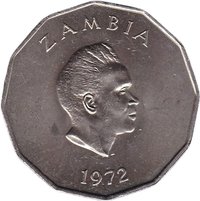
Description:
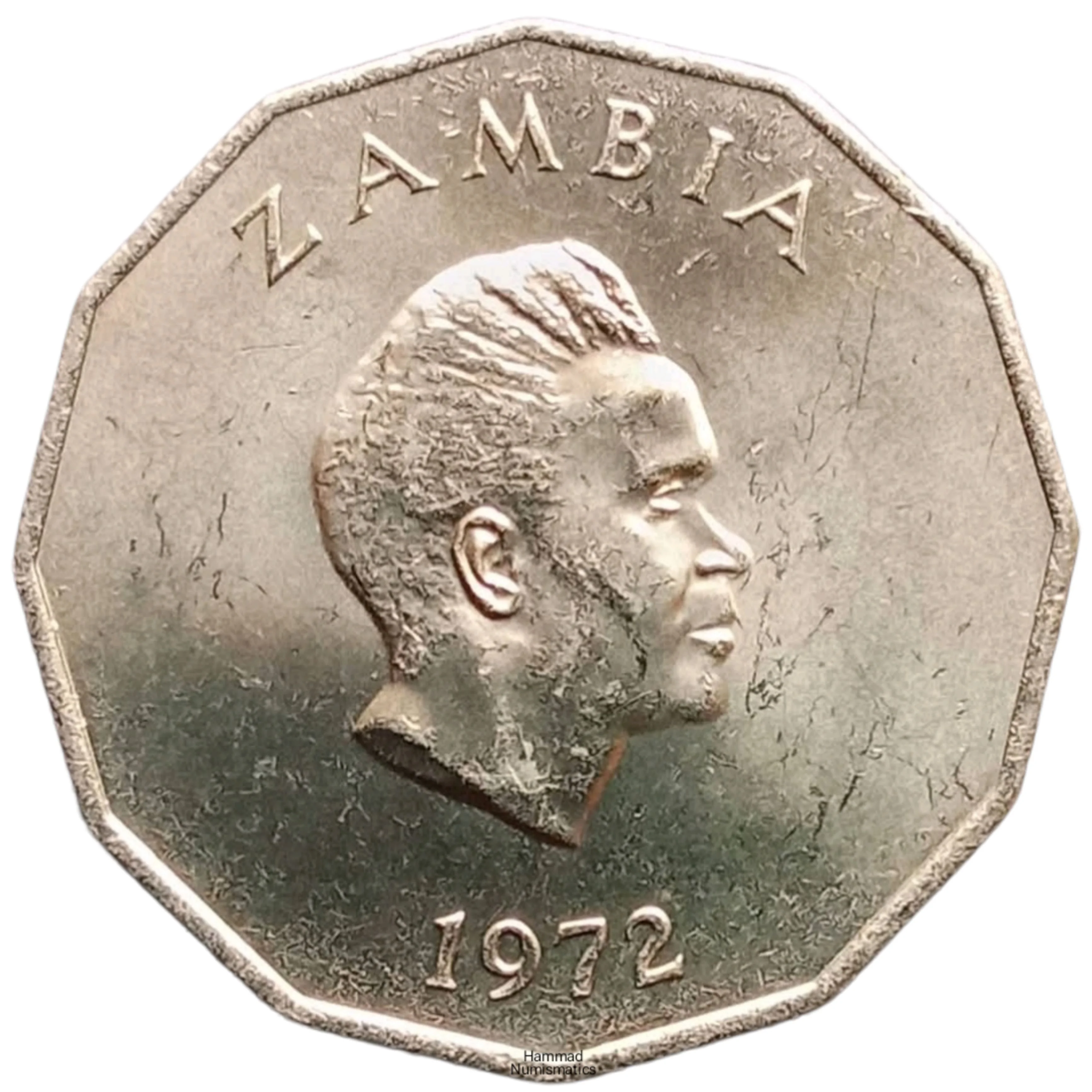
Kenneth Kaunda, Zambian president facing right. Date below.
Inscription:
ZAMBIA
1972
1972
Script: Latin
Reverse
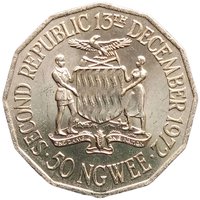
Description:
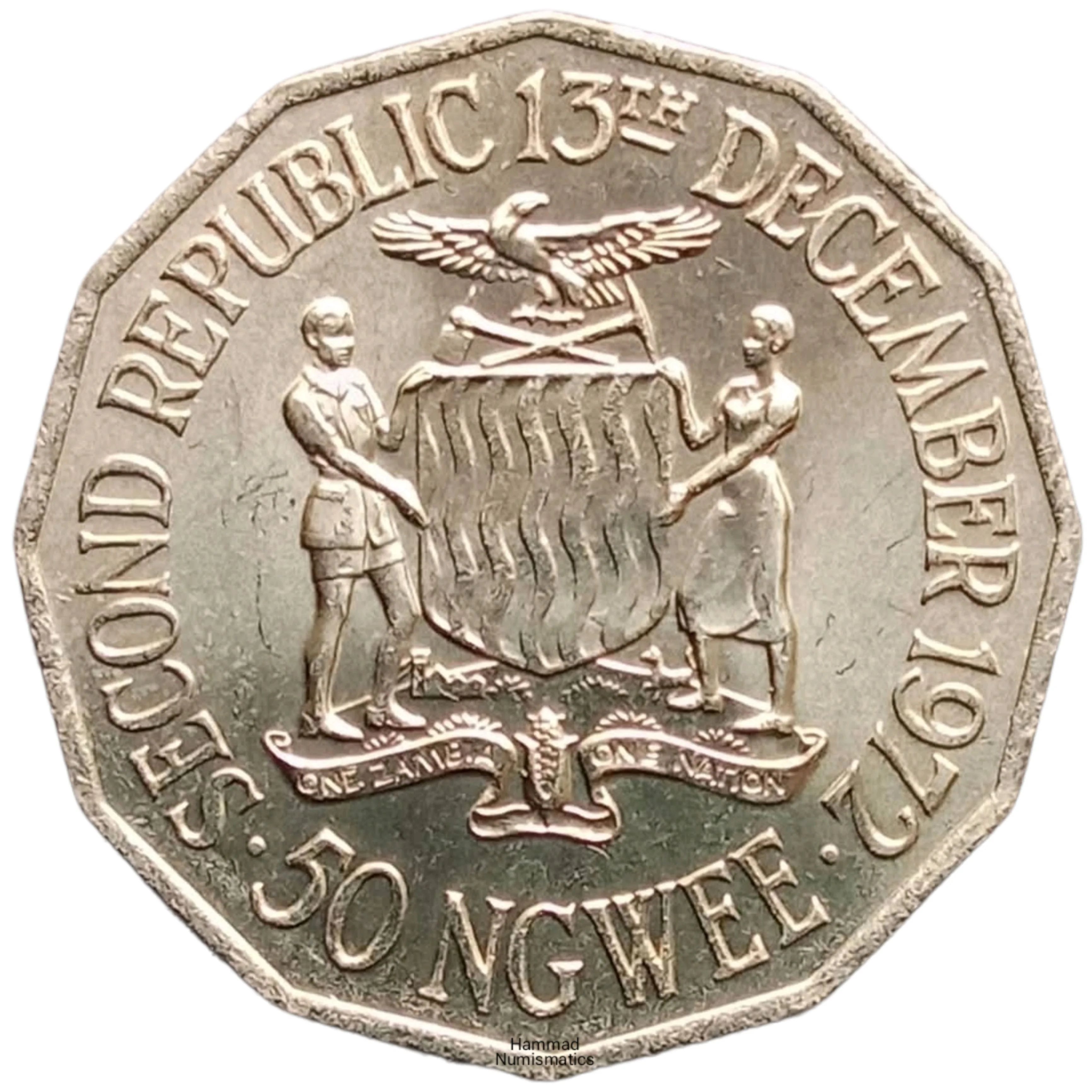
Zambian coat of arms in center, text encircling.
Inscription:
SECOND REPUBLIC 13TH DECEMBER 1972
·50 NGWEE·
·50 NGWEE·
Script: Latin
Edge
Plain
Categories
| Symbols> Coat of Arms |
| Animal> Bird> Eagle |
| Person> Politician |
Mints
| Name | Mark |
|---|---|
| Royal Mint | — |
Mintings
| Year | Mint Mark | Mintage | Quality | Collection |
|---|---|---|---|---|
| 1972 | 1973-1976 | 6,000,000 | ||
| 1972 | — | 2,000 | Proof | |
| 1978 | — | 24,000 | Proof | |
| 1983 | — | 998,000 |
Historical background
In 1972, Zambia's currency situation was intrinsically linked to its post-independence economic strategy and the volatile price of copper, which accounted for over 90% of the nation's export earnings. The Zambian kwacha, introduced in 1968 to replace the Zambian pound, was initially a strong currency, pegged to the British pound sterling and later to the U.S. dollar. This strength was underpinned by the booming copper prices of the late 1960s, which fueled ambitious state-led development and nationalization programs under President Kenneth Kaunda's "Zambian Humanism." However, this period of stability was nearing its end as global economic shifts began to expose the fragility of a mono-economy.
The year 1972 marked a critical juncture, as the first major signs of strain emerged. A significant decline in the world price of copper, triggered by the 1971 Nixon Shock and the collapse of the Bretton Woods system, severely reduced Zambia's foreign exchange reserves. This external shock coincided with rising costs from the country's landlocked position, which relied on rail lines through hostile white-minority ruled territories, and the increasing fiscal burden of state-owned enterprises. While the kwacha was not formally devalued until 1976, the pressures in 1972 set the stage for that eventual outcome, as the government began grappling with a growing balance of payments deficit.
Consequently, the government's response in 1972 was one of increasing control rather than liberalization. To conserve dwindling foreign reserves and maintain the overvalued official exchange rate, authorities tightened import and exchange controls. This created a scarcity of foreign currency for businesses and consumers, leading to the emergence of a black market for foreign exchange where the kwacha traded at a significant discount. Thus, the currency situation of 1972 was characterized by a growing divergence between the official, stable parity and the underlying economic realities of falling revenue and rising debt, laying the groundwork for a prolonged period of economic difficulty.
The year 1972 marked a critical juncture, as the first major signs of strain emerged. A significant decline in the world price of copper, triggered by the 1971 Nixon Shock and the collapse of the Bretton Woods system, severely reduced Zambia's foreign exchange reserves. This external shock coincided with rising costs from the country's landlocked position, which relied on rail lines through hostile white-minority ruled territories, and the increasing fiscal burden of state-owned enterprises. While the kwacha was not formally devalued until 1976, the pressures in 1972 set the stage for that eventual outcome, as the government began grappling with a growing balance of payments deficit.
Consequently, the government's response in 1972 was one of increasing control rather than liberalization. To conserve dwindling foreign reserves and maintain the overvalued official exchange rate, authorities tightened import and exchange controls. This created a scarcity of foreign currency for businesses and consumers, leading to the emergence of a black market for foreign exchange where the kwacha traded at a significant discount. Thus, the currency situation of 1972 was characterized by a growing divergence between the official, stable parity and the underlying economic realities of falling revenue and rising debt, laying the groundwork for a prolonged period of economic difficulty.
🌱 Common