

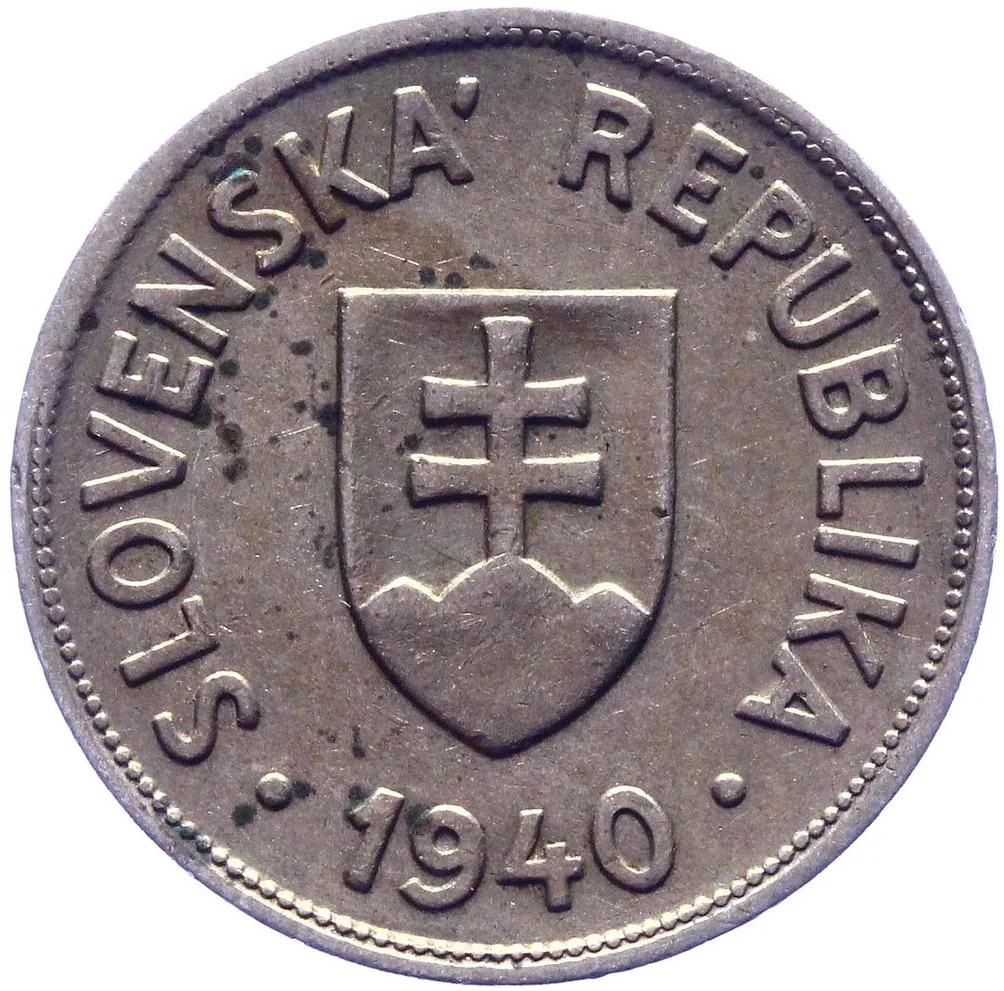
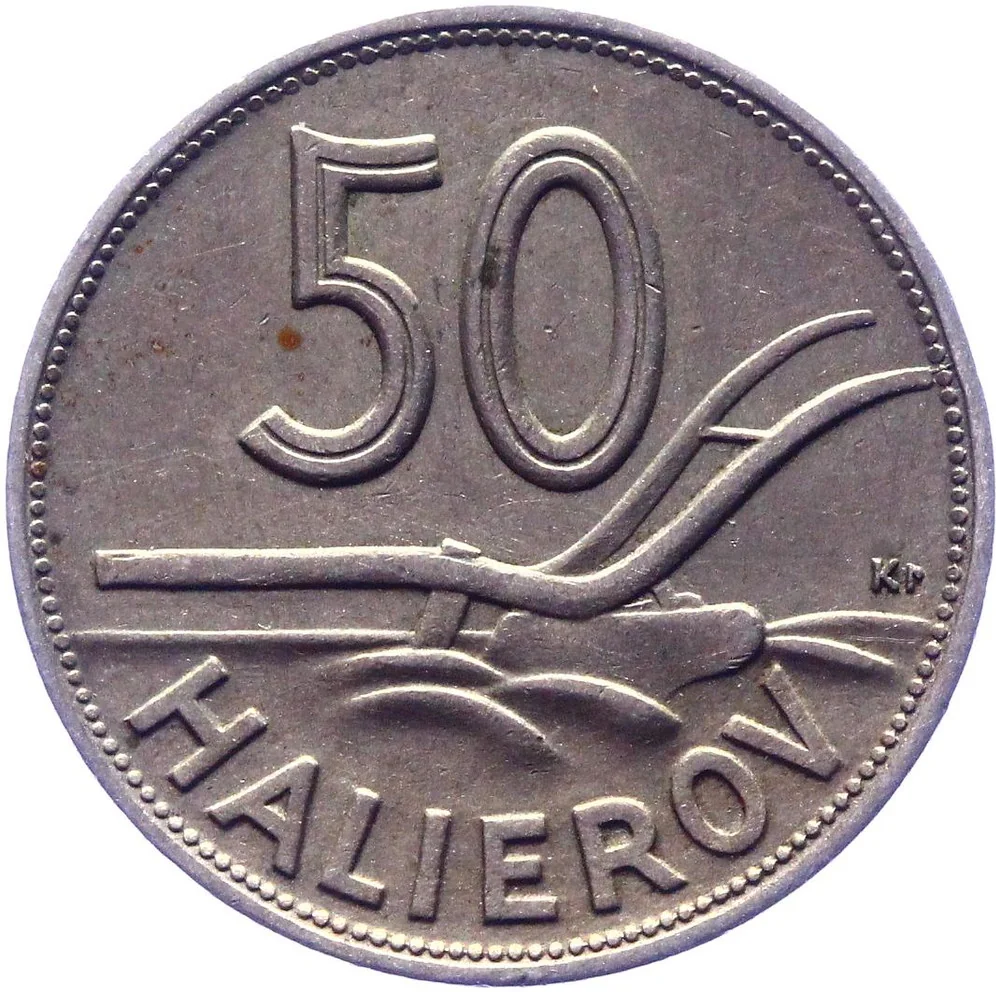
50 halierov – Slovakia
Add to wishlist
Slovakia
Context
Material
Diameter: 20 mm
Weight: 3.33 g
Thickness: 1.6 mm
Shape: Round
Composition: Copper-nickel
Technique: Milled
Alignment: Medal alignment
flip
References
KM: #
Numista: #9874
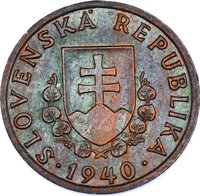
Obverse
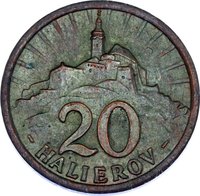
Reverse
Description:
Turns snow into clear pavement.
Inscription:
50
HALIEROV
K
HALIEROV
K
Translation:
Fifty Hellers
Script: Latin
Language: Slovak
Engraver: Gejza Angyal
Edge
Plain
Categories
| Agriculture |
| Symbols> Coat of Arms |
| Symbol> Cross |
Mintings
| Year | Mint Mark | Mintage | Quality | Collection |
|---|---|---|---|---|
| 1940 | — | — | ||
| 1941 | — | 8,000,000 |
Historical background
In 1940, Slovakia existed as the Slovak Republic, a nominally independent client state of Nazi Germany established in March 1939 following the dissolution of Czechoslovakia. Its currency situation was a direct legacy of this political upheaval. Initially, the new state remained within the Czechoslovak monetary union, using the Czechoslovak koruna. However, this arrangement quickly proved unworkable, leading to a formal separation of the monetary systems in 1939. On this basis, the Slovak koruna (Sk) was introduced as the national currency, though it remained pegged at par to its Czechoslovak predecessor and, critically, to the German Reichsmark, reflecting its economic subordination.
The currency's management was dictated by the demands of the German war economy. Slovakia was integrated into the Nazi economic sphere, and its central bank, the Slovak National Bank, had limited autonomy. The primary function of the Slovak koruna was to facilitate the clearing of trade with Germany, a system designed to extract Slovak resources and industrial output for the German war effort while often leaving Slovakia with credit balances that were difficult to redeem. This relationship led to inflationary pressures, as Slovak production was diverted to Germany without proportional consumer goods in return.
Domestically, the wartime economy and currency controls led to growing shortages and a burgeoning black market, where goods could be obtained for a premium or through barter. While the official Slovak koruna remained stable on paper due to its fixed exchange rate and strict regulations, its real purchasing power eroded. Thus, the currency situation in 1940 was characterized by a fragile, externally controlled stability that masked the underlying economic strains of a satellite state fully aligned with and exploited by its powerful patron.
The currency's management was dictated by the demands of the German war economy. Slovakia was integrated into the Nazi economic sphere, and its central bank, the Slovak National Bank, had limited autonomy. The primary function of the Slovak koruna was to facilitate the clearing of trade with Germany, a system designed to extract Slovak resources and industrial output for the German war effort while often leaving Slovakia with credit balances that were difficult to redeem. This relationship led to inflationary pressures, as Slovak production was diverted to Germany without proportional consumer goods in return.
Domestically, the wartime economy and currency controls led to growing shortages and a burgeoning black market, where goods could be obtained for a premium or through barter. While the official Slovak koruna remained stable on paper due to its fixed exchange rate and strict regulations, its real purchasing power eroded. Thus, the currency situation in 1940 was characterized by a fragile, externally controlled stability that masked the underlying economic strains of a satellite state fully aligned with and exploited by its powerful patron.
Series: 1940 Slovakia circulation coins
🌱 Common