

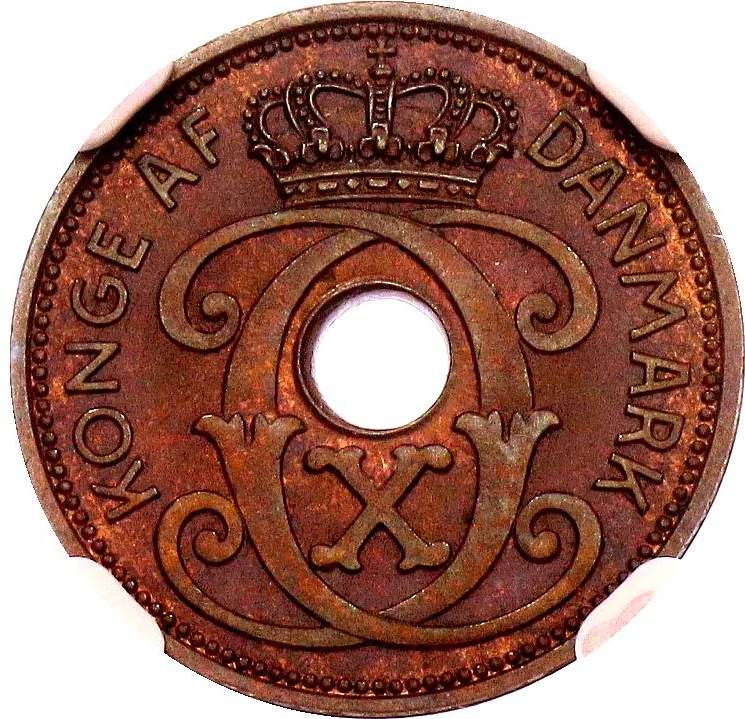
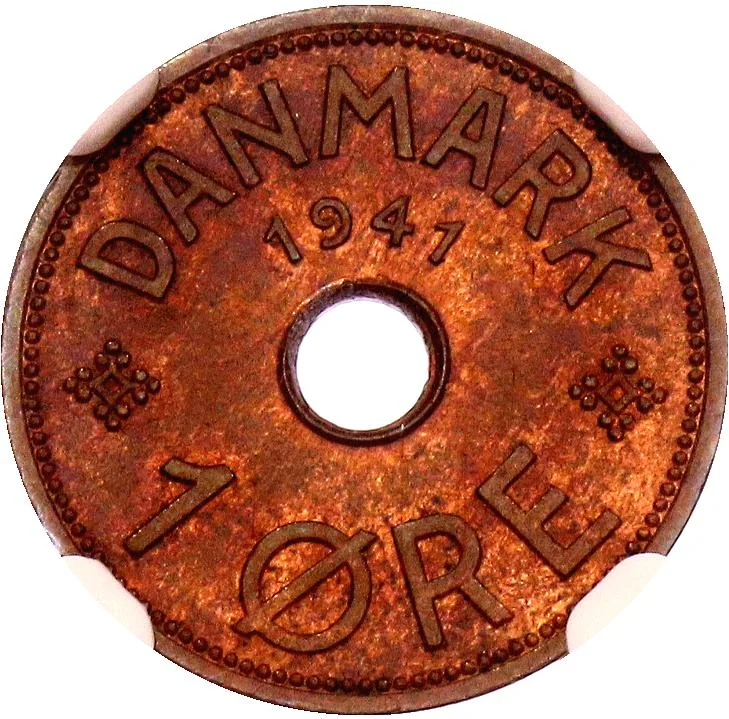
1 Øre – Faroe Islands
Denmark
Context
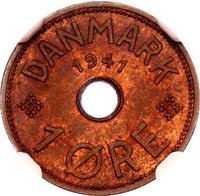
Year: 1941
Country: Denmark 
Issuer: Faroe Islands
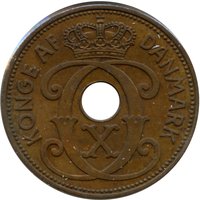
Ruler: Christian X
Currency:
(1873—1948)
Demonetized: Yes
Total mintage: 150,000
Material
References
KM: #Click to copy to clipboard1
Numista: #9870
Value
Exchange value: 0.01 DKK = $0.00
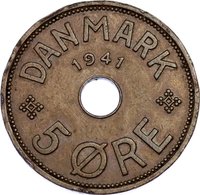
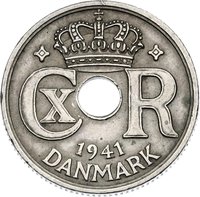
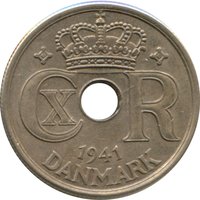
Obverse
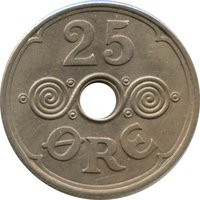
Reverse
Edge
Plain
Mints
| Name | Mark |
|---|---|
| Royal Mint (Tower Hill) | — |
Mintings
| Year | Mint Mark | Mintage | Quality | Collection |
|---|---|---|---|---|
| 1941 | — | 150,000 | ||
| 1941 | — | — | Proof |
Historical background
During the early years of World War II, the Faroe Islands, a Danish dependency, found themselves in a precarious monetary situation following the German occupation of Denmark on April 9, 1940. This event severed the islands' direct administrative and financial ties to Copenhagen. To prevent economic collapse and the influx of potentially compromised Danish currency, the British occupying force (arriving to preempt a German invasion) and the local Faroese authorities took immediate action. They declared all Danish banknotes on the islands invalid and initiated a unique "stamping" process.
In 1941, the currency solution was fully implemented. Existing Danish notes were overstamped with "FØROYAR" (Faroese for Faroe Islands) and a denomination in "krónur," creating a separate, localized currency. This stamped currency, often called the "Faroese króna," was pegged at par with the Danish krone but was only legal tender within the archipelago. This measure effectively created a closed monetary zone, controlling the money supply and preventing economic exploitation by outside forces. The British Treasury provided backing for this system, ensuring stability.
The 1941 currency situation was therefore one of necessity and ingenuity. It allowed the Faroese economy to continue functioning under wartime occupation, facilitated trade with Britain (which became the islands' lifeline), and asserted a degree of de facto administrative autonomy. This episode is a significant chapter in Faroese history, highlighting their economic resilience and serving as a foundational step toward greater self-governance, which would be formally recognized after the war.
In 1941, the currency solution was fully implemented. Existing Danish notes were overstamped with "FØROYAR" (Faroese for Faroe Islands) and a denomination in "krónur," creating a separate, localized currency. This stamped currency, often called the "Faroese króna," was pegged at par with the Danish krone but was only legal tender within the archipelago. This measure effectively created a closed monetary zone, controlling the money supply and preventing economic exploitation by outside forces. The British Treasury provided backing for this system, ensuring stability.
The 1941 currency situation was therefore one of necessity and ingenuity. It allowed the Faroese economy to continue functioning under wartime occupation, facilitated trade with Britain (which became the islands' lifeline), and asserted a degree of de facto administrative autonomy. This episode is a significant chapter in Faroese history, highlighting their economic resilience and serving as a foundational step toward greater self-governance, which would be formally recognized after the war.
🌟 Limited