

1 cent – United States
Add to wishlist
United States
Context
Years: 1839–1857
Issuer: United States
Period:
(since 1776)
Currency:
(since 1785)
Total mintage: 60,105,369
Material
References
KM: #
Numista: #982
Value
Exchange value: 0.01 USD = $0.01
Obverse
Description:
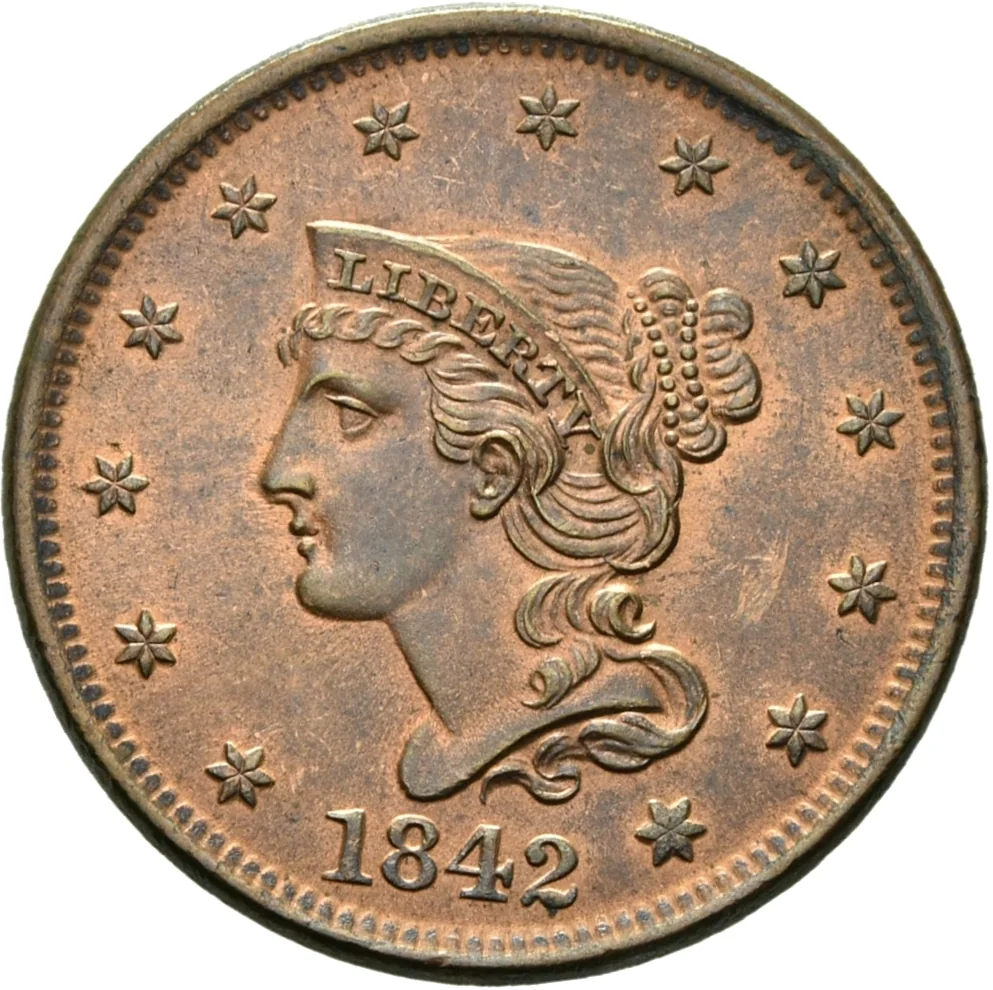
Liberty facing left, date beneath, 13 stars encircling.
Inscription:
1855
Script: Latin
Engraver: Christian Gobrecht
Reverse
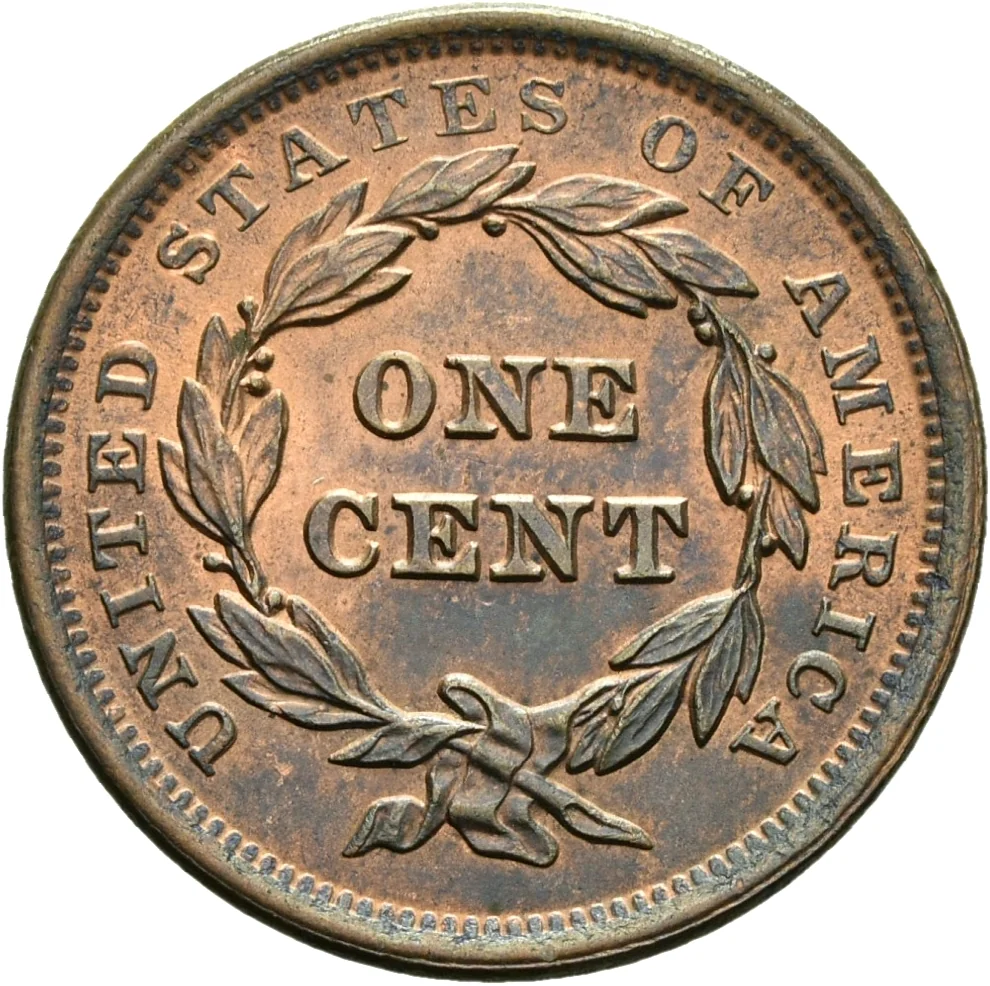
Description:
Wreath's worth
Inscription:
UNITED STATES OF AMERICA
ONE CENT
ONE CENT
Script: Latin
Engraver: Christian Gobrecht
Edge
Plain
Mints
| Name | Mark |
|---|---|
| United States Mint of Philadelphia | — |
Mintings
| Year | Mint Mark | Mintage | Quality | Collection |
|---|---|---|---|---|
| 1839 | — | — | ||
| 1840 | — | 2,462,700 | ||
| 1841 | — | 1,597,367 | ||
| 1842 | — | 2,383,390 | ||
| 1843 | — | — | ||
| 1844 | — | 2,398,752 | ||
| 1845 | — | 3,894,804 | ||
| 1846 | — | — | ||
| 1847 | — | 6,183,669 | ||
| 1848 | — | 6,415,799 | ||
| 1849 | — | 4,178,500 | ||
| 1850 | — | 4,426,844 | ||
| 1851 | — | 9,889,707 | ||
| 1852 | — | 5,063,094 | ||
| 1853 | — | 6,641,131 | ||
| 1854 | — | 4,236,156 | ||
| 1855 | — | — | ||
| 1856 | — | — | ||
| 1857 | — | 333,456 |
Historical background
In 1839, the United States found itself in the final throes of a severe financial crisis known as the Panic of 1837, a period defined by a chaotic and fragmented currency system. The nation operated without a central bank, as President Andrew Jackson had vetoed the recharter of the Second Bank of the United States in 1832 and subsequently distributed federal deposits to various state-chartered banks, dubbed "pet banks." This led to a proliferation of paper money, as hundreds of state banks issued their own banknotes with varying degrees of reliability. The value of this paper currency was highly unstable, often trading at a steep discount depending on the perceived solvency of the issuing bank and its distance from the financial centers of the East Coast.
The crisis was exacerbated by the Specie Circular of 1836, an executive order requiring payment for government land to be made in gold or silver coin ("specie"). This policy drained hard currency from Eastern banks and placed immense strain on the financial system, particularly in the West and South. By 1839, a brief, fragile recovery was shattered when a major cotton price collapse and a default on state bonds by several entities, including the state of Pennsylvania, triggered a second wave of bank failures and suspensions of specie payments. Confidence evaporated, and the nation faced a deep liquidity crisis where even sound businesses struggled to obtain credit or convertible currency, as banks hoarded specie and their notes became nearly worthless.
Consequently, the currency situation in 1839 was one of profound confusion and contraction. A bewildering array of depreciated and often fraudulent banknotes circulated, while genuine gold and silver coins became scarce. This environment crippled interstate commerce, as merchants had to constantly refer to "banknote detectors" — published guides listing the current discount rates for notes from thousands of banks — to avoid accepting worthless paper. The crisis underscored the dangers of a decentralized banking system without a uniform national currency or regulatory oversight, setting the stage for future political battles over banking and money that would culminate in the creation of the national banking system during the Civil War.
The crisis was exacerbated by the Specie Circular of 1836, an executive order requiring payment for government land to be made in gold or silver coin ("specie"). This policy drained hard currency from Eastern banks and placed immense strain on the financial system, particularly in the West and South. By 1839, a brief, fragile recovery was shattered when a major cotton price collapse and a default on state bonds by several entities, including the state of Pennsylvania, triggered a second wave of bank failures and suspensions of specie payments. Confidence evaporated, and the nation faced a deep liquidity crisis where even sound businesses struggled to obtain credit or convertible currency, as banks hoarded specie and their notes became nearly worthless.
Consequently, the currency situation in 1839 was one of profound confusion and contraction. A bewildering array of depreciated and often fraudulent banknotes circulated, while genuine gold and silver coins became scarce. This environment crippled interstate commerce, as merchants had to constantly refer to "banknote detectors" — published guides listing the current discount rates for notes from thousands of banks — to avoid accepting worthless paper. The crisis underscored the dangers of a decentralized banking system without a uniform national currency or regulatory oversight, setting the stage for future political battles over banking and money that would culminate in the creation of the national banking system during the Civil War.
🌱 Very Common