

1 schilling – Austria
Add to wishlist
Austria
Context
Year: 1924
Issuer: Austria
Period:
(1919—1934)
Currency:
(1925—1938)
Demonetization: 31 December 1926
Total mintage: 11,086,000
Material
Diameter: 26 mm
Weight: 7 g
Silver Weight:: 5.60 g
Thickness: 1.65 mm
Shape: 80% silver, 20% copper round
Composition: 80% Silver
Magnetic: No
Technique: Milled
Alignment: Medal alignment
flip
References
KM: #
Numista: #9794
Value
Bullion value: $14.03
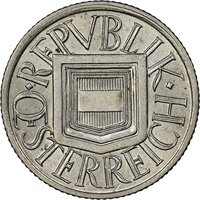
Obverse
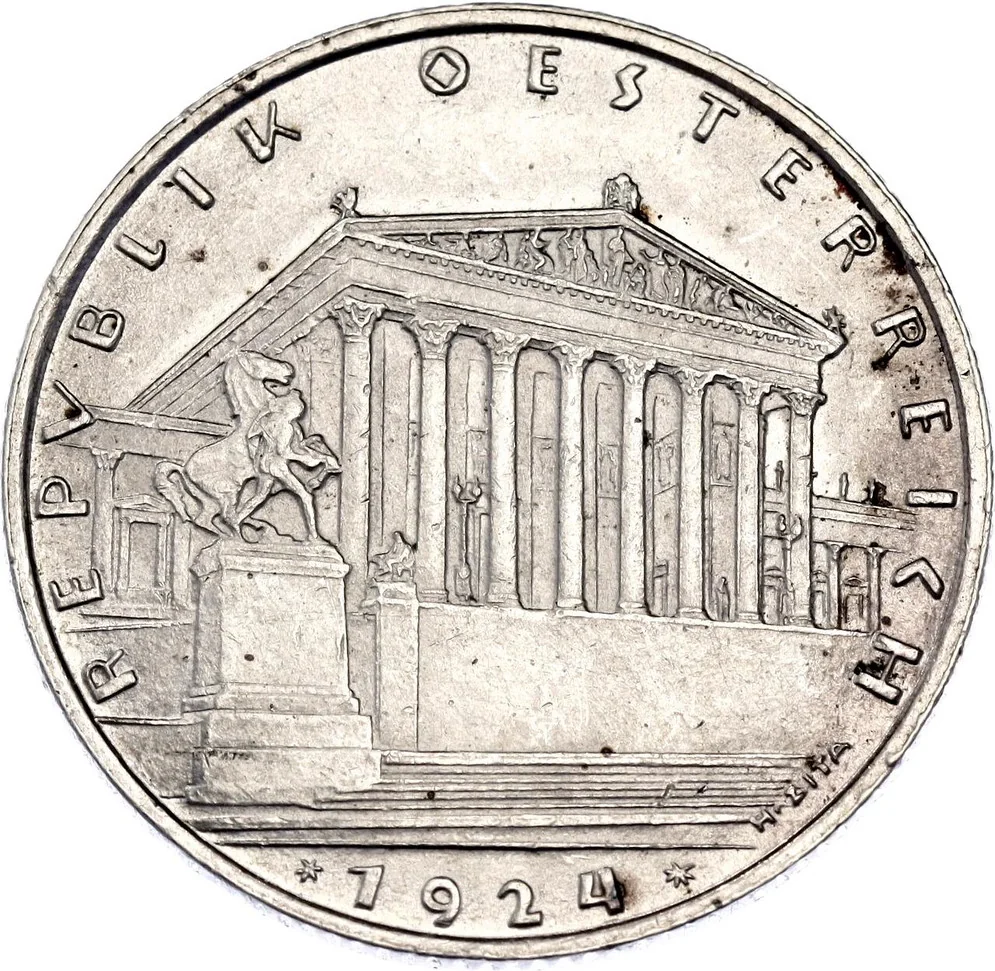
Description:
Austrian Parliament, Vienna, by Theophil Hansen.
Inscription:
REPVBLIK OESTERREICH
⁕ 1924 ⁕
H. ZITA
⁕ 1924 ⁕
H. ZITA
Translation:
REPUBLIC OF AUSTRIA
⁕ 1924 ⁕
H. ZITA
⁕ 1924 ⁕
H. ZITA
Script: Latin
Language: German
Engraver: Heinrich Zita
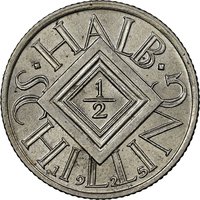
Reverse
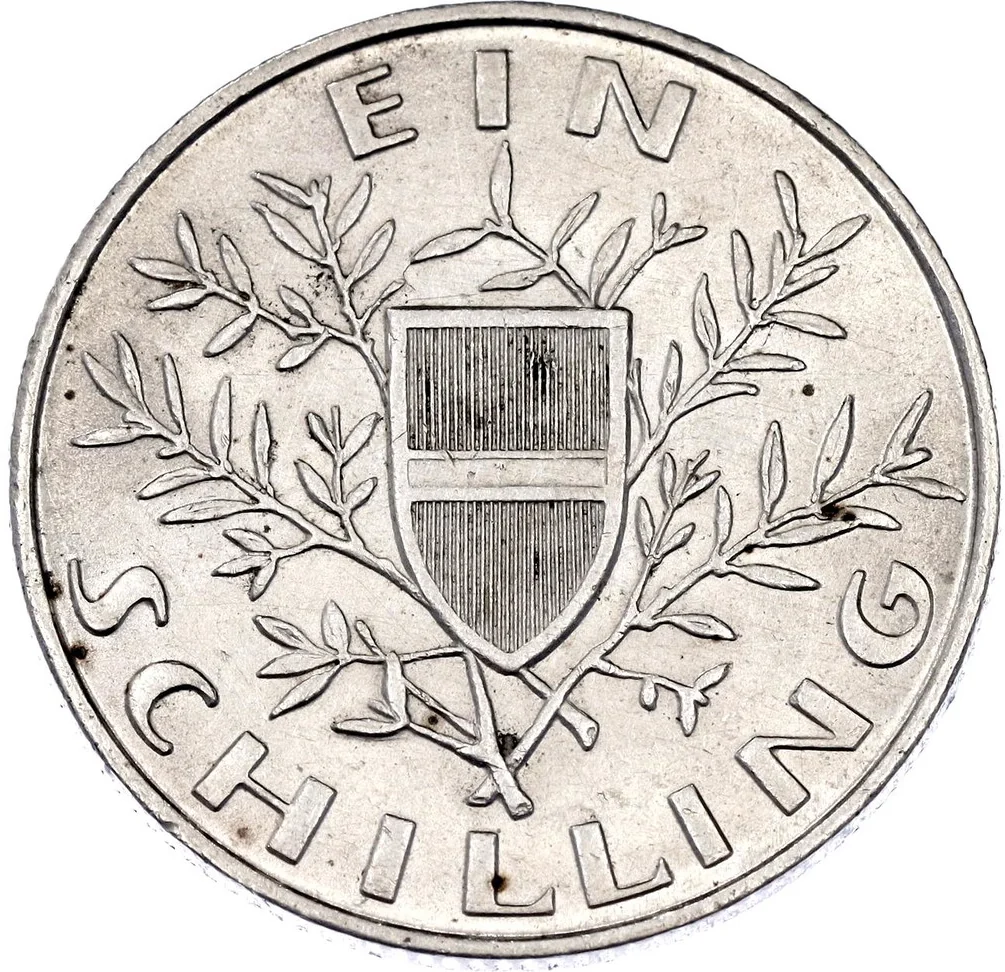
Description:
Austrian coat of arms with laurel branches.
Inscription:
EIN
SCHILLING
SCHILLING
Translation:
One Shilling
Script: Latin
Language: German
Engraver: Heinrich Zita
Edge
Reeded
Categories
| Building> Governmental building |
| Symbols> Coat of Arms |
Mints
| Name | Mark |
|---|---|
| Münze Österreich | — |
Mintings
| Year | Mint Mark | Mintage | Quality | Collection |
|---|---|---|---|---|
| 1924 | — | 11,086,000 |
Historical background
By 1924, Austria was emerging from one of the most severe hyperinflations in European history, a crisis born from the economic disintegration of the Austro-Hungarian Empire after World War I. To finance reconstruction and social welfare, the new republic resorted to printing money, leading to a catastrophic devaluation. By late 1922, the currency was virtually worthless, threatening total economic collapse and political instability. Salvation came in the form of international intervention, primarily orchestrated by the League of Nations, which granted Austria a substantial loan in 1922 contingent on strict fiscal reforms and oversight by a League Commissioner.
The cornerstone of the 1924 currency situation was the successful introduction of the new Schilling, which replaced the utterly devalated Krone at a rate of 10,000 Kronen to 1 Schilling on January 1, 1925 (with legislation passed in late 1924). This radical monetary reform was the direct result of the stabilization program enforced by the League. The government was forced to commit to a balanced budget, the creation of an independent central bank (the Oesterreichische Nationalbank, re-established in 1923), and the cessation of financing deficits by printing money. This restored domestic and, crucially, international confidence.
Consequently, by the end of 1924, Austria's currency situation had transformed from one of utter chaos to fragile stability. The hyperinflation was definitively halted, and the Schilling was established on the gold standard, pegging it to the U.S. Dollar. While this brought immediate price stability and ended the nightmare for savaries and wage earners, it came at a significant social cost, including deep public spending cuts and high unemployment. The stability was also dependent on continued foreign control and loans, leaving the Austrian economy vulnerable to future external shocks, which would materialize with the Great Depression later in the decade.
The cornerstone of the 1924 currency situation was the successful introduction of the new Schilling, which replaced the utterly devalated Krone at a rate of 10,000 Kronen to 1 Schilling on January 1, 1925 (with legislation passed in late 1924). This radical monetary reform was the direct result of the stabilization program enforced by the League. The government was forced to commit to a balanced budget, the creation of an independent central bank (the Oesterreichische Nationalbank, re-established in 1923), and the cessation of financing deficits by printing money. This restored domestic and, crucially, international confidence.
Consequently, by the end of 1924, Austria's currency situation had transformed from one of utter chaos to fragile stability. The hyperinflation was definitively halted, and the Schilling was established on the gold standard, pegging it to the U.S. Dollar. While this brought immediate price stability and ended the nightmare for savaries and wage earners, it came at a significant social cost, including deep public spending cuts and high unemployment. The stability was also dependent on continued foreign control and loans, leaving the Austrian economy vulnerable to future external shocks, which would materialize with the Great Depression later in the decade.
Series: 1924 Austria circulation coins
🌱 Common