

50 paisas – Pakistan
Add to wishlist
Pakistan
Context
Years: 1969–1974
Issuer: Pakistan
Period:
(since 1956)
Currency:
(since 1961)
Demonetization: 30 September 2014
Total mintage: 28,126,000
Material
Diameter: 22 mm
Weight: 5 g
Thickness: 1.7 mm
Shape: Round
Composition: Copper-nickel
Technique: Milled
Alignment: Medal alignment
flip
References
KM: #
Numista: #9788
Value
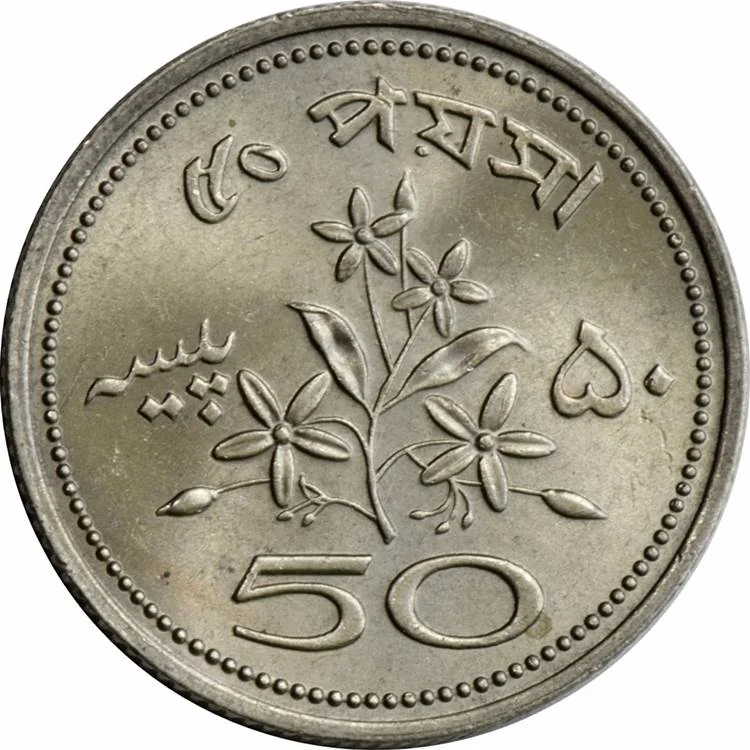
Exchange value: 0.50 PKR
Obverse
Description:
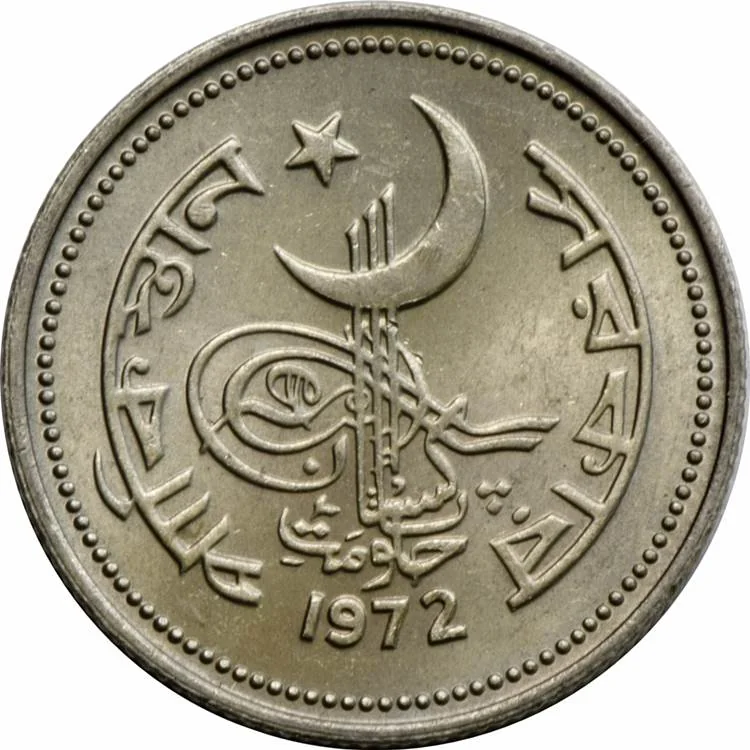
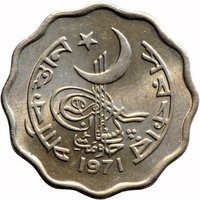
Tughra with crescent moon and star. Bengali and Urdu legend.
Inscription:
حكومت پاكستان
1972
1972
Translation:
Government of Pakistan
1972
1972
Language: Urdu
Reverse
Edge
Reeded
Mintings
| Year | Mint Mark | Mintage | Quality | Collection |
|---|---|---|---|---|
| 1969 | — | 8,268,000 | ||
| 1970 | — | 9,160,000 | ||
| 1971 | — | 4,670,000 | ||
| 1972 | — | 4,900,000 | ||
| 1974 | — | 1,128,000 |
Historical background
In 1969, Pakistan's currency situation was fundamentally shaped by the fixed exchange rate system established under the Bretton Woods agreement, with the Pakistani rupee pegged to the British pound sterling at a rate of Rs. 4.76 to £1. This peg, maintained by the State Bank of Pakistan, provided a facade of stability but masked underlying economic pressures. The country's external account was strained by persistent trade deficits, heavy reliance on foreign aid (particularly from the World Bank and the United States), and the costly aftermath of the 1965 war with India, which had led to a suspension of aid. Foreign exchange reserves were under constant pressure, necessitating strict import controls and licensing to conserve scarce foreign currency for essential goods and development projects.
Domestically, the economy was experiencing inflationary pressures, partly fueled by significant government spending on industrialization and infrastructure during the Ayub Khan era. While the 1960s had seen periods of growth, the benefits were unevenly distributed, leading to social unrest. By 1969, political turmoil was escalating as Ayub Khan's government neared its end, culminating in his handing over power to General Yahya Khan in March. This political instability further undermined economic confidence and complicated currency management, as investors and businesses grew cautious.
Ultimately, the fixed parity became increasingly unsustainable. The pressures built up in 1969 would lead to a major economic shift just two years later. In 1971, following the war and the independence of Bangladesh, Pakistan was forced to devalue the rupee significantly and eventually abandoned the sterling peg in 1972, transitioning to a managed float against the US dollar. Thus, the currency situation in 1969 represented the final phase of an increasingly untenable fixed exchange rate regime, poised on the brink of a decisive devaluation and reform.
Domestically, the economy was experiencing inflationary pressures, partly fueled by significant government spending on industrialization and infrastructure during the Ayub Khan era. While the 1960s had seen periods of growth, the benefits were unevenly distributed, leading to social unrest. By 1969, political turmoil was escalating as Ayub Khan's government neared its end, culminating in his handing over power to General Yahya Khan in March. This political instability further undermined economic confidence and complicated currency management, as investors and businesses grew cautious.
Ultimately, the fixed parity became increasingly unsustainable. The pressures built up in 1969 would lead to a major economic shift just two years later. In 1971, following the war and the independence of Bangladesh, Pakistan was forced to devalue the rupee significantly and eventually abandoned the sterling peg in 1972, transitioning to a managed float against the US dollar. Thus, the currency situation in 1969 represented the final phase of an increasingly untenable fixed exchange rate regime, poised on the brink of a decisive devaluation and reform.
🌱 Common