

2½ cents – Netherlands
Add to wishlist
Netherlands
Context
Years: 1912–1941
Issuer: Netherlands
Ruler: Wilhelmina
Currency:
(1817—2001)
Demonetized: Yes
Total mintage: 52,800,000
Material
References
KM: #
Numista: #9775
Value
Exchange value: 0.025 NLG
Obverse
Description:
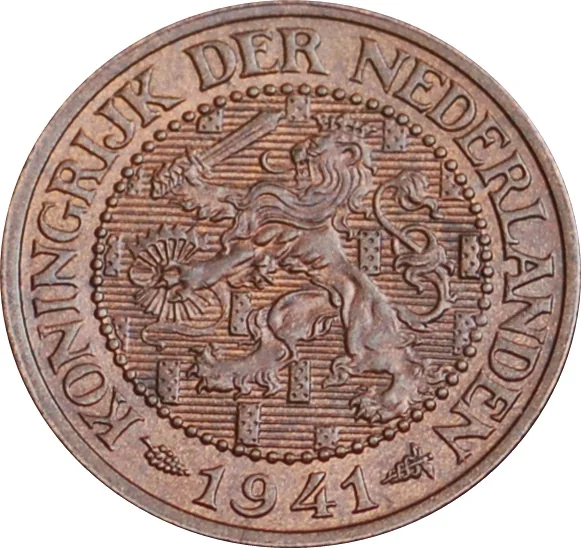
Crowned lion with shields in circle, date below.
Inscription:
KONINGRIJK DER NEDERLANDEN
1941
1941
Translation:
KINGDOM OF THE NETHERLANDS
1941
1941
Script: Latin
Language: Dutch
Engraver: Johan Philip Matthias Menger
Reverse
Edge
Reeded
Categories
| Symbols> Coat of Arms |
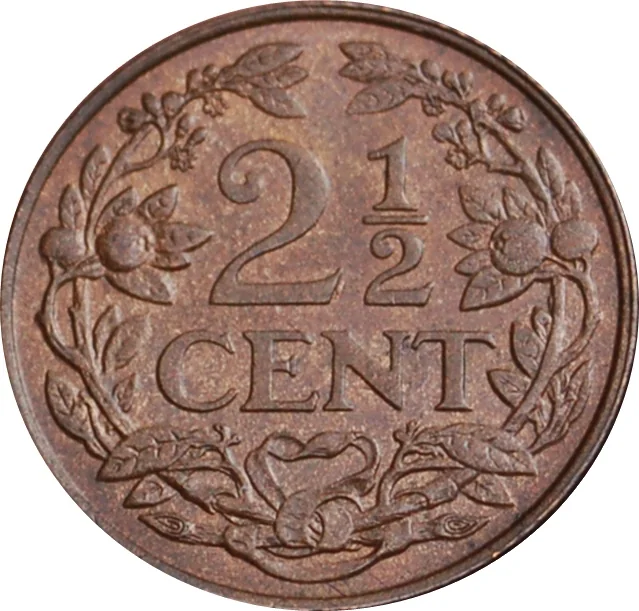
| Symbol> Wreath |
Mints
| Name | Mark |
|---|---|
| Royal Dutch Mint | — |
Mintings
| Year | Mint Mark | Mintage | Quality | Collection |
|---|---|---|---|---|
| 1912 | — | 2,000,000 | ||
| 1913 | — | 4,000,000 | ||
| 1914 | — | 2,000,000 | ||
| 1915 | — | 3,000,000 | ||
| 1916 | — | 8,000,000 | ||
| 1918 | — | 4,000,000 | ||
| 1919 | — | 2,000,000 | ||
| 1929 | — | 8,000,000 | ||
| 1941 | — | 19,800,000 |
Historical background
In 1912, the Netherlands operated under the classical gold standard, a system it had adhered to since 1875. The Dutch guilder (gulden) was legally defined as a fixed quantity of gold, making it fully convertible. This provided significant monetary stability, low inflation, and deep integration with the global economy, particularly with other major European powers and their trading empires. The central bank, De Nederlandsche Bank, was primarily tasked with maintaining this gold convertibility, holding substantial gold reserves to back the currency in circulation and ensure public and international confidence.
Domestically, the currency system was a practical mix. While gold coins existed for large transactions, everyday commerce was dominated by silver rijksdaalders and smaller silver and nickel coins, which were token money—their metallic value was less than their face value but they were convertible into gold on demand. Banknotes, issued by De Nederlandsche Bank, were also in widespread use and freely redeemable for gold. This multi-metallic circulation under a gold anchor was a mature and settled system, largely taken for granted by the Dutch public and business community on the eve of World War I.
However, this apparent stability existed within a tense international context. The pre-war gold standard was under growing strain from geopolitical rivalries, competitive economic policies, and imbalances in gold flows. While the Netherlands itself was not in crisis, as a small, open trading nation it was highly vulnerable to financial shocks emanating from larger powers. The system's rigidity meant the country had little independent monetary policy to address domestic economic fluctuations, being wholly committed to maintaining the gold parity. The currency situation of 1912, therefore, represented the calm zenith of a global monetary order that would be shattered just two years later by the outbreak of war, leading to the suspension of gold convertibility and a new era of financial uncertainty.
Domestically, the currency system was a practical mix. While gold coins existed for large transactions, everyday commerce was dominated by silver rijksdaalders and smaller silver and nickel coins, which were token money—their metallic value was less than their face value but they were convertible into gold on demand. Banknotes, issued by De Nederlandsche Bank, were also in widespread use and freely redeemable for gold. This multi-metallic circulation under a gold anchor was a mature and settled system, largely taken for granted by the Dutch public and business community on the eve of World War I.
However, this apparent stability existed within a tense international context. The pre-war gold standard was under growing strain from geopolitical rivalries, competitive economic policies, and imbalances in gold flows. While the Netherlands itself was not in crisis, as a small, open trading nation it was highly vulnerable to financial shocks emanating from larger powers. The system's rigidity meant the country had little independent monetary policy to address domestic economic fluctuations, being wholly committed to maintaining the gold parity. The currency situation of 1912, therefore, represented the calm zenith of a global monetary order that would be shattered just two years later by the outbreak of war, leading to the suspension of gold convertibility and a new era of financial uncertainty.
🌱 Very Common