

½ cent – Netherlands
Add to wishlist
Netherlands
Context
Years: 1909–1940
Issuer: Netherlands
Ruler: Wilhelmina
Currency:
(1817—2001)
Demonetized: Yes
Total mintage: 69,000,000
Material
References
KM: #
Numista: #9774
Value
Exchange value: 0.005 NLG
Obverse
Description:
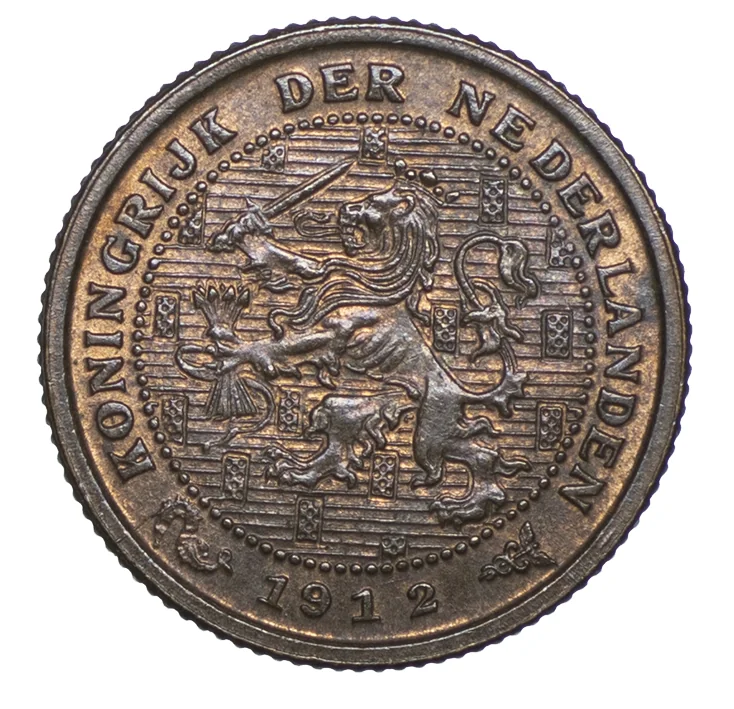
Rampant lion left within beaded circle on a field of 15 blocks; date with privy mark left and mint mark right.
Inscription:
KONINGRIJK DER NEDERLANDEN
1940
1940
Translation:
KINGDOM OF THE NETHERLANDS
1940
1940
Script: Latin
Language: Dutch
Engraver: Johan Philip Matthias Menger
Reverse
Edge
Milled
Categories
| Symbols> Coat of Arms |
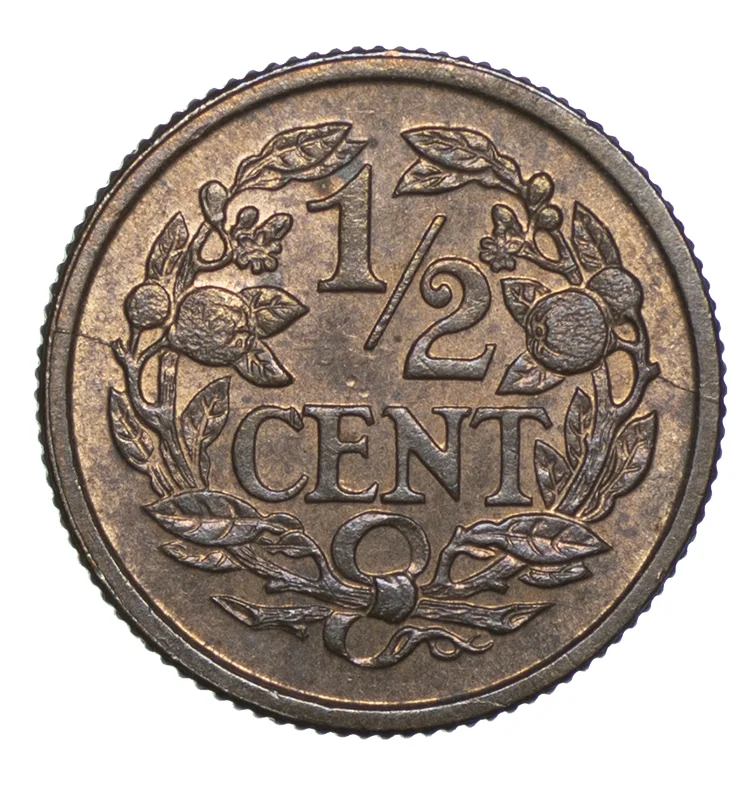
| Symbol> Wreath |
Mints
| Name | Mark |
|---|---|
| Royal Dutch Mint | — |
Mintings
| Year | Mint Mark | Mintage | Quality | Collection |
|---|---|---|---|---|
| 1909 | — | 5,000,000 | ||
| 1911 | — | 5,000,000 | ||
| 1912 | — | 5,000,000 | ||
| 1914 | — | 5,000,000 | ||
| 1915 | — | 2,500,000 | ||
| 1916 | — | 4,000,000 | ||
| 1917 | — | 5,000,000 | ||
| 1921 | — | 1,500,000 | ||
| 1922 | — | — | ||
| 1928 | — | 4,000,000 | ||
| 1930 | — | 6,000,000 | ||
| 1934 | — | 5,000,000 | ||
| 1936 | — | 5,000,000 | ||
| 1937 | — | 1,600,000 | ||
| 1938 | — | 8,400,000 | ||
| 1940 | — | 6,000,000 |
Historical background
In 1909, the Netherlands operated under the classical gold standard, a system it had adhered to since 1875. This meant the Dutch guilder (gulden) had a fixed value defined by a specific quantity of gold, ensuring stability and facilitating international trade. The country's central bank, De Nederlandsche Bank (DNB), was legally obligated to exchange banknotes for gold on demand, and the currency's value was effectively anchored to the pound sterling and other major gold-backed currencies. This environment fostered price stability and investor confidence, but it also meant monetary policy was largely automatic, tied to gold flows rather than domestic economic needs.
However, the system was not without its tensions. The turn of the century saw increasing global gold production, which contributed to a gradual worldwide inflation that also affected the Netherlands. Furthermore, the demands of a modernizing economy were putting pressure on the monetary framework. Internally, there was ongoing political and academic debate about the role and management of De Nederlandsche Bank, particularly concerning the renewal of its charter, which was due to expire in 1914. Critics argued for more state influence over the bank to better serve the national economy, rather than purely maintaining the gold link.
Looking ahead, the currency situation of 1909 was one of apparent surface stability but underlying transition. The solidity of the gold guilder was a point of national pride and economic identity. Yet, the discussions and pressures building in that year were precursors to significant change. Within five years, the outbreak of World War I in 1914 would force the Netherlands—like most other nations—to suspend gold convertibility, ending the very era of automatic monetary stability that defined the guilder in 1909 and ushering in a period of managed currency and financial uncertainty.
However, the system was not without its tensions. The turn of the century saw increasing global gold production, which contributed to a gradual worldwide inflation that also affected the Netherlands. Furthermore, the demands of a modernizing economy were putting pressure on the monetary framework. Internally, there was ongoing political and academic debate about the role and management of De Nederlandsche Bank, particularly concerning the renewal of its charter, which was due to expire in 1914. Critics argued for more state influence over the bank to better serve the national economy, rather than purely maintaining the gold link.
Looking ahead, the currency situation of 1909 was one of apparent surface stability but underlying transition. The solidity of the gold guilder was a point of national pride and economic identity. Yet, the discussions and pressures building in that year were precursors to significant change. Within five years, the outbreak of World War I in 1914 would force the Netherlands—like most other nations—to suspend gold convertibility, ending the very era of automatic monetary stability that defined the guilder in 1909 and ushering in a period of managed currency and financial uncertainty.
🌱 Very Common