

1 ducat – Austrian Empire
Add to wishlist
Austria
Context
Years: 1872–1915
Country: Austria
Issuer: Austrian Empire
Ruler: Francis Joseph I
Currency:
(1857—1892)
Demonetized: Yes
Total mintage: 17,015,639
Material
References
KM: #
Numista: #26247
Value
Bullion value: $530.81
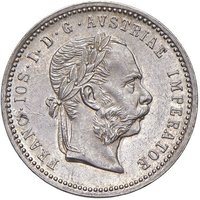
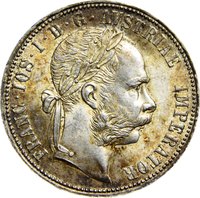
Obverse
Description:
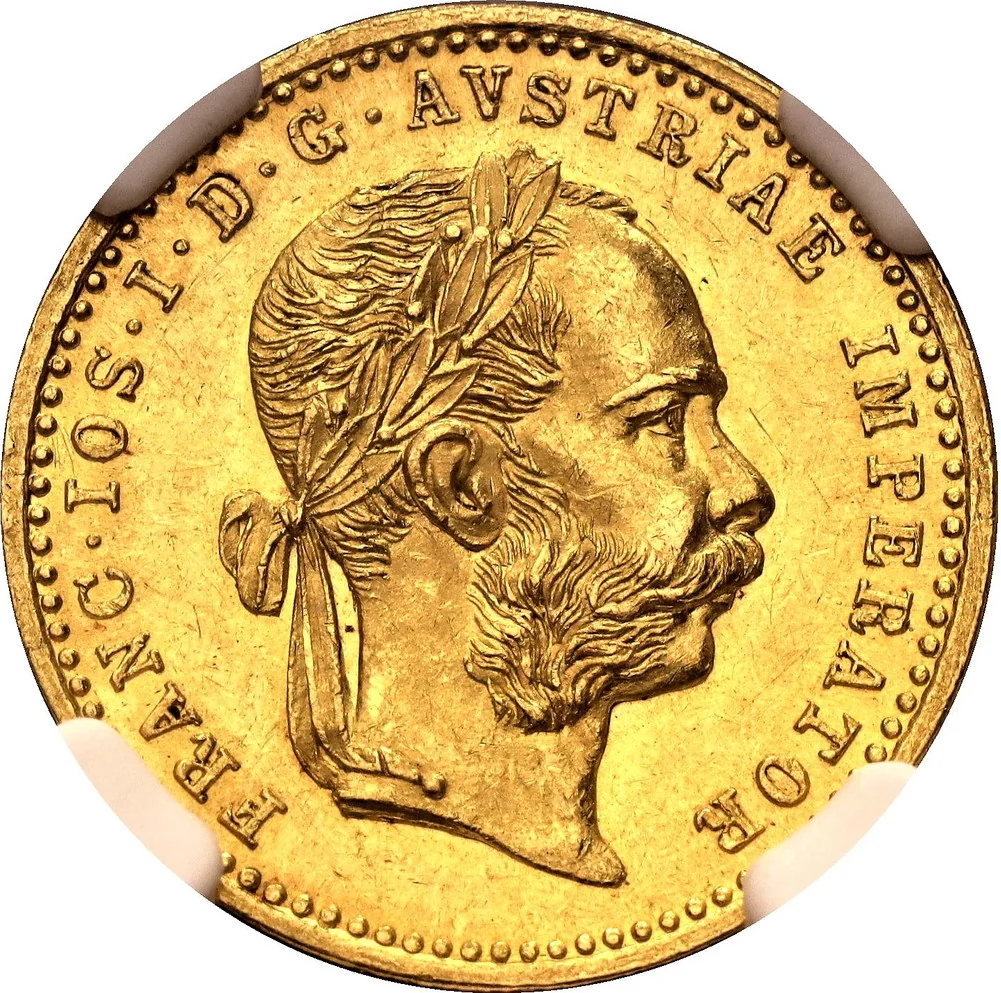
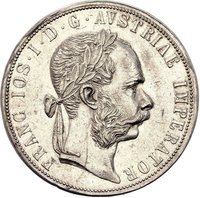
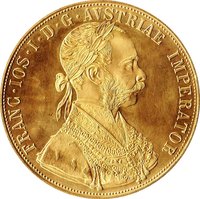
Laureate Franz Joseph facing right, with thick whiskers.
Inscription:
FRANC IOS I D G AUSTRIAE IMPERATOR
Translation:
FRANCIS I, BY THE GRACE OF GOD, EMPEROR OF AUSTRIA
Script: Latin
Language: Latin
Engraver: Friedrich Leisek
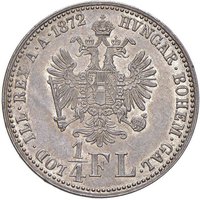
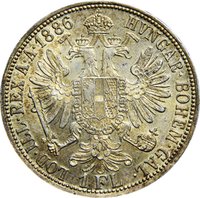
Reverse
Description:
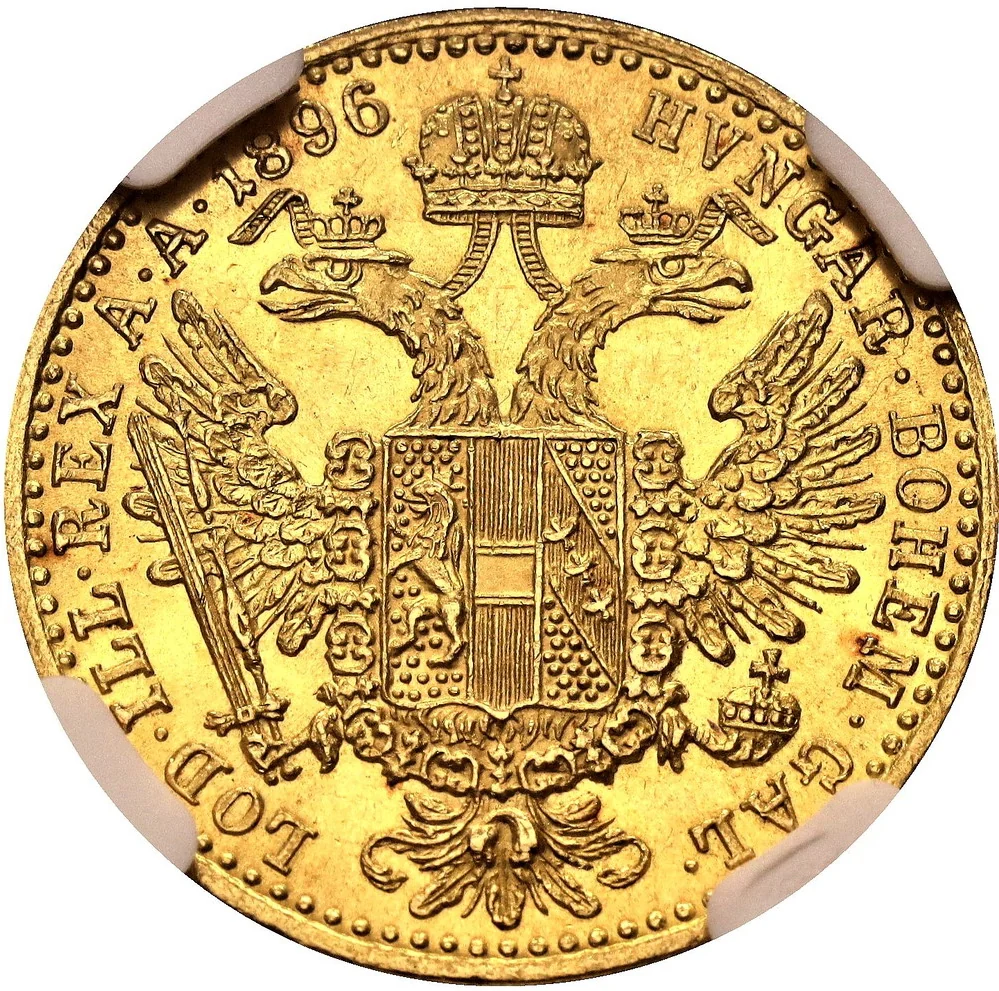
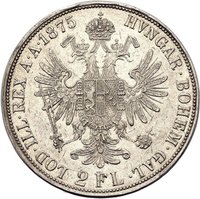
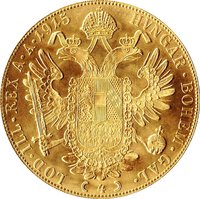
Austria's arms on a crowned double-headed Imperial eagle.
Inscription:
HUNGAR BOHEM GAL LOD ILL REX A A 1915
Translation:
Augustus, by the Grace of God, Emperor of Austria, Apostolic King of Hungary, King of Bohemia, Galicia, Lodomeria, and Illyria, etc.
Script: Latin
Engraver: Friedrich Leisek
Edge
Reeded
Categories
| Symbol> Double-headed eagle |
Mints
| Name | Mark |
|---|---|
| Münze Österreich | — |
Mintings
| Year | Mint Mark | Mintage | Quality | Collection |
|---|---|---|---|---|
| 1872 | — | 796,140 | ||
| 1873 | — | 515,616 | ||
| 1874 | — | 352,729 | ||
| 1875 | — | 184,488 | ||
| 1876 | — | 679,847 | ||
| 1877 | — | 822,508 | ||
| 1878 | — | 280,963 | ||
| 1879 | — | 361,556 | ||
| 1880 | — | 340,912 | ||
| 1881 | — | 476,872 | ||
| 1882 | — | 389,909 | ||
| 1883 | — | 408,639 | ||
| 1884 | — | 238,039 | ||
| 1885 | — | 257,383 | ||
| 1886 | — | 290,705 | ||
| 1887 | — | 223,055 | ||
| 1888 | — | 308,869 | ||
| 1889 | — | 334,788 | ||
| 1890 | — | 373,860 | ||
| 1891 | — | 324,584 | ||
| 1892 | — | 360,841 | ||
| 1893 | — | 285,024 | ||
| 1894 | — | 292,645 | ||
| 1895 | — | 329,569 | ||
| 1896 | — | 413,892 | ||
| 1897 | — | 256,151 | ||
| 1898 | — | 349,590 | ||
| 1899 | — | 411,559 | ||
| 1900 | — | 360,811 | ||
| 1901 | — | 348,621 | ||
| 1902 | — | 311,471 | ||
| 1903 | — | 380,014 | ||
| 1904 | — | 517,118 | ||
| 1905 | — | 391,534 | ||
| 1906 | — | 491,574 | ||
| 1907 | — | 554,205 | ||
| 1908 | — | 408,832 | ||
| 1909 | — | 366,318 | ||
| 1910 | — | 440,424 | ||
| 1911 | — | 590,826 | ||
| 1912 | — | 494,991 | ||
| 1913 | — | 319,926 | ||
| 1914 | — | 378,241 | ||
| 1915 | — | — | ||
| 1915 | — | — | Proof |
Historical background
By 1872, the Austrian Empire was in the final stages of a complex monetary transition, navigating the legacy of its chronic fiscal instability. For decades, the Empire had relied on a forced paper currency, the Austrian Gulden (Florin), which was not convertible to silver and had fluctuated in value since its introduction during the Napoleonic Wars. This period of "finance gulden" created uncertainty for both domestic commerce and international trade, as its value was often discounted against stable silver currencies like the Prussian Thaler. The state's substantial debt and history of deficit financing, particularly following the Austro-Prussian War of 1866, made the establishment of a sound, metallic currency a persistent but elusive goal.
The pivotal shift began with the Austro-Hungarian Compromise of 1867, which created the dual monarchy of Austria-Hungary. A key economic component of this new structure was the commitment to monetary union and reform. This led to the Currency Law of 1892, but the groundwork was laid in the preceding decades. In 1867, the Gulden was placed on a de facto silver standard, and by 1872, the government was actively working to stabilize the currency and prepare for the eventual introduction of a new gold-based unit, the Krone. The immediate goal was to end the era of inconvertible paper and establish a fixed parity with silver, thereby integrating the Empire's economy more securely into European financial markets.
Thus, the currency situation in 1872 was one of cautious transition. The Austrian Gulden remained the official unit, but it was now operating under a legislated silver standard, with the authorities accumulating metallic reserves and aiming for full convertibility. The process was slow and fraught with the challenges of managing a large public debt, but the direction was clear: away from discretionary paper money and toward a fixed, metallic standard shared with Hungary. This period set the essential administrative and financial stage for the comprehensive currency reform that would culminate two decades later with the full adoption of the gold-based Krone.
The pivotal shift began with the Austro-Hungarian Compromise of 1867, which created the dual monarchy of Austria-Hungary. A key economic component of this new structure was the commitment to monetary union and reform. This led to the Currency Law of 1892, but the groundwork was laid in the preceding decades. In 1867, the Gulden was placed on a de facto silver standard, and by 1872, the government was actively working to stabilize the currency and prepare for the eventual introduction of a new gold-based unit, the Krone. The immediate goal was to end the era of inconvertible paper and establish a fixed parity with silver, thereby integrating the Empire's economy more securely into European financial markets.
Thus, the currency situation in 1872 was one of cautious transition. The Austrian Gulden remained the official unit, but it was now operating under a legislated silver standard, with the authorities accumulating metallic reserves and aiming for full convertibility. The process was slow and fraught with the challenges of managing a large public debt, but the direction was clear: away from discretionary paper money and toward a fixed, metallic standard shared with Hungary. This period set the essential administrative and financial stage for the comprehensive currency reform that would culminate two decades later with the full adoption of the gold-based Krone.
🌱 Common