

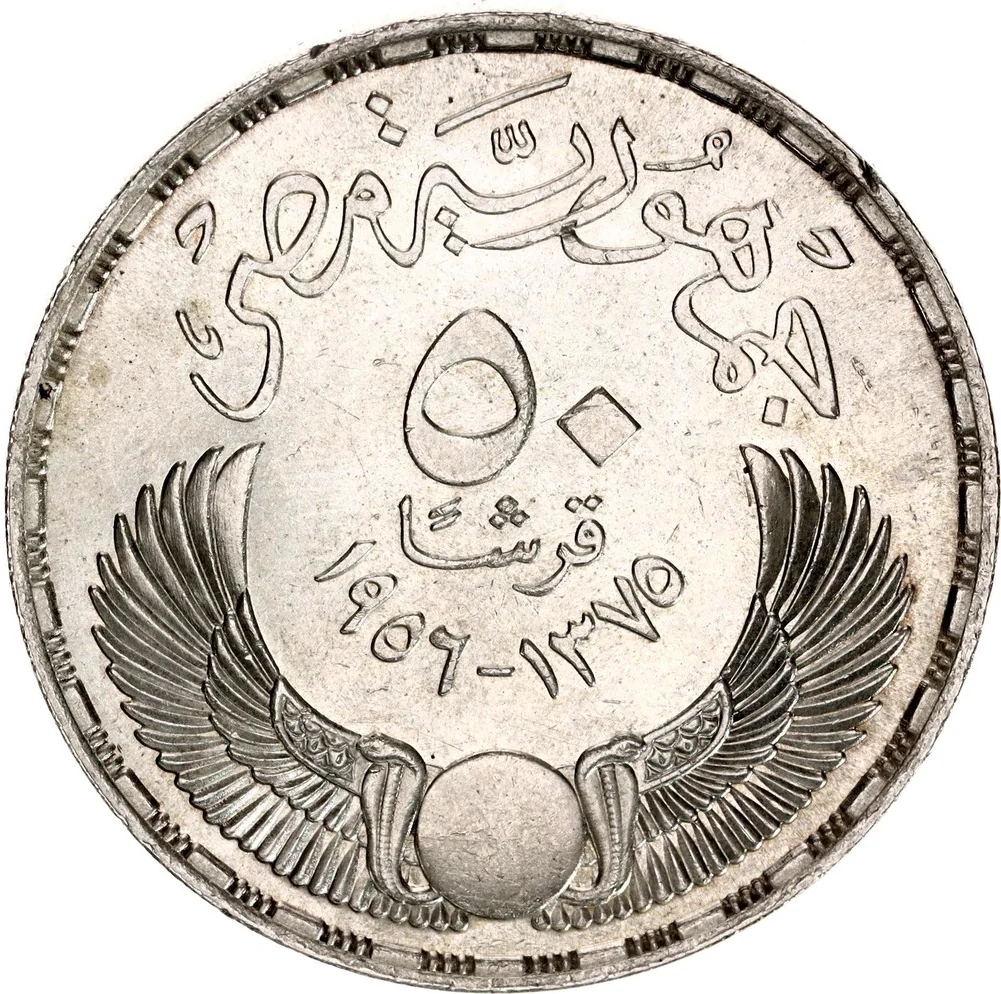
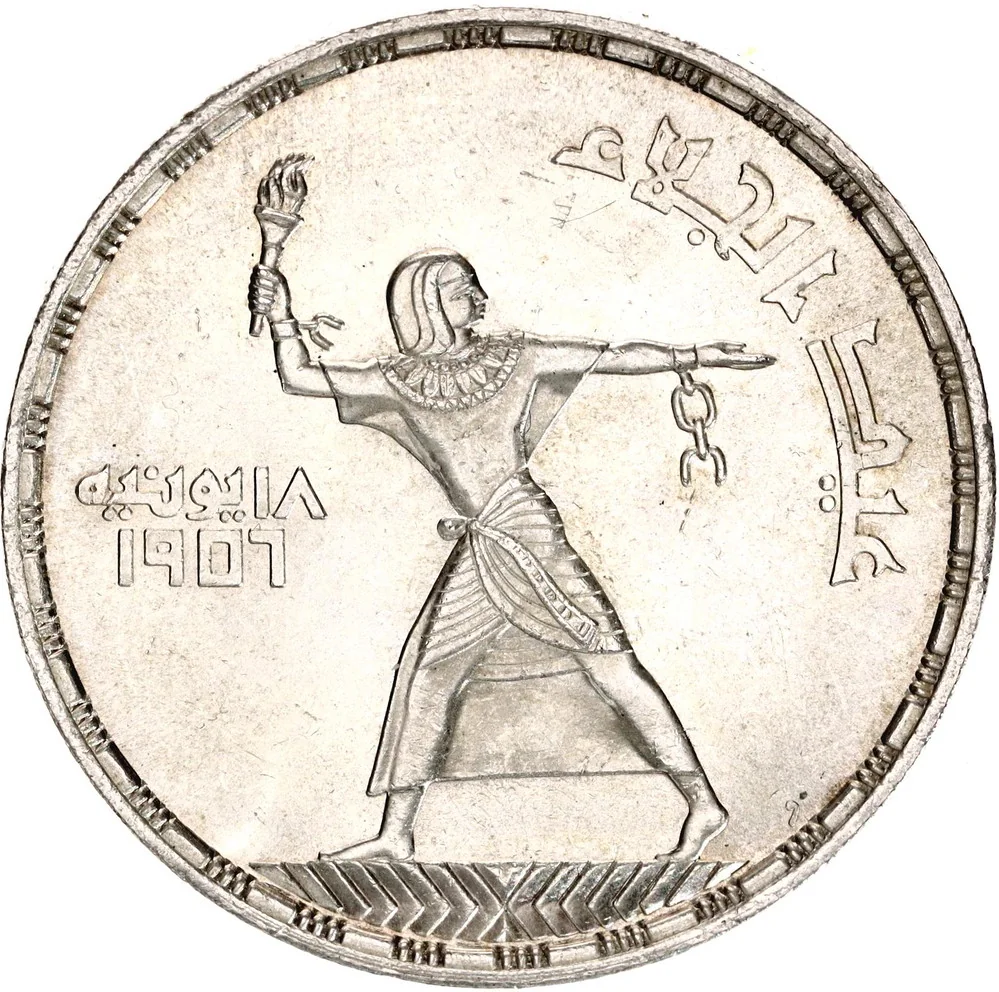
50 piastres – Egypt
Add to wishlist
Circulating commemorative coins
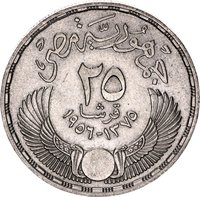
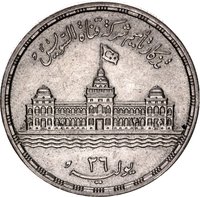
Commemoration: Evacuation Day, 18 June 1956
Egypt
Context
Year: 1956
Islamic (Hijri) Year:: 1375
Issuer: Egypt
Period:
(1953—1958)
Currency:
(since 1916)
Demonetized: Yes
Total mintage: 250,000
Material
References
KM: #
Numista: #26190
Value
Exchange value: 0.50 EGP
Bullion value: $63.89
Obverse
Reverse
Edge
Reeded
Mints
| Name | Mark |
|---|---|
| Egyptian Mint Authority | — |
Mintings
| Year | Mint Mark | Mintage | Quality | Collection |
|---|---|---|---|---|
| 1956 | — | 250,000 |
Historical background
In 1956, Egypt's currency situation was intrinsically linked to the nation's bold political and economic ambitions under President Gamal Abdel Nasser. The year was dominated by the dramatic nationalization of the Suez Canal in July, a move intended to generate revenue for the monumental Aswan High Dam project after the withdrawal of Western financing. This act of economic sovereignty directly precipitated the Suez Crisis in October-November, a tripartite invasion by Britain, France, and Israel that sought to reverse the nationalization. The conflict created immediate financial instability, as it threatened a vital source of hard currency (canal tolls) and disrupted trade, placing severe pressure on Egypt's foreign reserves and the Egyptian pound.
The currency itself, the Egyptian pound, was historically tied to the British sterling and managed by the National Bank of Egypt. However, following the 1952 revolution, the new republican government began asserting greater control. A significant institutional shift occurred in 1956 with the founding of the Central Bank of Egypt, which took over currency issuance and monetary policy, marking a decisive break from the sterling area and British financial influence. This move was a cornerstone of Nasser's policy of economic independence and state-led development.
Despite the political triumph of surviving the Suez invasion, the year ended with underlying economic strains that would define the coming decade. The costs of military mobilization, coupled with a commitment to massive state-led industrialization and social programs, began to stretch public finances. While not yet in crisis, the currency system in 1956 was at a pivot point: it had successfully been harnessed as a tool of national sovereignty, but was becoming increasingly vulnerable to the pressures of deficit financing and a growing reliance on centralized planning, setting the stage for future challenges.
The currency itself, the Egyptian pound, was historically tied to the British sterling and managed by the National Bank of Egypt. However, following the 1952 revolution, the new republican government began asserting greater control. A significant institutional shift occurred in 1956 with the founding of the Central Bank of Egypt, which took over currency issuance and monetary policy, marking a decisive break from the sterling area and British financial influence. This move was a cornerstone of Nasser's policy of economic independence and state-led development.
Despite the political triumph of surviving the Suez invasion, the year ended with underlying economic strains that would define the coming decade. The costs of military mobilization, coupled with a commitment to massive state-led industrialization and social programs, began to stretch public finances. While not yet in crisis, the currency system in 1956 was at a pivot point: it had successfully been harnessed as a tool of national sovereignty, but was becoming increasingly vulnerable to the pressures of deficit financing and a growing reliance on centralized planning, setting the stage for future challenges.
🌱 Fairly Common