

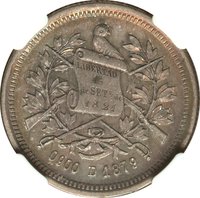
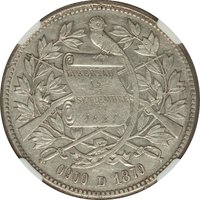
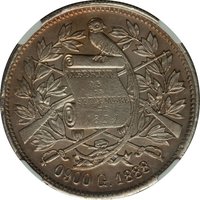
Obverse
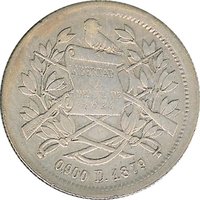
Description:
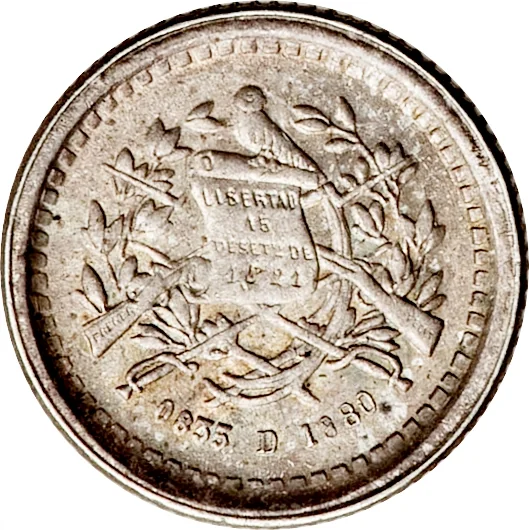
Coat of arms with fineness and date below.
Inscription:
LIBERTAD 15 DE SET DE 1821
0835 D 1880
0835 D 1880
Translation:
LIBERTY 15 SEPT 1821
0835 D 1880
0835 D 1880
Script: Latin
Language: Spanish
Engraver: Johann-Baptist Frener
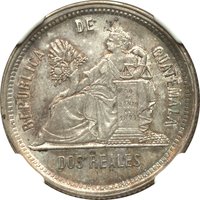
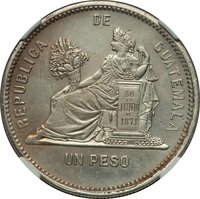
Reverse
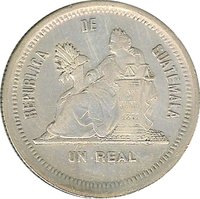
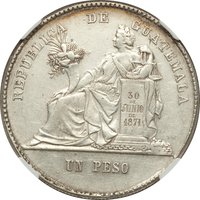
Description:
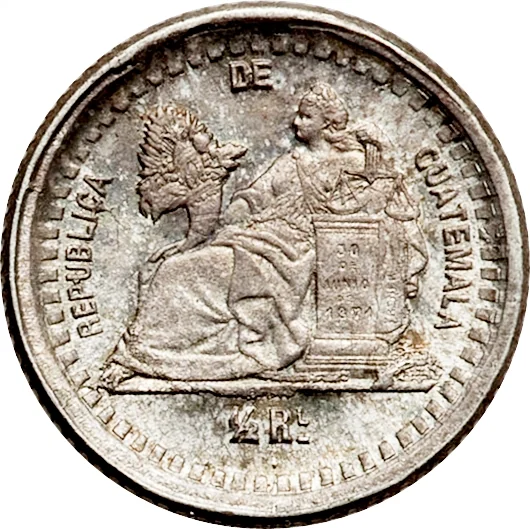
Justice seated with Constitution, legend around, value below.
Inscription:
REPUBLICA DE GUATEMALA
30 DE JUNIO DE 1871
1/2 Rs
30 DE JUNIO DE 1871
1/2 Rs
Translation:
REPUBLIC OF GUATEMALA
JUNE 30, 1871
1/2 REAL
JUNE 30, 1871
1/2 REAL
Script: Latin
Language: Spanish
Engraver: Johann-Baptist Frener
Edge
Milled
Categories
| Symbol> Allegory |
| Symbols> Coat of Arms |
Mints
| Name | Mark |
|---|---|
| Casa de Moneda de Guatemala | — |
Mintings
| Year | Mint Mark | Mintage | Quality | Collection |
|---|---|---|---|---|
| 1879 | D | 1,683,490 | ||
| 1880 | — | — | ||
| 1880 | D | 2,714,999 |
Historical background
In 1879, Guatemala’s currency situation was characterized by a chaotic and fragmented system, a legacy of the colonial era and post-independence instability. The primary circulating medium was the peso, a large silver coin often cut into fractional pieces (reales and cuartillos) for smaller transactions, leading to physical degradation and confusion. Alongside this, a vast array of foreign coins, particularly Mexican and Peruvian silver, circulated at varying rates of acceptance. This lack of a uniform, state-controlled currency hindered commerce, facilitated fraud, and complicated government finances, reflecting the broader challenges of economic modernization.
This monetary disarray occurred under the authoritarian but modernizing regime of President Justo Rufino Barrios (1873-1885), who was implementing sweeping Liberal Reforms. Barrios’s government was actively promoting coffee exports, building infrastructure, and seeking to integrate Guatemala into the global economy. The archaic currency system was a significant obstacle to these goals, as it created uncertainty for foreign investors and domestic merchants alike. The state’s need for greater fiscal control and a more efficient medium for tax collection and international trade made monetary reform an urgent priority.
Consequently, 1879 was a pivotal year, serving as the immediate prelude to a major reform. That same year, the government took concrete steps by contracting with a foreign mint to produce new, standardized coinage. This effort culminated in 1881 with the official introduction of the Guatemalan peso, a decimalized currency divided into 100 centavos, and the establishment of the Quetzal as a unit of account equal to one peso. Thus, the situation in 1879 was one of final crisis and transition, where the pressures of a export-driven economy finally forced the state to dismantle the old colonial monetary legacy and impose a uniform, national currency system.
This monetary disarray occurred under the authoritarian but modernizing regime of President Justo Rufino Barrios (1873-1885), who was implementing sweeping Liberal Reforms. Barrios’s government was actively promoting coffee exports, building infrastructure, and seeking to integrate Guatemala into the global economy. The archaic currency system was a significant obstacle to these goals, as it created uncertainty for foreign investors and domestic merchants alike. The state’s need for greater fiscal control and a more efficient medium for tax collection and international trade made monetary reform an urgent priority.
Consequently, 1879 was a pivotal year, serving as the immediate prelude to a major reform. That same year, the government took concrete steps by contracting with a foreign mint to produce new, standardized coinage. This effort culminated in 1881 with the official introduction of the Guatemalan peso, a decimalized currency divided into 100 centavos, and the establishment of the Quetzal as a unit of account equal to one peso. Thus, the situation in 1879 was one of final crisis and transition, where the pressures of a export-driven economy finally forced the state to dismantle the old colonial monetary legacy and impose a uniform, national currency system.
Series: 1879 Guatemala circulation coins
🌟 Limited