

Obverse
Description:
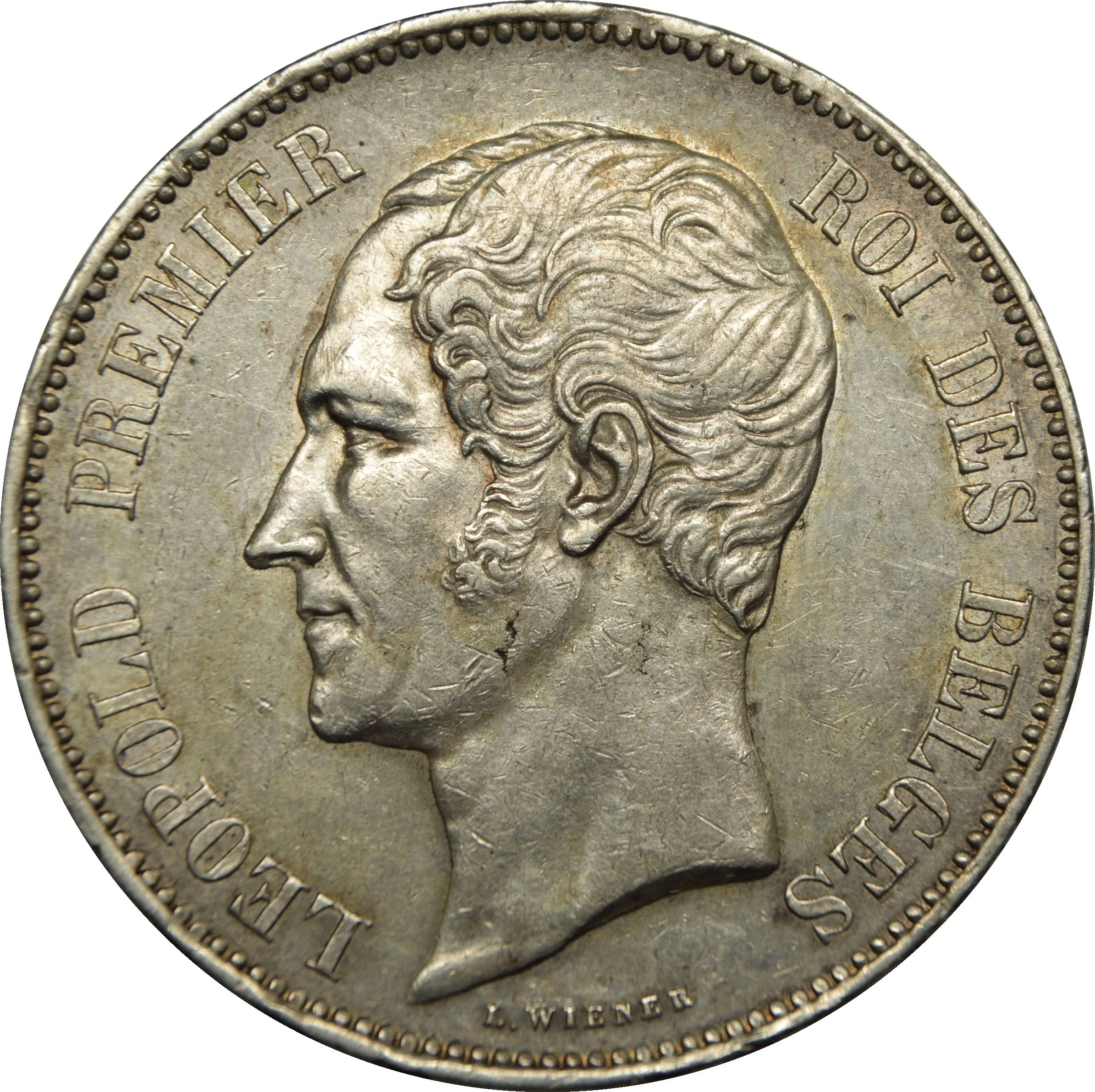
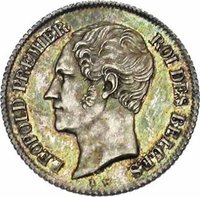
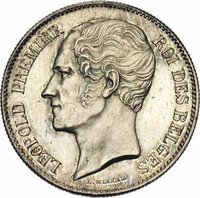
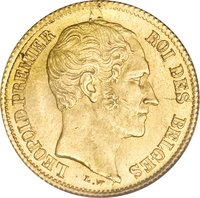
Leopold I of Belgium in left profile, bare-headed, encircled by a French legend.
Inscription:
LEOPOLD PREMIER ROI DES BELGES
L. WIENER
L. WIENER
Translation:
LEOPOLD THE FIRST KING OF THE BELGIANS
L. WIENER
L. WIENER
Script: Latin
Language: French
Engraver: Léopold Wiener
Reverse
Description:
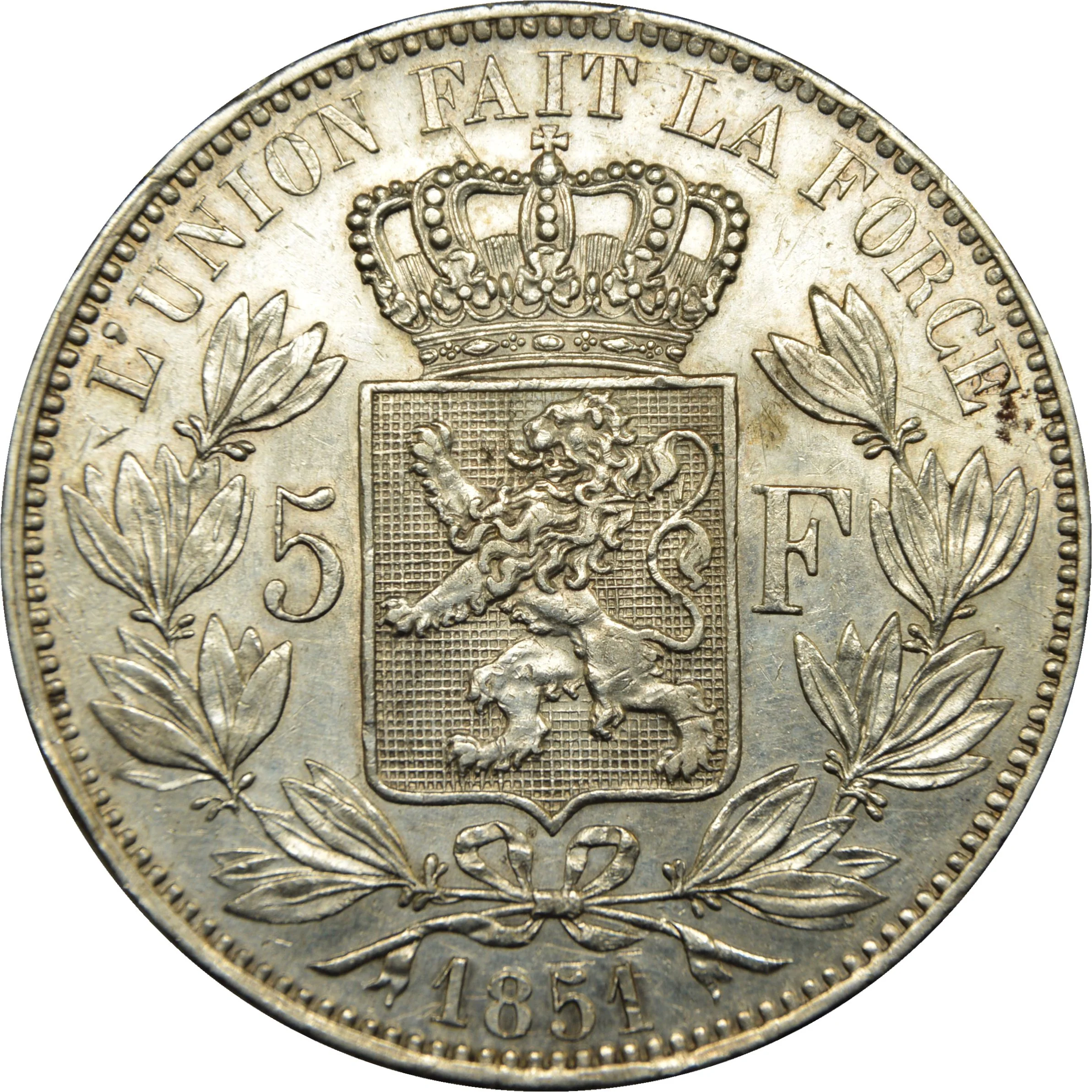
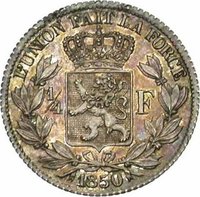
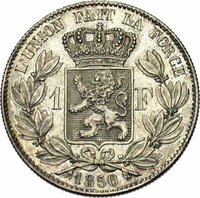
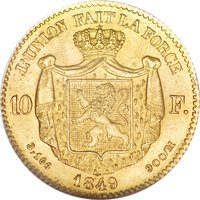
Coat of arms in wreath divides value. French motto above, year below.
Inscription:
L'UNION FAIT LA FORCE
5 F
1851
5 F
1851
Translation:
Union makes strength
5 Francs
1851
5 Francs
1851
Script: Latin
Language: French
Engraver: Léopold Wiener
Edge
Plain with letters in relief
Legend:
DIEU PROTEGE LA BELGIQUE ★★★
Translation:
God Protects Belgium ★★★
Language: French
Mints
| Name | Mark |
|---|---|
| Royal Mint of Belgium | — |
Mintings
| Year | Mint Mark | Mintage | Quality | Collection |
|---|---|---|---|---|
| 1849 | — | — | ||
| 1850 | — | — | Proof | |
| 1850 | — | 5,265,296 | ||
| 1851 | — | 3,707,922 | ||
| 1852 | — | 4,604,676 | ||
| 1853 | — | 2,426,598 | ||
| 1858 | — | 18,102 | ||
| 1865 | — | 907,360 |
Historical background
In 1849, Belgium’s currency situation was characterized by a pragmatic and stable bimetallic system, a legacy of its foundational years as an independent nation. Following its separation from the Netherlands in 1830, Belgium needed its own monetary identity and, in 1832, formally adopted a franc-based system aligned with the French bimetallic standard. This meant the Belgian franc was defined by both gold and silver at a fixed legal ratio (1:15.5), with both metals serving as legal tender for unlimited payments. This system provided stability and facilitated crucial trade with its powerful neighbor, France, anchoring the young kingdom's economy during its early industrial expansion.
However, by the late 1840s, this bimetallic system was under subtle strain from global market forces. The discovery of new silver sources was beginning to depress the metal's market value relative to gold, a phenomenon that would later disrupt bimetallism across Europe. While not yet a crisis in 1849, this trend created a risk of "Gresham's Law," where undervalued gold coins might be hoarded or exported, leaving only silver in circulation. The Belgian government and the National Bank of Belgium (founded in 1850) were thus operating in a period of watchfulness, managing a sound but increasingly anachronistic monetary framework on the eve of significant European monetary shifts.
Consequently, the situation in 1849 was one of de facto stability but underlying transition. The currency was trusted domestically, and the state's finances were sound, especially compared to the revolutionary turmoil affecting other European nations that year. Yet, Belgium was on the cusp of major change. Within two decades, it would help pioneer the Latin Monetary Union (1865), a multinational attempt to sustain a shared bimetallic standard. Therefore, 1849 represents a quiet but pivotal moment—the final years of a purely national bimetallism before Belgium sought multinational solutions to the growing impracticality of maintaining two metallic standards in a changing global market.
However, by the late 1840s, this bimetallic system was under subtle strain from global market forces. The discovery of new silver sources was beginning to depress the metal's market value relative to gold, a phenomenon that would later disrupt bimetallism across Europe. While not yet a crisis in 1849, this trend created a risk of "Gresham's Law," where undervalued gold coins might be hoarded or exported, leaving only silver in circulation. The Belgian government and the National Bank of Belgium (founded in 1850) were thus operating in a period of watchfulness, managing a sound but increasingly anachronistic monetary framework on the eve of significant European monetary shifts.
Consequently, the situation in 1849 was one of de facto stability but underlying transition. The currency was trusted domestically, and the state's finances were sound, especially compared to the revolutionary turmoil affecting other European nations that year. Yet, Belgium was on the cusp of major change. Within two decades, it would help pioneer the Latin Monetary Union (1865), a multinational attempt to sustain a shared bimetallic standard. Therefore, 1849 represents a quiet but pivotal moment—the final years of a purely national bimetallism before Belgium sought multinational solutions to the growing impracticality of maintaining two metallic standards in a changing global market.
Series: 1849 Belgium circulation coins
🌱 Common