

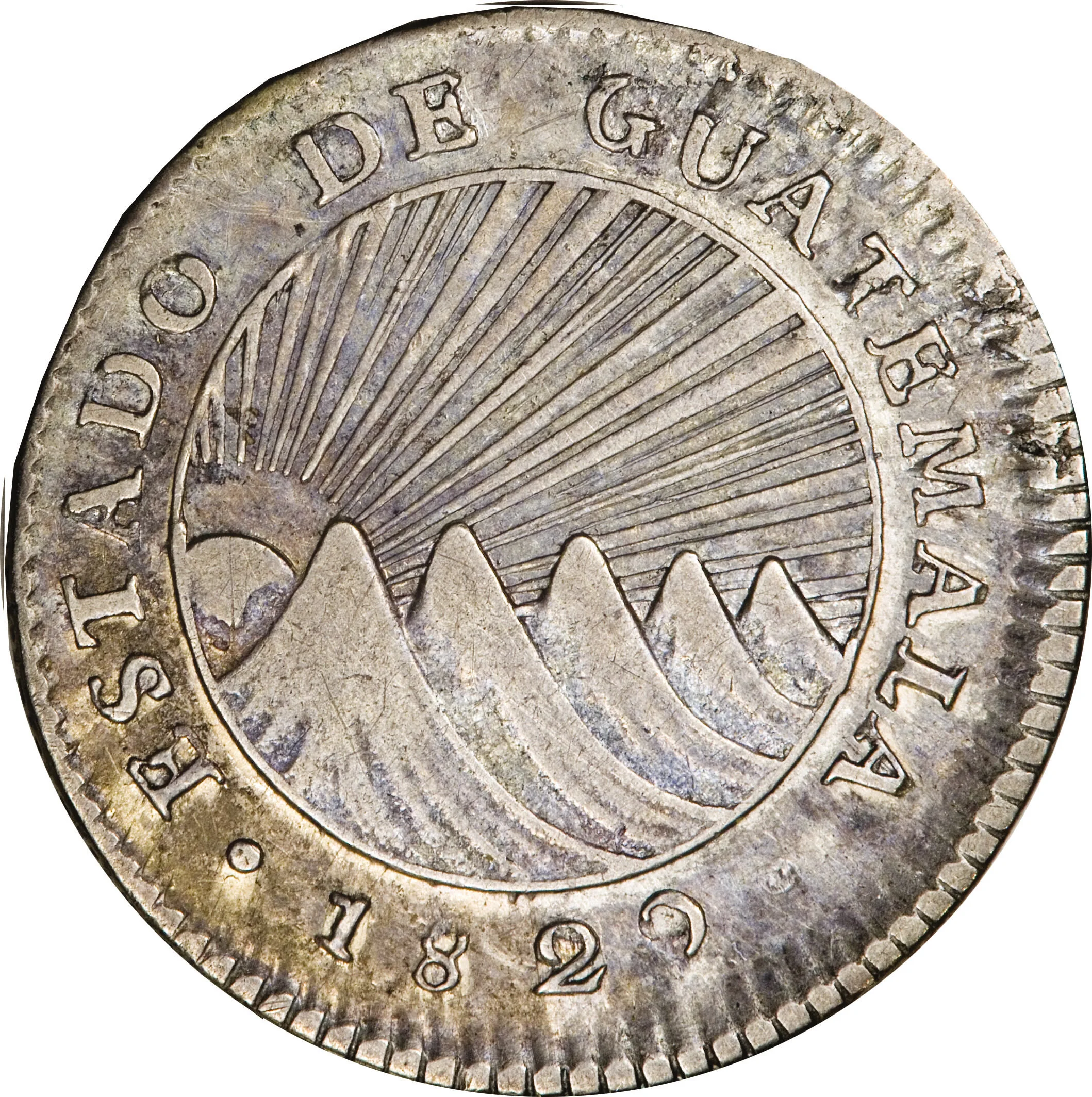
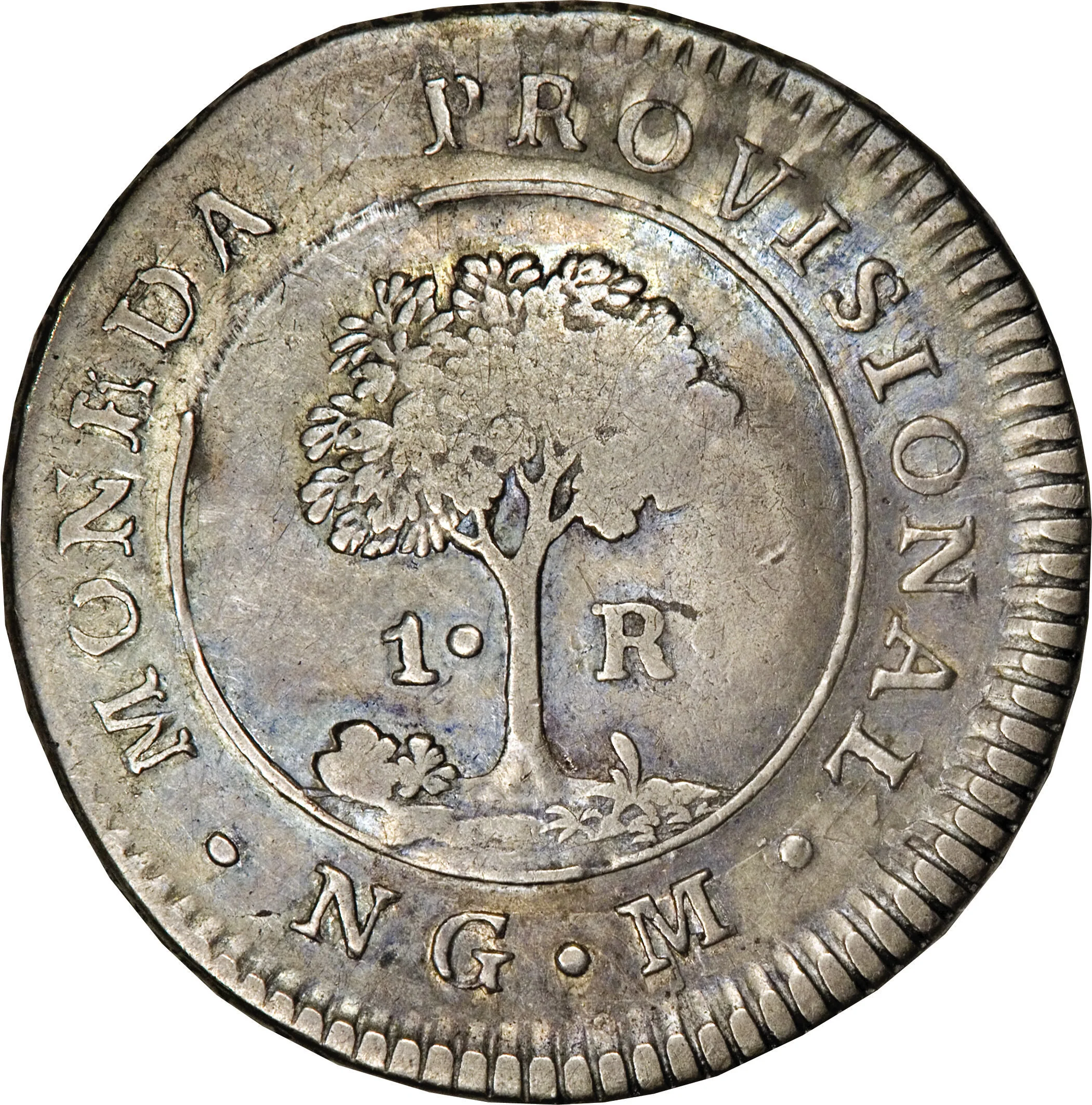
1 Real – Guatemala
Guatemala
Obverse
Reverse
Edge
Mints
| Name | Mark |
|---|---|
| Casa de Moneda de Guatemala | NG |
Mintings
| Year | Mint Mark | Mintage | Quality | Collection |
|---|---|---|---|---|
| 1829 | NG | — |
Historical background
Following Guatemala's independence from Spain in 1821, the currency situation in 1829 was one of profound instability and transition, reflecting the broader political and economic turmoil of the newly formed Federal Republic of Central America. The Spanish colonial monetary system, based on the silver real and gold escudo, remained in physical circulation but was increasingly scarce. This scarcity was exacerbated by a severe economic depression, diminished trade, and the flight of capital during the violent political struggles between Conservatives and Liberals. The federal and state governments, lacking robust institutions and precious metal reserves, struggled to assert monetary authority, leading to a chaotic mix of worn Spanish coins, coins from other nations (like Mexican pesos), and even cut or counterfeited pieces circulating at variable values.
The critical issue in 1829 was the lack of a unified, trusted currency issued by a sovereign authority. While the federal government had authorized the minting of national coins as early as 1824, production at the Guatemala City Mint was limited and inconsistent. The ongoing civil war, culminating in Liberal General Francisco Morazán's capture of Guatemala City in April 1829, diverted all state resources toward the conflict. Consequently, the state could not implement a coherent monetary policy or introduce sufficient quantities of official currency to displace the fragmented colonial legacy. This environment fostered widespread confusion in commerce, as the value of coins depended heavily on their metal content, origin, and physical condition, rather than a guaranteed face value.
Ultimately, the currency situation of 1829 was a symptom of a fledgling state in crisis. The political victory of the Liberals did not immediately resolve the monetary chaos; it would take years of gradual stabilization before Guatemala could establish a more uniform currency system. The period is therefore characterized not by a specific monetary reform, but by a protracted vacuum of authority, where the practical economy relied on a depreciating and heterogeneous mix of metallic money, hindering recovery and integration into the post-independence world.
The critical issue in 1829 was the lack of a unified, trusted currency issued by a sovereign authority. While the federal government had authorized the minting of national coins as early as 1824, production at the Guatemala City Mint was limited and inconsistent. The ongoing civil war, culminating in Liberal General Francisco Morazán's capture of Guatemala City in April 1829, diverted all state resources toward the conflict. Consequently, the state could not implement a coherent monetary policy or introduce sufficient quantities of official currency to displace the fragmented colonial legacy. This environment fostered widespread confusion in commerce, as the value of coins depended heavily on their metal content, origin, and physical condition, rather than a guaranteed face value.
Ultimately, the currency situation of 1829 was a symptom of a fledgling state in crisis. The political victory of the Liberals did not immediately resolve the monetary chaos; it would take years of gradual stabilization before Guatemala could establish a more uniform currency system. The period is therefore characterized not by a specific monetary reform, but by a protracted vacuum of authority, where the practical economy relied on a depreciating and heterogeneous mix of metallic money, hindering recovery and integration into the post-independence world.
✨ Legendary