

30 Baiocchi – Papal States
Vatican City
Context
Year: 1834
Country: Vatican City 
Issuer: Papal States
Ruler: Gregory XVI
Currency:
(1534—1835)
Demonetized: Yes
Total mintage: 16,770
Material
Diameter: 26 mm
Weight: 7.93 g
Silver weight: 7.27 g
Shape: Round
Composition: 91.7% Silver
Standard: Silver quarter ounce
Magnetic: No
Technique: Milled
Alignment: Coin alignment
flip
References
KM: #Click to copy to clipboard1104
Numista: #259706
Value
Bullion value: $20.40
Obverse
Description:
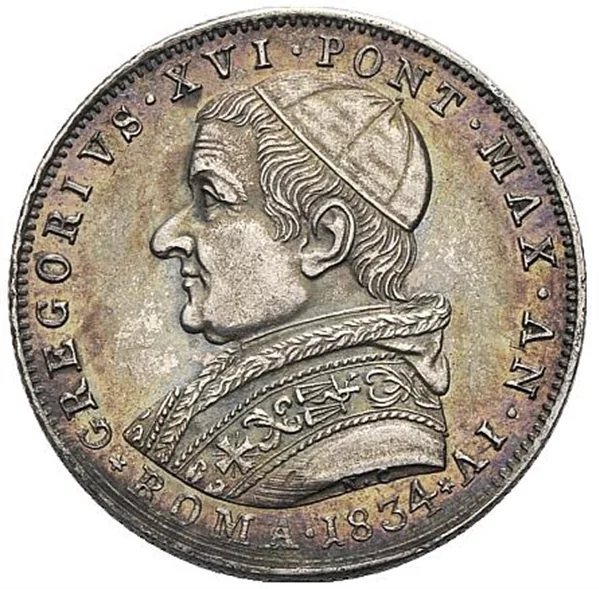
Pope Gregory XVI, who reigned from 1831 to 1846, was a staunch conservative who condemned modern political ideas and resisted reforms.
Inscription:
GREGORIVS٠XVI٠PONT٠MAX٠AN٠IV
*ROMA٠1834*
*ROMA٠1834*
Translation:
Gregory XVI, Supreme Pontiff, Year 4.
Rome, 1834.
Rome, 1834.
Script: Latin
Language: Latin
Engraver: Niccolò Cerbara
Reverse
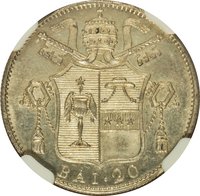
Description:
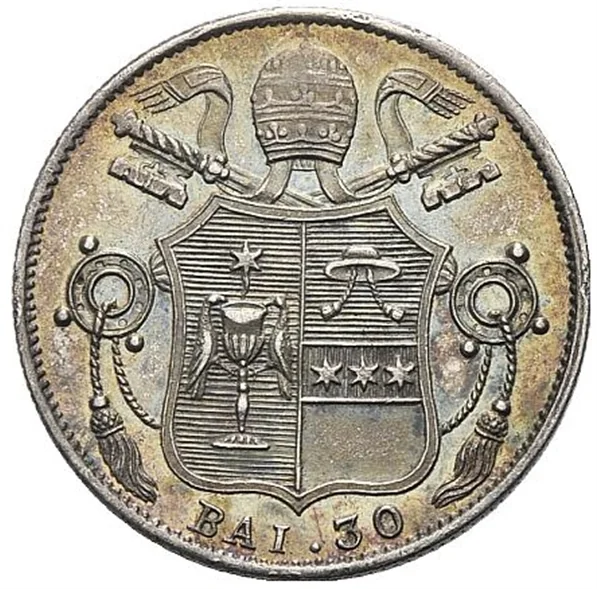
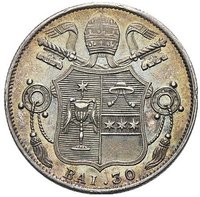
Gregory XVI's coat of arms
Inscription:
BAI. 30
Translation:
Victorious. 30.
Script: Latin
Language: Latin
Engraver: Niccolò Cerbara
Edge
Reeded
Categories
| Symbols> Coat of Arms |
| Person> Religious figure |
| Object> Hat |
Mints
| Name | Mark |
|---|---|
| Rome | — |
Mintings
| Year | Mint Mark | Mintage | Quality | Collection |
|---|---|---|---|---|
| 1834 | — | 16,770 |
Historical background
In 1834, the Papal States found itself navigating a complex and challenging monetary landscape, characteristic of pre-unification Italy. The territory lacked a unified, modern currency system, instead operating with a fragmented mix of coins from various eras and origins. The official standard was the Papal Scudo, divided into 100 Baiocchi, but in practice, circulation was dominated by a bewildering variety of foreign coins—particularly French, Austrian, and Neapolitan—alongside older papal issues and even debased local coinage from cities like Bologna. This created chronic confusion in commerce, as exchange rates fluctuated and the intrinsic silver value of coins often differed from their face value.
The root of this disorder lay in both political and economic weakness. The papal government, under Pope Gregory XVI, was fiscally strained and conservative, resistant to the banking and monetary reforms seen in other European states. Furthermore, the presence of Austrian troops, following the suppression of the 1831 revolts, increased the circulation and influence of Austrian currency, particularly the Conventionsthaler, within the northern Legations. This monetary fragmentation mirrored the administrative disunity of the Papal States itself, hindering internal trade and economic development by creating uncertainty and transaction costs for merchants and the populace alike.
Consequently, the year 1834 did not mark a period of reform but rather one of persistent stagnation within a deteriorating system. The papal mint struggled to produce sufficient quality coinage to establish a reliable standard, while counterfeiting and clipping of coins were rampant. The situation would only begin to move toward resolution decades later, with the sweeping monetary reforms of Pope Pius IX in the 1860s, which ultimately gave way to the complete integration into the Italian Lira system following the annexation of the Papal States by the Kingdom of Italy in 1870.
The root of this disorder lay in both political and economic weakness. The papal government, under Pope Gregory XVI, was fiscally strained and conservative, resistant to the banking and monetary reforms seen in other European states. Furthermore, the presence of Austrian troops, following the suppression of the 1831 revolts, increased the circulation and influence of Austrian currency, particularly the Conventionsthaler, within the northern Legations. This monetary fragmentation mirrored the administrative disunity of the Papal States itself, hindering internal trade and economic development by creating uncertainty and transaction costs for merchants and the populace alike.
Consequently, the year 1834 did not mark a period of reform but rather one of persistent stagnation within a deteriorating system. The papal mint struggled to produce sufficient quality coinage to establish a reliable standard, while counterfeiting and clipping of coins were rampant. The situation would only begin to move toward resolution decades later, with the sweeping monetary reforms of Pope Pius IX in the 1860s, which ultimately gave way to the complete integration into the Italian Lira system following the annexation of the Papal States by the Kingdom of Italy in 1870.
✨ Legendary