

5 Rupees – India - British
India
Context
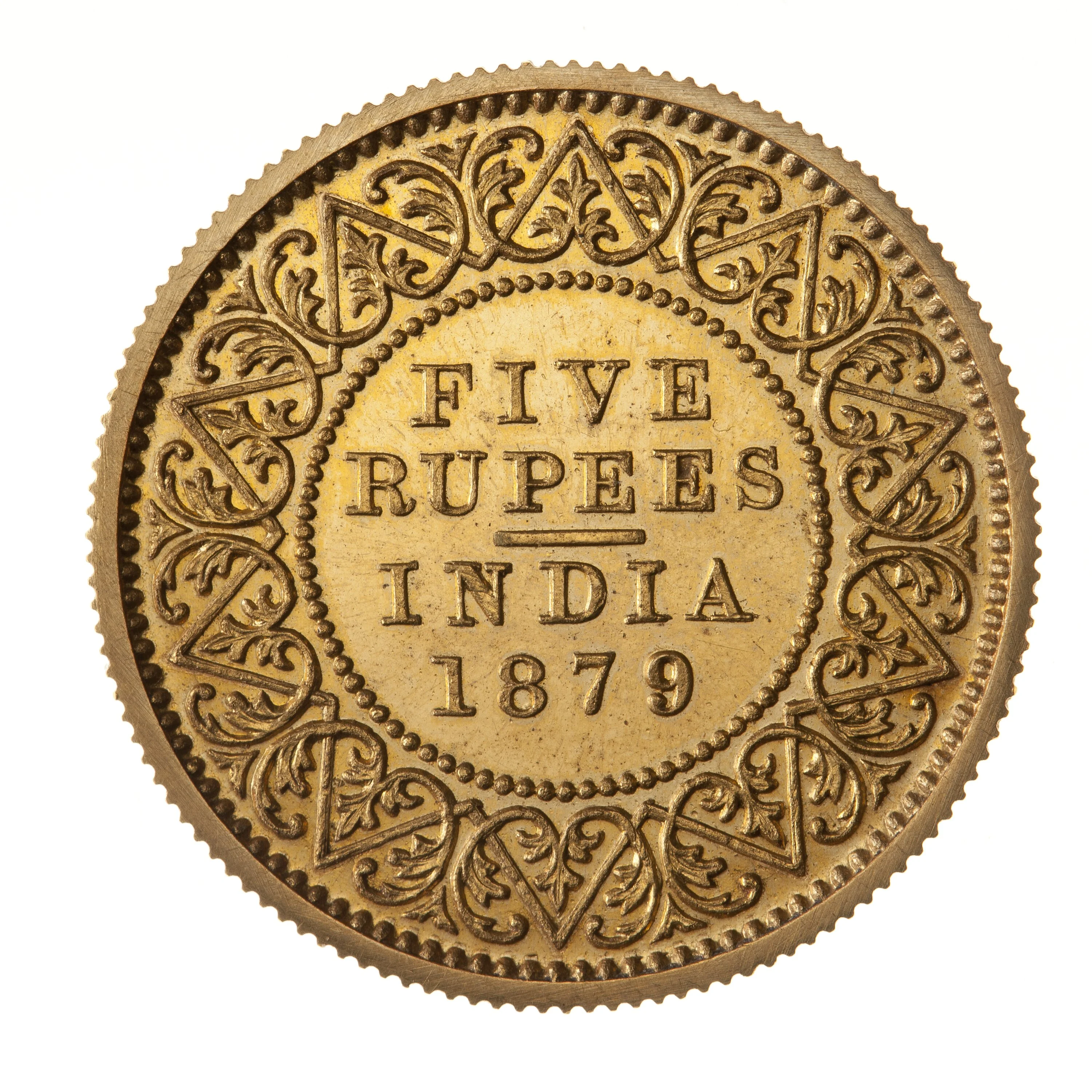
Year: 1879
Country: India 
Issuer: India - British
Ruler: Victoria
Currency:
(1770—1947)
Demonetized: Yes
Material
References
KM: #Click to copy to clipboard493
Numista: #25931
Value
Bullion value: $594.23
Obverse
Description:
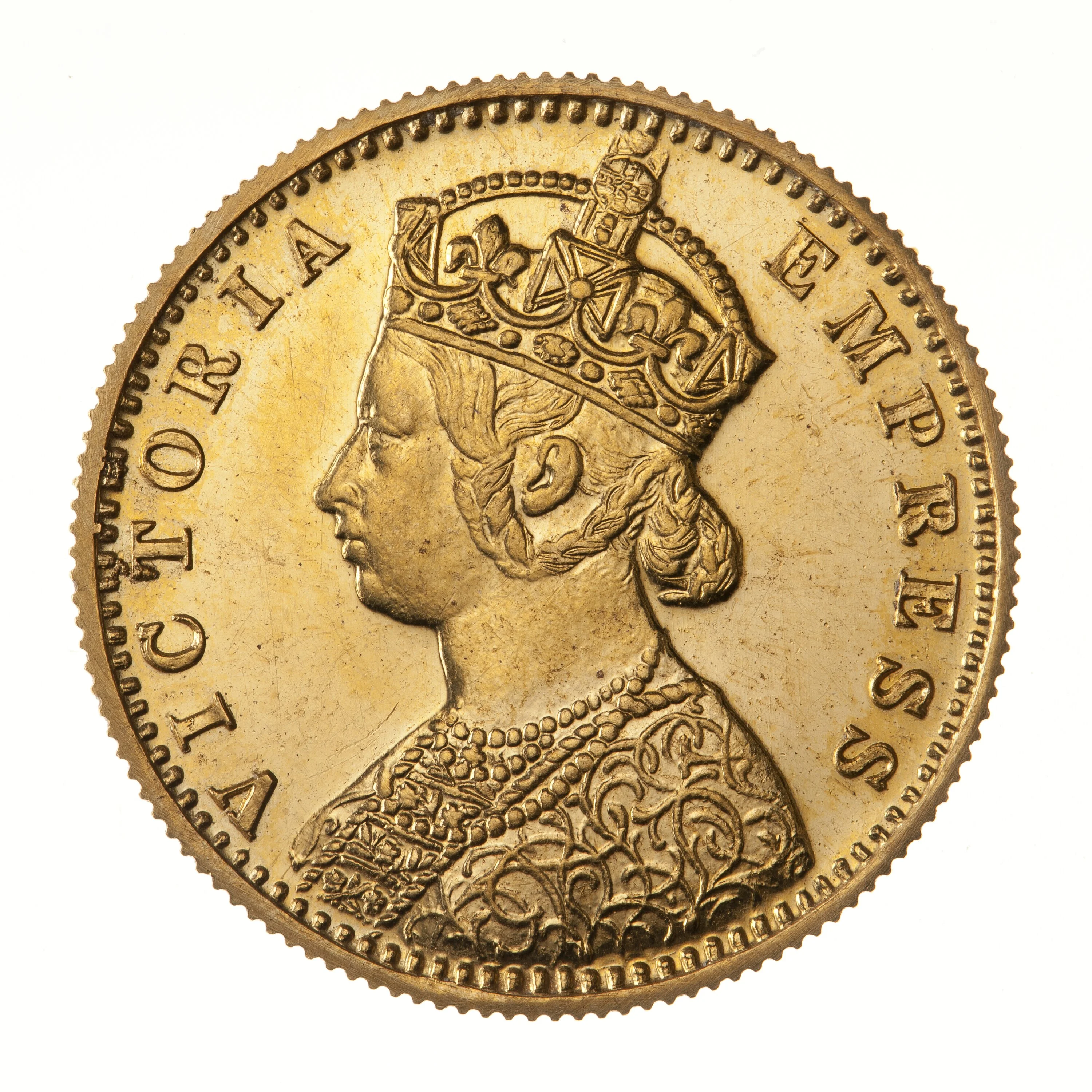
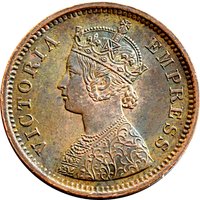
Portrait of Empress Victoria in left profile.
Inscription:
VICTORIA EMPRESS
Script: Latin
Engraver: William Wyon
Reverse
Edge
Mintings
| Year | Mint Mark | Mintage | Quality | Collection |
|---|---|---|---|---|
| 1879 | — | — |
Historical background
By 1879, the currency situation in British India was defined by a complex and often unstable transition towards a unified gold-exchange standard, though the rupee remained a silver-based coin. The global phenomenon of the "fall of the rupee" was the dominant crisis, driven by the dramatic depreciation of silver on the international market following increased production and Germany's shift to the gold standard. As the rupee's external value plummeted, it severely increased the cost of India's "Home Charges" (payments to Britain for administration, debt, and military costs) and caused economic uncertainty for European merchants and the colonial government, whose sterling obligations became more expensive to meet.
The government's response, led by the Lytton administration, was the controversial Currency Act of 1878, which came into force in 1879. This legislation officially closed the Indian mints to the free coinage of silver for private individuals, effectively demonetising the bullion value of the metal. The goal was to arrest the rupee's decline by limiting its supply and pegging its value artificially. However, the Act did not establish a fixed gold standard; instead, it created a "managed" currency where the government promised to issue rupees in exchange for gold at a fixed rate of 1 rupee = 1 shilling 4 pence (or £1 = 15 rupees), while still selling council bills (used to remit funds to London) for silver at market rates. This created a dual system that was confusing and not fully effective in immediately stabilising the exchange rate.
Consequently, in 1879, India found itself in a transitional and precarious monetary limbo. The rupee's value was now partially government-managed rather than purely market-determined by its silver content, but confidence was low. The system placed immense strain on the Secretary of State for India's treasury in London and failed to provide immediate relief from exchange volatility. This unsatisfactory interim arrangement would ultimately pave the way for the more definitive Fowler Committee of 1898 and the full-fledged gold-exchange standard of the early 20th century, making the late 1870s a period of acute financial strain and pivotal policy change.
The government's response, led by the Lytton administration, was the controversial Currency Act of 1878, which came into force in 1879. This legislation officially closed the Indian mints to the free coinage of silver for private individuals, effectively demonetising the bullion value of the metal. The goal was to arrest the rupee's decline by limiting its supply and pegging its value artificially. However, the Act did not establish a fixed gold standard; instead, it created a "managed" currency where the government promised to issue rupees in exchange for gold at a fixed rate of 1 rupee = 1 shilling 4 pence (or £1 = 15 rupees), while still selling council bills (used to remit funds to London) for silver at market rates. This created a dual system that was confusing and not fully effective in immediately stabilising the exchange rate.
Consequently, in 1879, India found itself in a transitional and precarious monetary limbo. The rupee's value was now partially government-managed rather than purely market-determined by its silver content, but confidence was low. The system placed immense strain on the Secretary of State for India's treasury in London and failed to provide immediate relief from exchange volatility. This unsatisfactory interim arrangement would ultimately pave the way for the more definitive Fowler Committee of 1898 and the full-fledged gold-exchange standard of the early 20th century, making the late 1870s a period of acute financial strain and pivotal policy change.
✨ Legendary