

½ Paisa – India - British
India
Context
Years: 1885–1901
Country: India 
Issuer: India - British
Ruler: Victoria
Currency:
(1770—1947)
Demonetized: Yes
Total mintage: 126,004,074
Material
References
KM: #Click to copy to clipboard484
Numista: #17534
Obverse
Description:
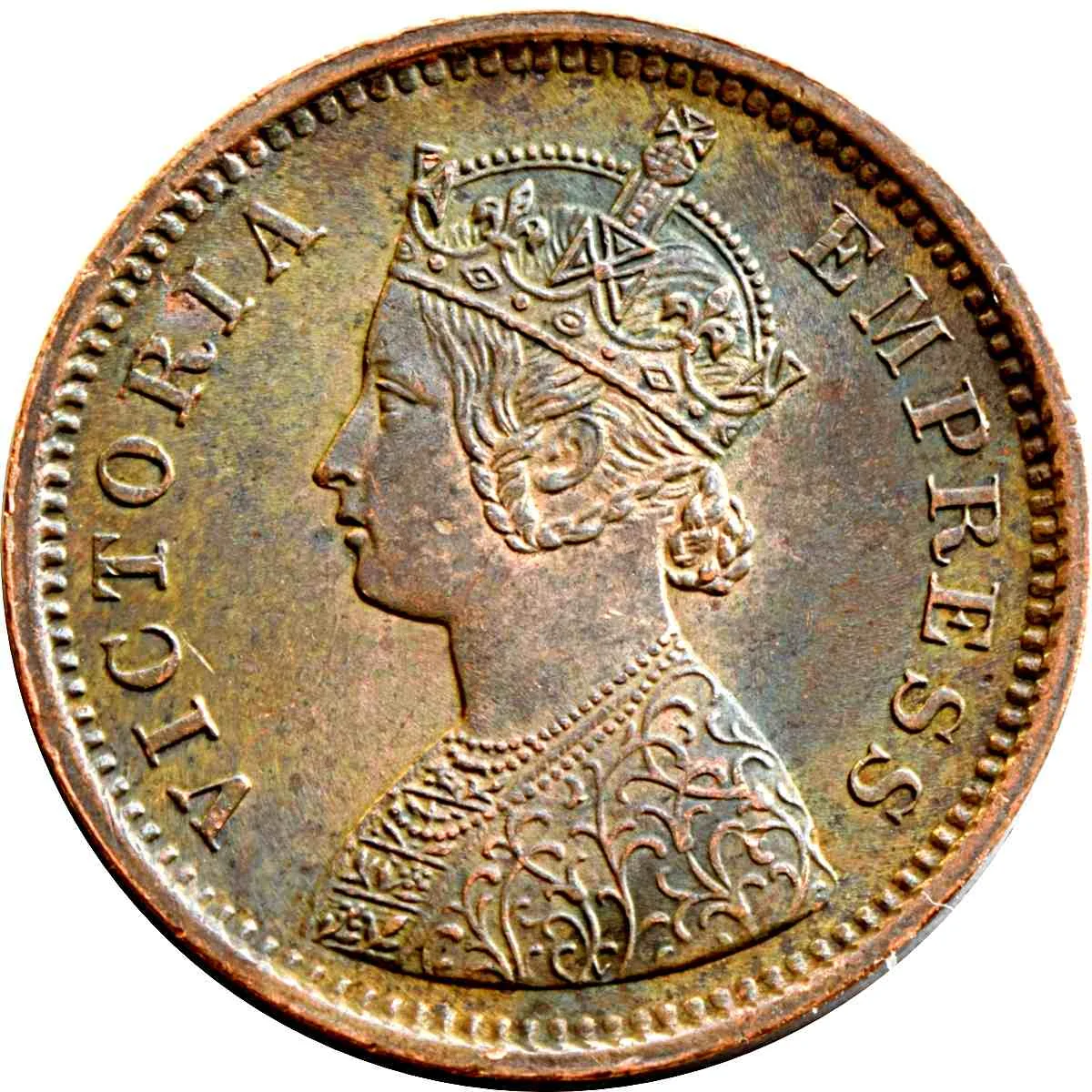
Crowned left-facing portrait, split legend, toothed rim.
Inscription:
VICTORIA EMPRESS
Script: Latin
Engraver: William Wyon
Reverse
Description:
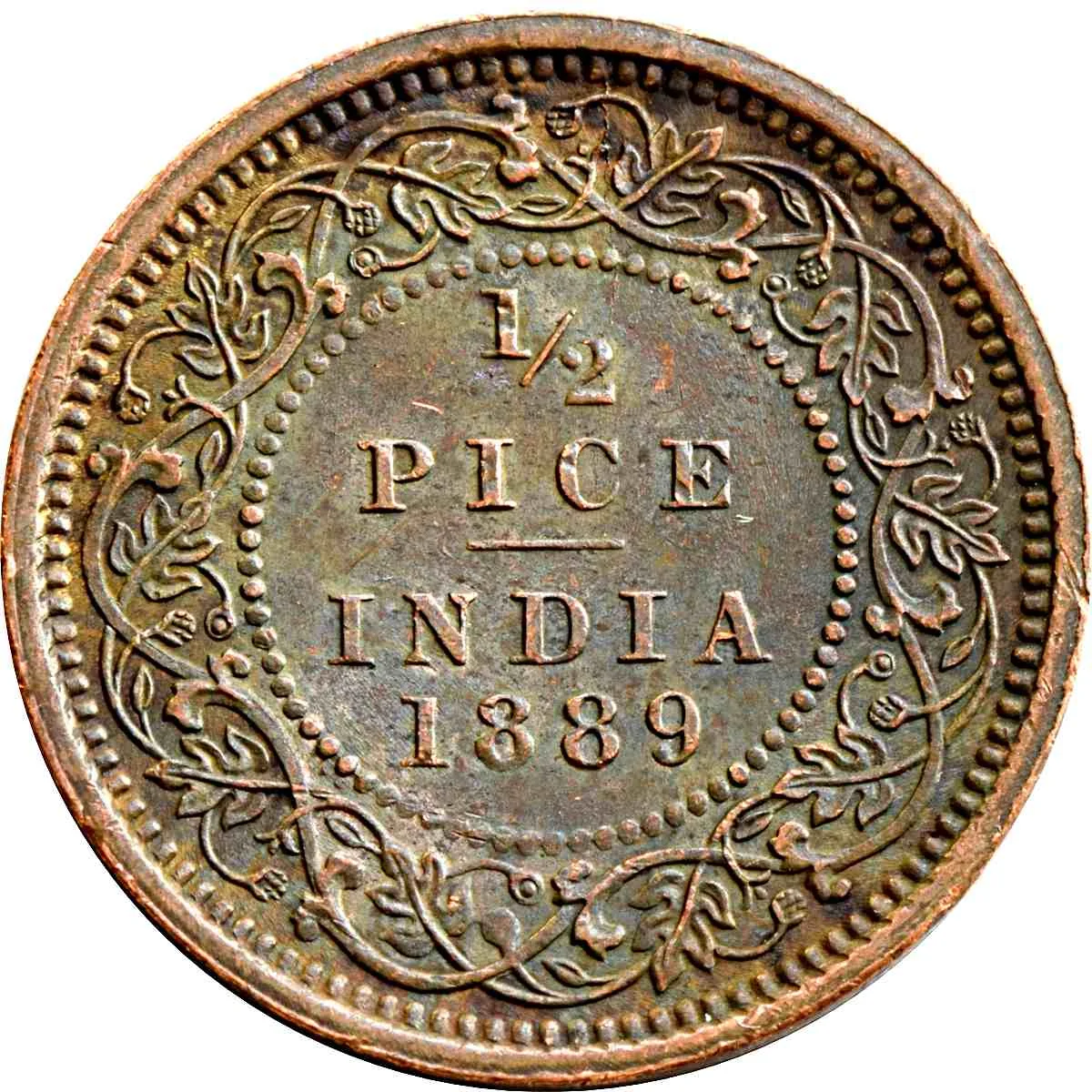
Central beaded circle with value above, dividing line, then country and date. Ornate leaves and toothed rim surround.
Inscription:
1/2
PICE
INDIA
1889
PICE
INDIA
1889
Script: Latin
Edge
Plain
Mintings
| Year | Mint Mark | Mintage | Quality | Collection |
|---|---|---|---|---|
| 1885 | — | 6,205,840 | ||
| 1886 | — | 7,733,430 | ||
| 1887 | — | 6,464,053 | ||
| 1888 | — | 3,190,351 | ||
| 1889 | — | 7,587,200 | ||
| 1890 | — | 3,504,000 | ||
| 1891 | — | 5,139,262 | ||
| 1892 | — | 4,774,338 | ||
| 1893 | — | 7,004,800 | ||
| 1894 | — | 7,776,882 | ||
| 1895 | — | 9,873,826 | ||
| 1896 | — | 6,113,374 | ||
| 1897 | — | 8,483,515 | ||
| 1898 | — | 12,940,403 | ||
| 1899 | — | 7,936,000 | ||
| 1900 | — | 5,219,900 | ||
| 1901 | — | 16,056,900 |
Historical background
In 1885, the currency situation in British India was a complex and hybrid system, primarily operating on a silver standard but under severe strain. The official currency was the silver rupee, minted by the government, with the British gold sovereign also declared legal tender at a fixed rate of 1 sovereign to 15 rupees. However, this bimetallic system was unstable in practice. The late 19th century saw a dramatic global decline in the value of silver relative to gold, causing the rupee's exchange value against sterling to fall steadily. This created a significant financial problem for the Government of India, which had to make substantial "Home Charges" payments in gold to Britain for services like railway construction and pensions, while its revenue was collected in depreciating silver rupees.
The falling rupee exacerbated economic tensions and became a central political issue, coinciding with the founding of the Indian National Congress in 1885. The colonial administration, seeking fiscal stability, favoured moving towards a gold exchange standard to secure its financial obligations. This intention was deeply controversial, as Indian nationalists and export-oriented businesses (like tea and jute) benefited from a cheaper rupee, while importers and the government faced higher costs. The period was thus marked by intense official debates and commissions, most notably the Herschell Committee (1892), which would later recommend closing the Indian mints to the free coinage of silver—a pivotal move towards the eventual gold standard.
Consequently, the monetary landscape of 1885 was one of transition and uncertainty. The currency was effectively on a managed silver standard with a weakening exchange rate, causing budgetary distress for the state and influencing trade dynamics. The situation pitted the colonial government's need for fiscal predictability against the interests of various sections of the Indian economy, setting the stage for major monetary reforms in the 1890s that would fundamentally alter India's financial relationship with the British Empire.
The falling rupee exacerbated economic tensions and became a central political issue, coinciding with the founding of the Indian National Congress in 1885. The colonial administration, seeking fiscal stability, favoured moving towards a gold exchange standard to secure its financial obligations. This intention was deeply controversial, as Indian nationalists and export-oriented businesses (like tea and jute) benefited from a cheaper rupee, while importers and the government faced higher costs. The period was thus marked by intense official debates and commissions, most notably the Herschell Committee (1892), which would later recommend closing the Indian mints to the free coinage of silver—a pivotal move towards the eventual gold standard.
Consequently, the monetary landscape of 1885 was one of transition and uncertainty. The currency was effectively on a managed silver standard with a weakening exchange rate, causing budgetary distress for the state and influencing trade dynamics. The situation pitted the colonial government's need for fiscal predictability against the interests of various sections of the Indian economy, setting the stage for major monetary reforms in the 1890s that would fundamentally alter India's financial relationship with the British Empire.
🌱 Common