

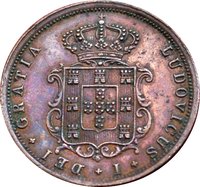
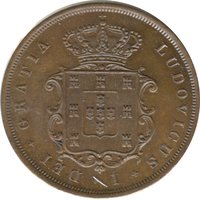
Obverse
Description:
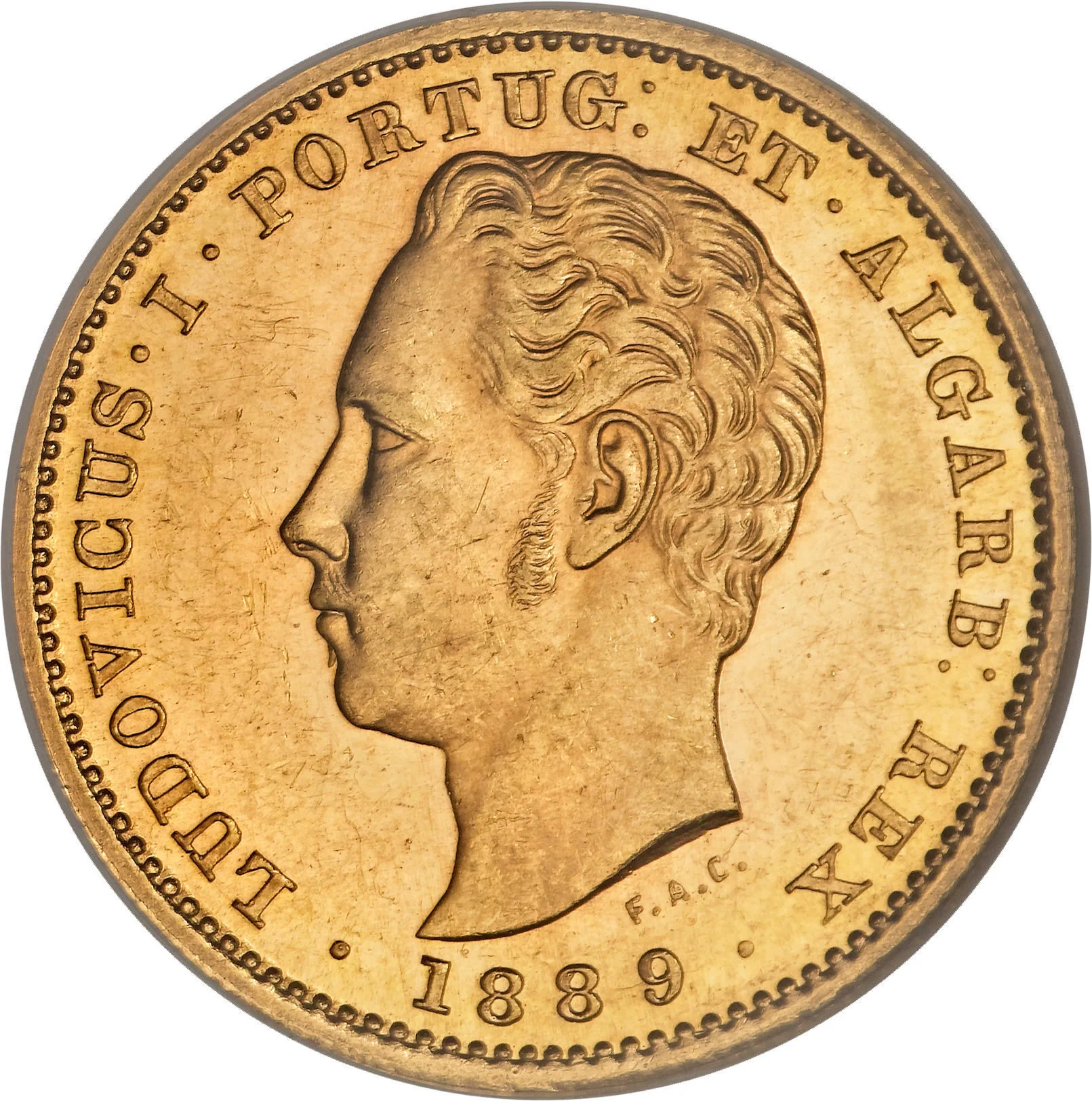
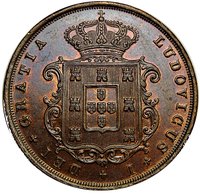
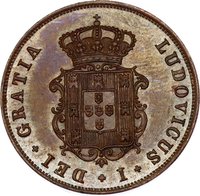
Portrait of Luís I of Portugal.
Inscription:
LUDOVICUS·I·PORTUG: ET·ALGARB: REX
F.A.C.
· 1889 ·
F.A.C.
· 1889 ·
Translation:
Louis I of Portugal and the Algarve, King
By the Grace of God, Faithful King
1889
By the Grace of God, Faithful King
1889
Script: Latin
Languages: Portuguese, Latin
Engraver: Frederico Augusto de Campos
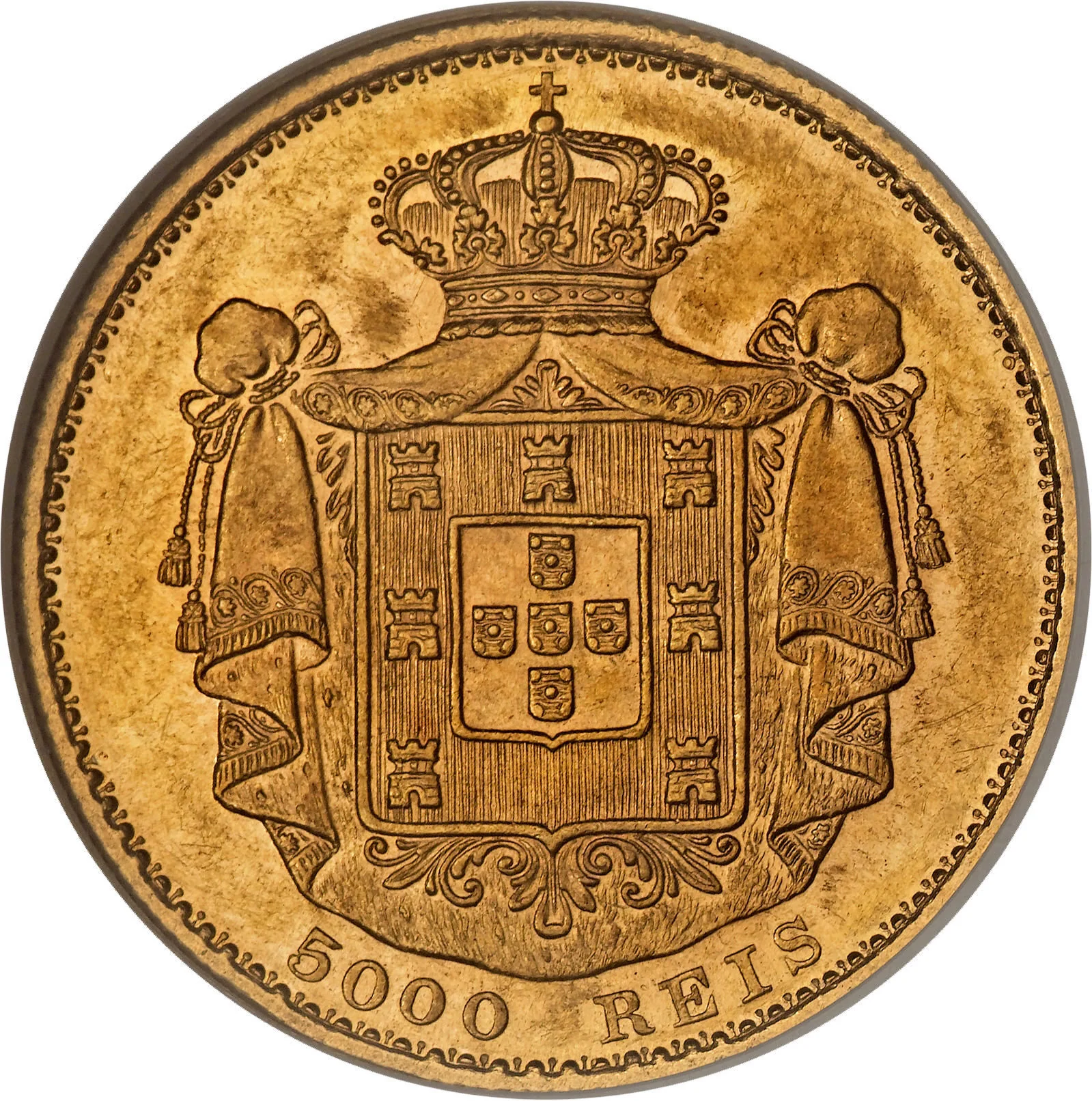
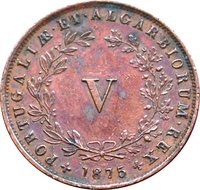
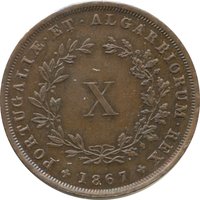
Reverse
Edge
Reeded
Mints
| Name | Mark |
|---|---|
| Imprensa Nacional - Casa da Moeda | — |
Mintings
| Year | Mint Mark | Mintage | Quality | Collection |
|---|---|---|---|---|
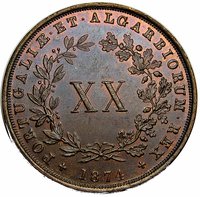
| 1867 | — | 45,000 | ||
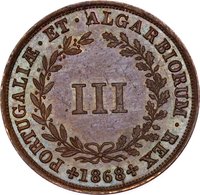
| 1868 | — | 64,000 | ||
| 1869 | — | 77,000 | ||
| 1870 | — | 61,000 | ||
| 1871 | — | 47,000 | ||
| 1872 | — | 28,000 | ||
| 1874 | — | 6,800 | ||
| 1875 | — | 10,000 | ||
| 1876 | — | 15,000 | ||
| 1877 | — | 9,400 | ||
| 1878 | — | 8,400 | ||
| 1880 | — | 7,000 | ||
| 1883 | — | 23,000 | ||
| 1886 | — | 27,000 | ||
| 1887 | — | 44,000 | ||
| 1888 | — | 4,800 | ||
| 1889 | — | 9,000 | ||
| 1889 | — | — | Proof |
Historical background
In 1867, Portugal's currency situation was characterized by a complex and often unstable system, transitioning from a bimetallic standard to a de facto gold standard. The monetary unit was the real (plural: réis), but transactions were often denoted in the higher unit of milréis (1,000 réis). The legal framework was the 1854 law, which adopted a bimetallic system of gold and silver but with a fixed ratio that failed to reflect global market prices, leading to the gradual disappearance of full-bodied gold coinage from circulation due to Gresham's Law. Consequently, the most commonly used coins were silver and, especially, low-value copper coins, while paper money issued by the Banco de Portugal (founded 1846) was gaining prominence but still faced some public skepticism.
This period was one of fiscal strain and debt, placing pressure on the currency. The state's chronic budget deficits, exacerbated by extensive public works and colonial expenses, led to heavy borrowing. The money supply was influenced as much by government debt operations with the Banco de Portugal as by economic activity, creating inflationary risks. Furthermore, Portugal was part of the Latin Monetary Union in principle (having adhered in 1865), which aimed to standardize coinage across several European nations. However, Portugal struggled to fully comply with the Union's standards, as its silver coins often had a lower intrinsic value than their face value, limiting their acceptance abroad.
Overall, the currency scenario in 1867 reflected a nation modernizing its financial systems while grappling with legacy issues. The push towards the gold standard and international monetary integration was evident, but it was constrained by fiscal weaknesses and a circulating medium comprised of undervalued silver, abundant copper, and an expanding but not yet fully trusted paper currency. This precarious balance highlighted the broader economic challenges of the Portuguese monarchy in the latter half of the 19th century.
This period was one of fiscal strain and debt, placing pressure on the currency. The state's chronic budget deficits, exacerbated by extensive public works and colonial expenses, led to heavy borrowing. The money supply was influenced as much by government debt operations with the Banco de Portugal as by economic activity, creating inflationary risks. Furthermore, Portugal was part of the Latin Monetary Union in principle (having adhered in 1865), which aimed to standardize coinage across several European nations. However, Portugal struggled to fully comply with the Union's standards, as its silver coins often had a lower intrinsic value than their face value, limiting their acceptance abroad.
Overall, the currency scenario in 1867 reflected a nation modernizing its financial systems while grappling with legacy issues. The push towards the gold standard and international monetary integration was evident, but it was constrained by fiscal weaknesses and a circulating medium comprised of undervalued silver, abundant copper, and an expanding but not yet fully trusted paper currency. This precarious balance highlighted the broader economic challenges of the Portuguese monarchy in the latter half of the 19th century.
Series: 1867 Portugal circulation coins
⭐ Rare