


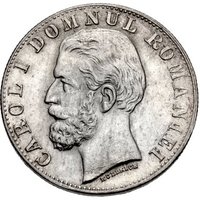
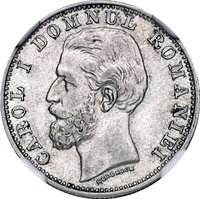
Obverse
Description:
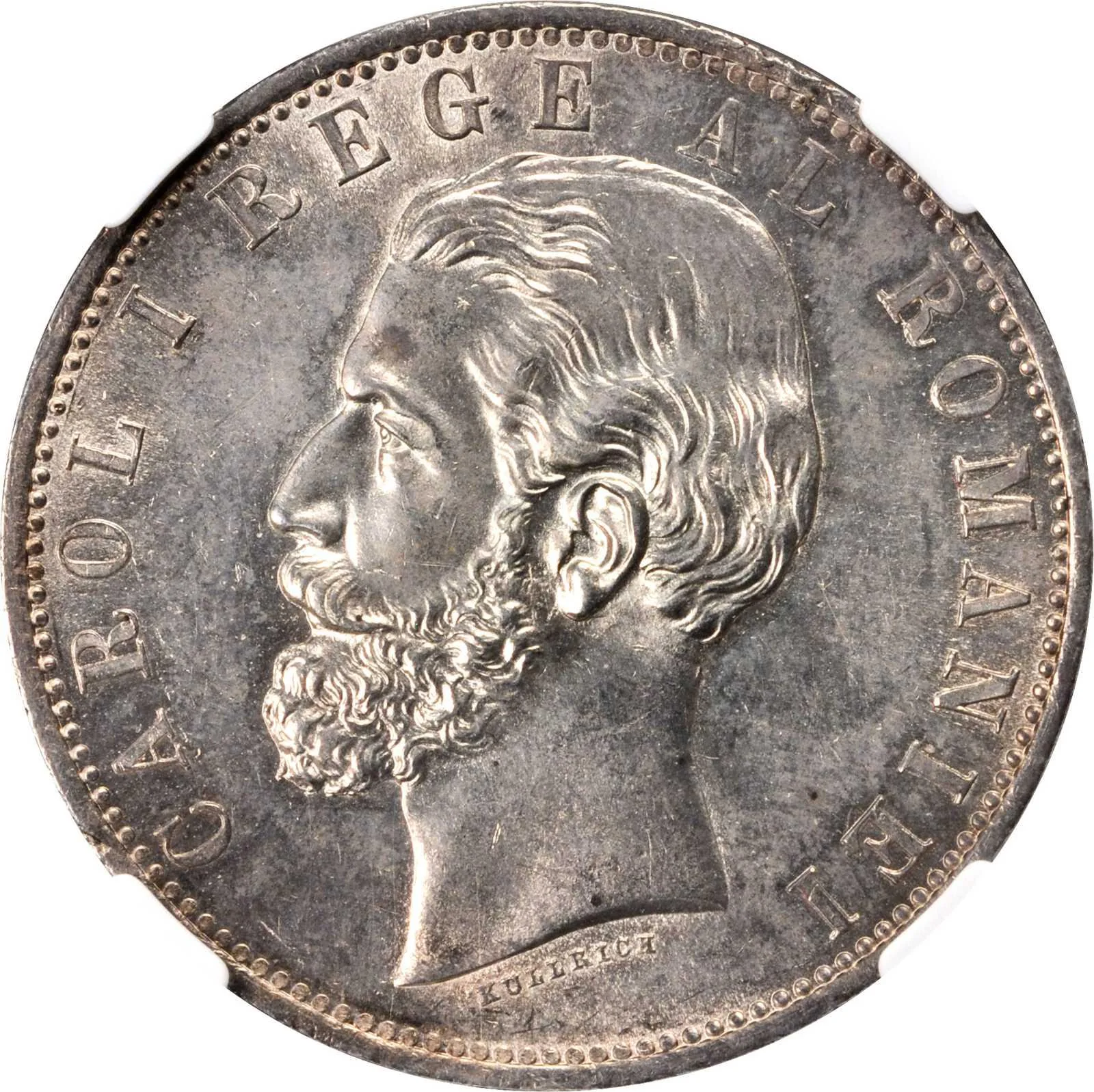
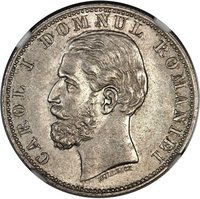
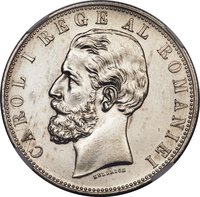
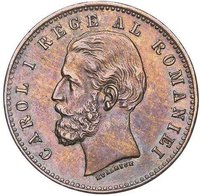
Carol I bust, left-facing.
Inscription:
CAROL I REGE AL ROMANIEI
KULLRICH
KULLRICH
Translation:
CAROL I KING OF ROMANIA
KULLRICH
KULLRICH
Script: Latin
Engraver: Friedrich Wilhelm Kullrich
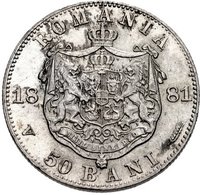
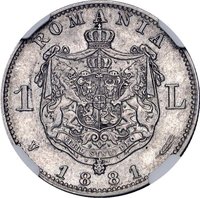
Reverse
Edge
Categories
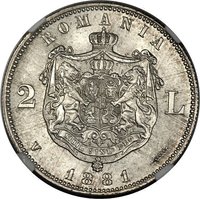
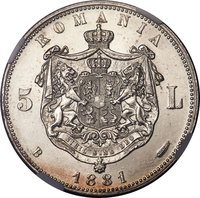
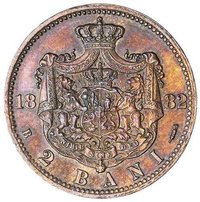
| Symbols> Coat of Arms |
| Person> Monarch |
Mints
| Name | Mark |
|---|---|
| Hamburgische Münze | B |
| State Mint | B |
Mintings
Historical background
In 1881, Romania’s currency situation was characterized by a complex and unstable system, heavily influenced by the nation's recent political elevation to a kingdom. The official currency was the Romanian Leu (plural: Lei), but the economy operated on a bimetallic standard of silver and gold, as formalized by the Latin Monetary Union treaties which Romania had joined in 1867. However, the reality was far from unified; a multitude of foreign coins, particularly French, Turkish, Russian, and Austrian, circulated freely alongside domestic issues, leading to confusion in everyday transactions and commercial accounting.
This monetary fragmentation was a direct legacy of Romania's history as the Ottoman vassal principalities of Moldavia and Wallachia, which had long used a mix of currencies from their dominant trading partners. Following unification and independence, the government struggled to assert a single, trusted national currency. A significant problem was the chronic shortage of state-minted coinage, which forced reliance on foreign specie. Furthermore, the value of the leu was not particularly strong, and the country lacked a central bank (the National Bank of Romania would not be founded until 1880 and began operations in 1881), which limited control over monetary policy and credit.
Therefore, the year 1881 stands at a pivotal point of transition. The establishment of the National Bank that year was a critical step toward modernizing the financial system, with the goal of issuing a stable, uniform national currency and phasing out foreign coinage. The challenges were immense, requiring the bank to build public confidence, manage the state's debt, and navigate the complexities of the international gold standard, all while supporting the economic development of the new kingdom. The currency situation was thus a microcosm of Romania's broader struggle to consolidate its sovereignty and integrate into the European economic order.
This monetary fragmentation was a direct legacy of Romania's history as the Ottoman vassal principalities of Moldavia and Wallachia, which had long used a mix of currencies from their dominant trading partners. Following unification and independence, the government struggled to assert a single, trusted national currency. A significant problem was the chronic shortage of state-minted coinage, which forced reliance on foreign specie. Furthermore, the value of the leu was not particularly strong, and the country lacked a central bank (the National Bank of Romania would not be founded until 1880 and began operations in 1881), which limited control over monetary policy and credit.
Therefore, the year 1881 stands at a pivotal point of transition. The establishment of the National Bank that year was a critical step toward modernizing the financial system, with the goal of issuing a stable, uniform national currency and phasing out foreign coinage. The challenges were immense, requiring the bank to build public confidence, manage the state's debt, and navigate the complexities of the international gold standard, all while supporting the economic development of the new kingdom. The currency situation was thus a microcosm of Romania's broader struggle to consolidate its sovereignty and integrate into the European economic order.
Series: 1881 Romania circulation coins
🌱 Fairly Common