

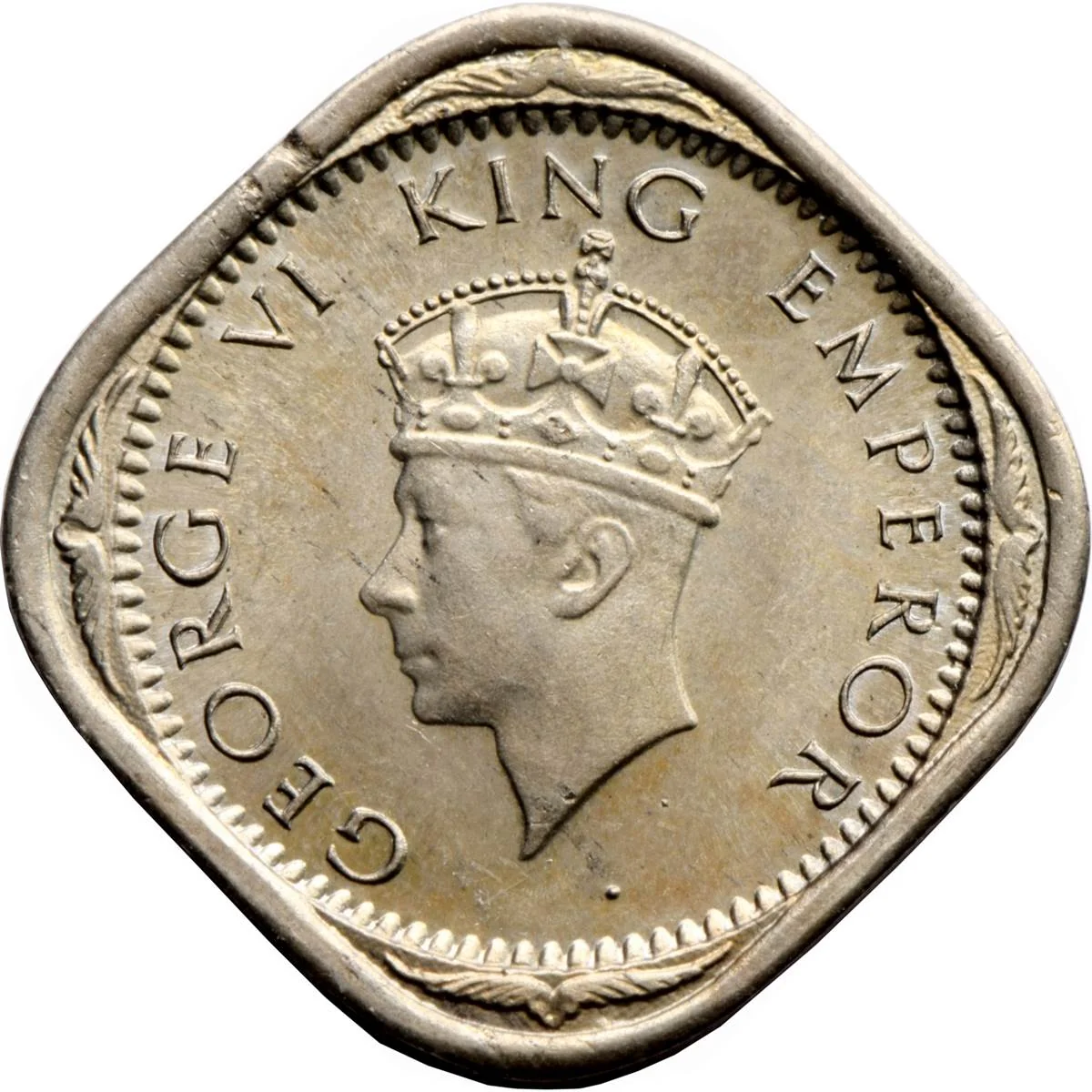
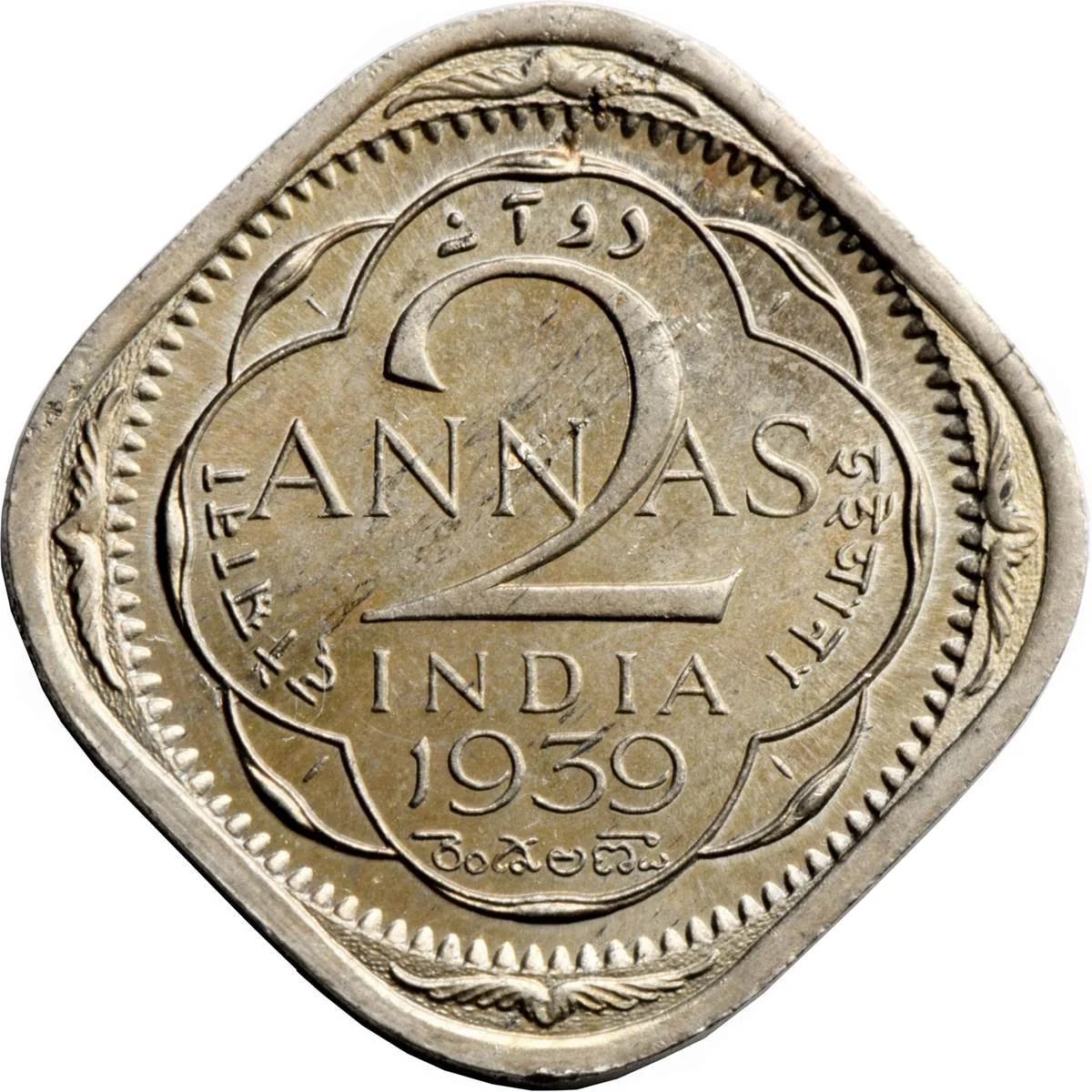
2 Annas – India - British
India
Context
Years: 1939–1940
Country: India 
Issuer: India - British
Ruler: George VI
Currency:
(1770—1947)
Demonetized: Yes
Total mintage: 7,540,309
Material
Weight: 5.84 g
Thickness: 1.7 mm
Shape: Square with rounded corners
Composition: Copper-nickel
Technique: Milled
Alignment: Medal alignment
flip
References
KM: #Click to copy to clipboard540
Numista: #25398
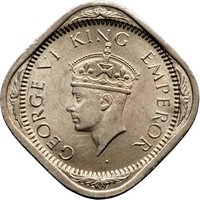
Obverse
Description:
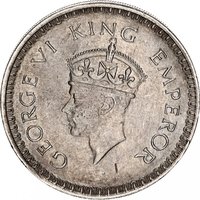
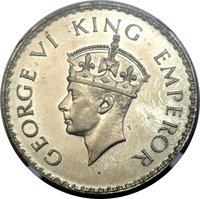
King George VI crowned, left profile, English legend.
Inscription:
GEORGE VI KING EMPEROR
Translation:
GEORGE VI KING EMPEROR
Language: English
Engraver: Percy Metcalfe
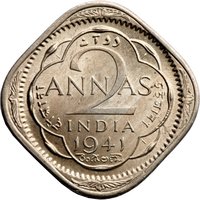
Reverse
Edge
Plain
Mintings
| Year | Mint Mark | Mintage | Quality | Collection |
|---|---|---|---|---|
| 1939 | — | 4,148,000 | ||
| 1939 | • | 3,392,309 | ||
| 1940 | — | — | ||
| 1940 | • | — |
Historical background
By 1939, the currency situation in British India was a managed system firmly under the control of the colonial government, designed to serve imperial economic and strategic interests. The rupee was not freely convertible but was linked to the British Pound Sterling through a "sterling exchange standard." The Reserve Bank of India (RBI), established in 1935, held the country's foreign exchange reserves predominantly in sterling in London. The rupee's value was effectively fixed at 1 shilling 6 pence (1s 6d), meaning India’s currency and credit system was intrinsically tied to Britain's financial fortunes.
This arrangement heavily favored British economic priorities, particularly the need to manage India's large sterling balances—accumulated through export surpluses and wartime expenditures—which were crucial for financing the UK's own deficits. The system ensured that India’s vast resources were readily available to support the metropolitan economy, especially with the outbreak of World War II in September 1939. Immediately upon the declaration of war, the colonial government passed the Defence of India Rules, imposing strict capital controls and formally pegging the rupee to sterling at 1s 6d, making all outward payments subject to government approval.
Consequently, India’s currency mechanism was primed to function as a critical financial pillar for the British war effort. The fixed exchange rate and controlled system facilitated the automatic financing of UK war purchases in India, leading to the massive accumulation of sterling credits (the "Sterling Balances") in London. This locked India's economic fate to Britain's wartime needs, creating a forced savings scenario that would fuel inflation and post-war economic debates about sovereignty and debt, while ensuring that Indian resources flowed seamlessly into the Allied campaign.
This arrangement heavily favored British economic priorities, particularly the need to manage India's large sterling balances—accumulated through export surpluses and wartime expenditures—which were crucial for financing the UK's own deficits. The system ensured that India’s vast resources were readily available to support the metropolitan economy, especially with the outbreak of World War II in September 1939. Immediately upon the declaration of war, the colonial government passed the Defence of India Rules, imposing strict capital controls and formally pegging the rupee to sterling at 1s 6d, making all outward payments subject to government approval.
Consequently, India’s currency mechanism was primed to function as a critical financial pillar for the British war effort. The fixed exchange rate and controlled system facilitated the automatic financing of UK war purchases in India, leading to the massive accumulation of sterling credits (the "Sterling Balances") in London. This locked India's economic fate to Britain's wartime needs, creating a forced savings scenario that would fuel inflation and post-war economic debates about sovereignty and debt, while ensuring that Indian resources flowed seamlessly into the Allied campaign.
🌱 Common