

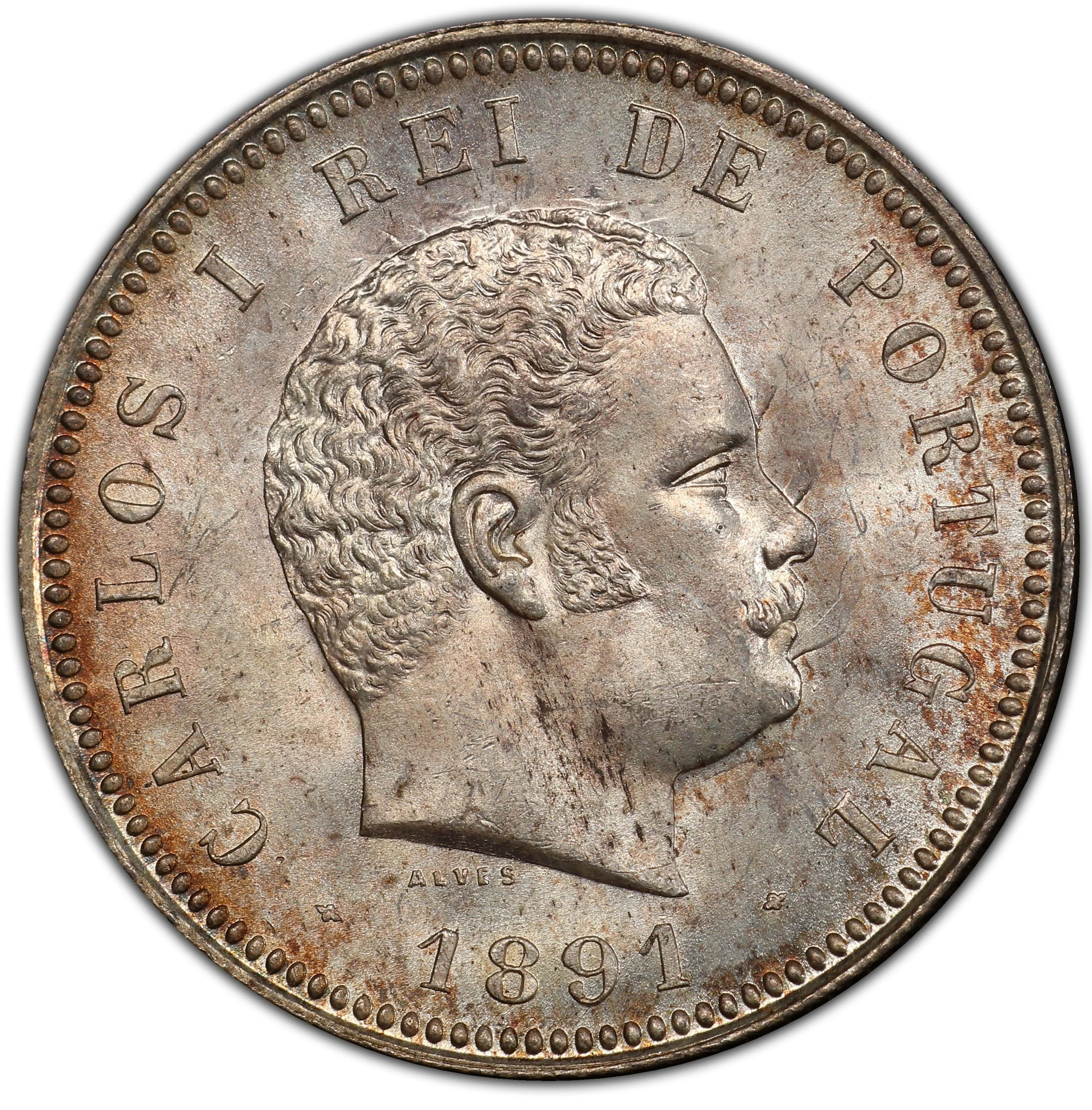
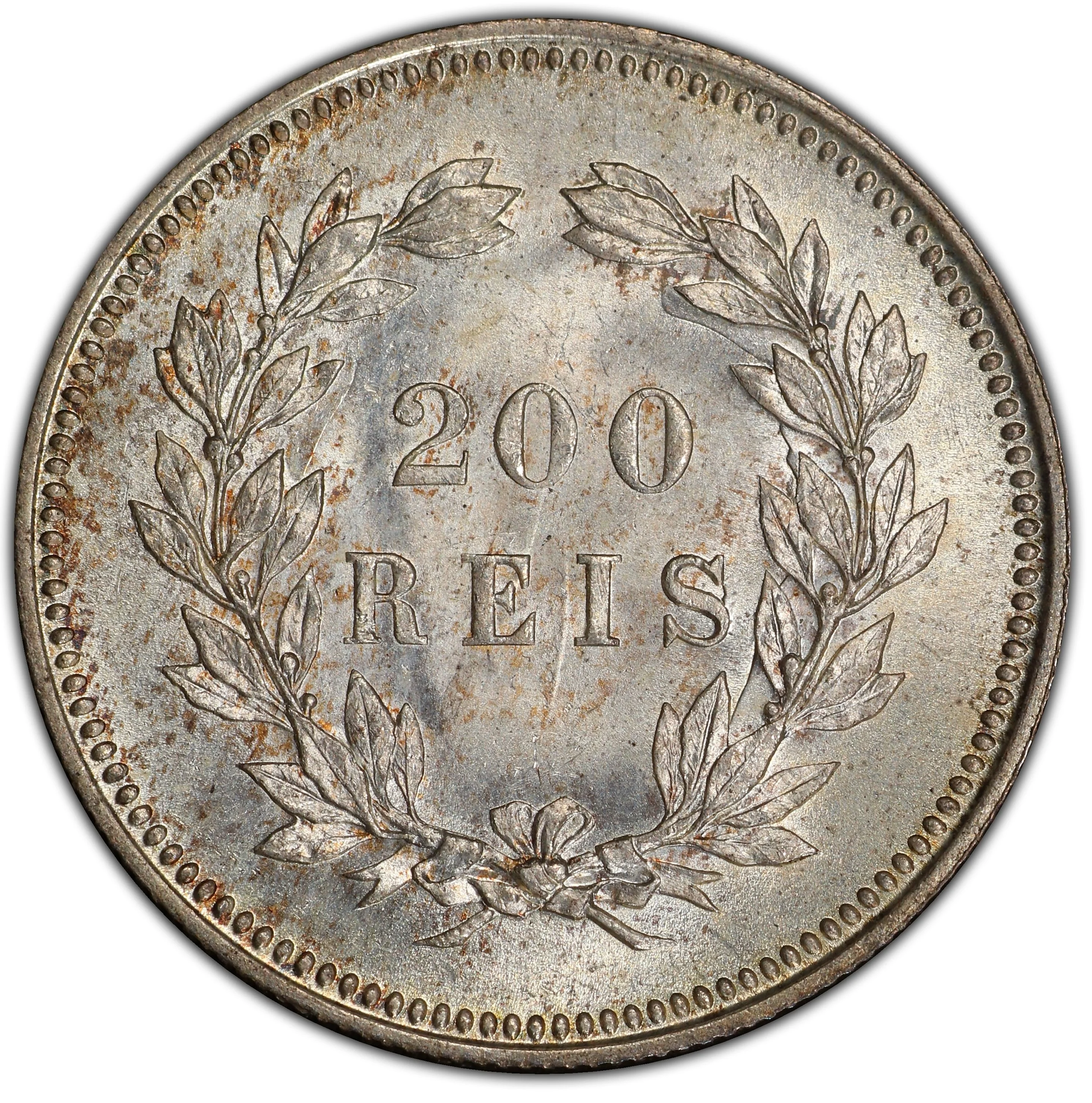
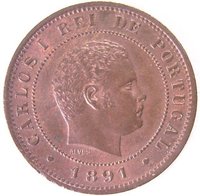
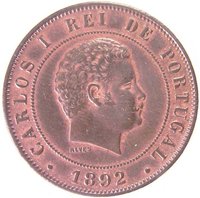
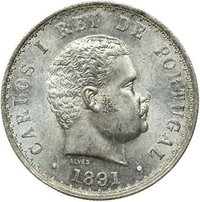
Obverse
Description:
Go right
Inscription:
CARLOS I REI DE PORTUGAL
ALVES
* 1891 *
ALVES
* 1891 *
Translation:
CARLOS I KING OF PORTUGAL
ALVES
* 1891 *
ALVES
* 1891 *
Script: Latin
Language: Portuguese
Engraver: Valancio Alves
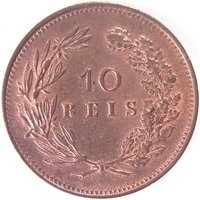
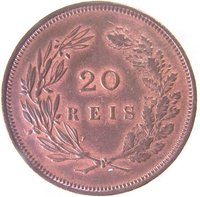
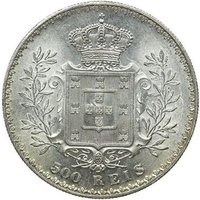
Reverse
Edge
Reeded
Mints
| Name | Mark |
|---|---|
| Imprensa Nacional - Casa da Moeda | — |
Mintings
| Year | Mint Mark | Mintage | Quality | Collection |
|---|---|---|---|---|
| 1891 | — | 2,365,000 | ||
| 1891 | — | — | Proof | |
| 1892 | — | 788,000 | ||
| 1893 | — | — | Proof | |
| 1893 | — | 1,205,000 | ||
| 1901 | — | — | ||
| 1903 | — | — |
Historical background
In 1891, Portugal faced a severe financial and currency crisis that stemmed from decades of economic mismanagement and structural weakness. The state was burdened by massive public debt, chronic budget deficits, and heavy reliance on foreign loans, particularly from Britain, to finance infrastructure projects and colonial ventures in Africa. This precarious position was exposed in January 1891 when the government, led by Prime Minister João Crisóstomo de Abreu e Sousa, failed to secure a critical loan from the House of Rothschild. This triggered a loss of international confidence, a run on gold reserves, and the effective bankruptcy of the Portuguese state.
The immediate consequence was the collapse of the country's gold standard regime. To halt the drain on its bullion, the Banco de Portugal (the central bank) suspended the convertibility of its banknotes into gold on January 9, 1891. This plunged the Portuguese currency into a state of fiduciary inconvertibility, meaning the escudo was now a fiat currency backed only by government decree rather than a metallic reserve. The value of the escudo plummeted on foreign exchange markets, leading to rampant inflation, a sharp rise in the cost of living, and a dramatic increase in the real burden of the country's foreign-denominated debt.
The 1891 crisis had profound and lasting political and economic repercussions. It led to public unrest, including a republican uprising in Porto later that same month, and eroded the legitimacy of the Portuguese monarchy. Economically, it marked the beginning of a long period of financial instability, currency depreciation, and protectionist policies. Portugal would not return to a form of the gold standard until the 1930s, and the crisis is widely seen as a pivotal event that accelerated the decline of the constitutional monarchy and set the stage for the republican revolution of 1910.
The immediate consequence was the collapse of the country's gold standard regime. To halt the drain on its bullion, the Banco de Portugal (the central bank) suspended the convertibility of its banknotes into gold on January 9, 1891. This plunged the Portuguese currency into a state of fiduciary inconvertibility, meaning the escudo was now a fiat currency backed only by government decree rather than a metallic reserve. The value of the escudo plummeted on foreign exchange markets, leading to rampant inflation, a sharp rise in the cost of living, and a dramatic increase in the real burden of the country's foreign-denominated debt.
The 1891 crisis had profound and lasting political and economic repercussions. It led to public unrest, including a republican uprising in Porto later that same month, and eroded the legitimacy of the Portuguese monarchy. Economically, it marked the beginning of a long period of financial instability, currency depreciation, and protectionist policies. Portugal would not return to a form of the gold standard until the 1930s, and the crisis is widely seen as a pivotal event that accelerated the decline of the constitutional monarchy and set the stage for the republican revolution of 1910.
Series: 1891 Portugal circulation coins
🌱 Fairly Common