

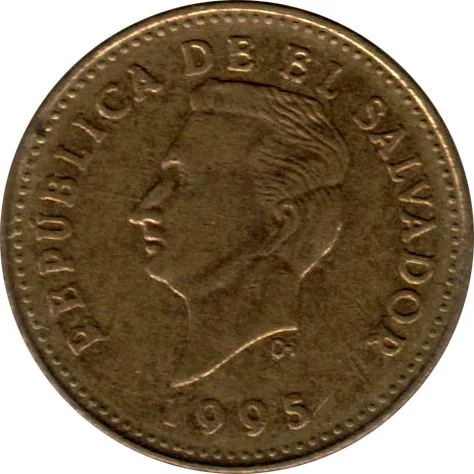
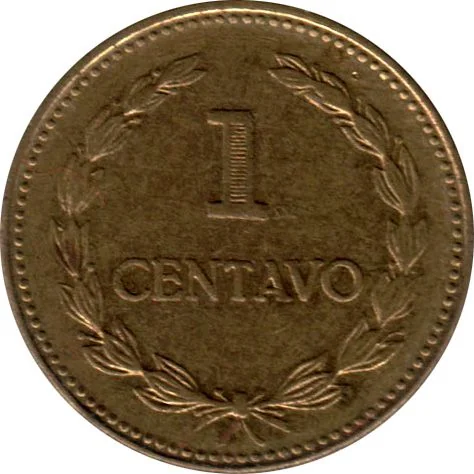
1 centavo – El Salvador
Add to wishlist
El Salvador
Context
Year: 1995
Issuer: El Salvador
Issuing organization: Central Reserve Bank of El Salvador
Period:
(since 1841)
Currency:
(since 1892)
Demonetization: 1 January 2001
Material
References
KM: #
Numista: #2525
Value
Exchange value: 0.01 SVC
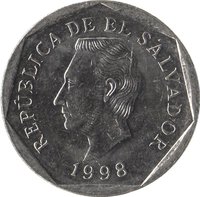
Obverse
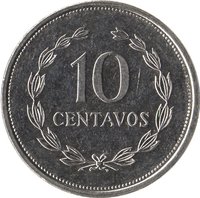
Reverse
Edge
Mints
| Name | Mark |
|---|---|
| Royal Mint | — |
Mintings
| Year | Mint Mark | Mintage | Quality | Collection |
|---|---|---|---|---|
| 1995 | — | — |
Historical background
In 1995, El Salvador's currency situation was defined by a period of transition and stability under a unique dual-system. The official currency was the colón, which had been historically pegged to the US dollar at a fixed rate of 8.75 colones to one dollar since 1994. This peg, managed by the Central Reserve Bank, was a cornerstone of economic policy aimed at controlling inflation and providing monetary stability after the turbulent years of civil war and high inflation in the 1980s.
Alongside the colón, the US dollar circulated widely and informally as a de facto parallel currency, especially for large transactions, real estate, and international trade. This unofficial dollarization was a pragmatic response by the population to past instability and reflected deep integration with the US economy through remittances and trade. Consequently, the economy operated with a high degree of de facto dollarization even before any legal change, creating a dual monetary environment where prices were often mentally calculated in both currencies.
The stability provided by the fixed exchange rate was a key achievement, but it also meant El Salvador had relinquished independent monetary policy, tying its economic fortunes closely to US Federal Reserve decisions. This period set the stage for the formal and complete dollarization that would follow six years later, in 2001, when the US dollar became the sole legal tender, effectively retiring the colón. The 1995 environment, therefore, represents the calm and consolidated prelude to that definitive monetary shift.
Alongside the colón, the US dollar circulated widely and informally as a de facto parallel currency, especially for large transactions, real estate, and international trade. This unofficial dollarization was a pragmatic response by the population to past instability and reflected deep integration with the US economy through remittances and trade. Consequently, the economy operated with a high degree of de facto dollarization even before any legal change, creating a dual monetary environment where prices were often mentally calculated in both currencies.
The stability provided by the fixed exchange rate was a key achievement, but it also meant El Salvador had relinquished independent monetary policy, tying its economic fortunes closely to US Federal Reserve decisions. This period set the stage for the formal and complete dollarization that would follow six years later, in 2001, when the US dollar became the sole legal tender, effectively retiring the colón. The 1995 environment, therefore, represents the calm and consolidated prelude to that definitive monetary shift.
🌱 Fairly Common