

20 Francs – France
France
Context
Year: 1815
Issuer: France 
Ruler: Napoleon I
Currency:
(1795—1959)
Demonetization: 25 June 1928
Total mintage: 463,124
Material
References
KM: #Click to copy to clipboard705
Numista: #25234
Value
Bullion value: $967.89
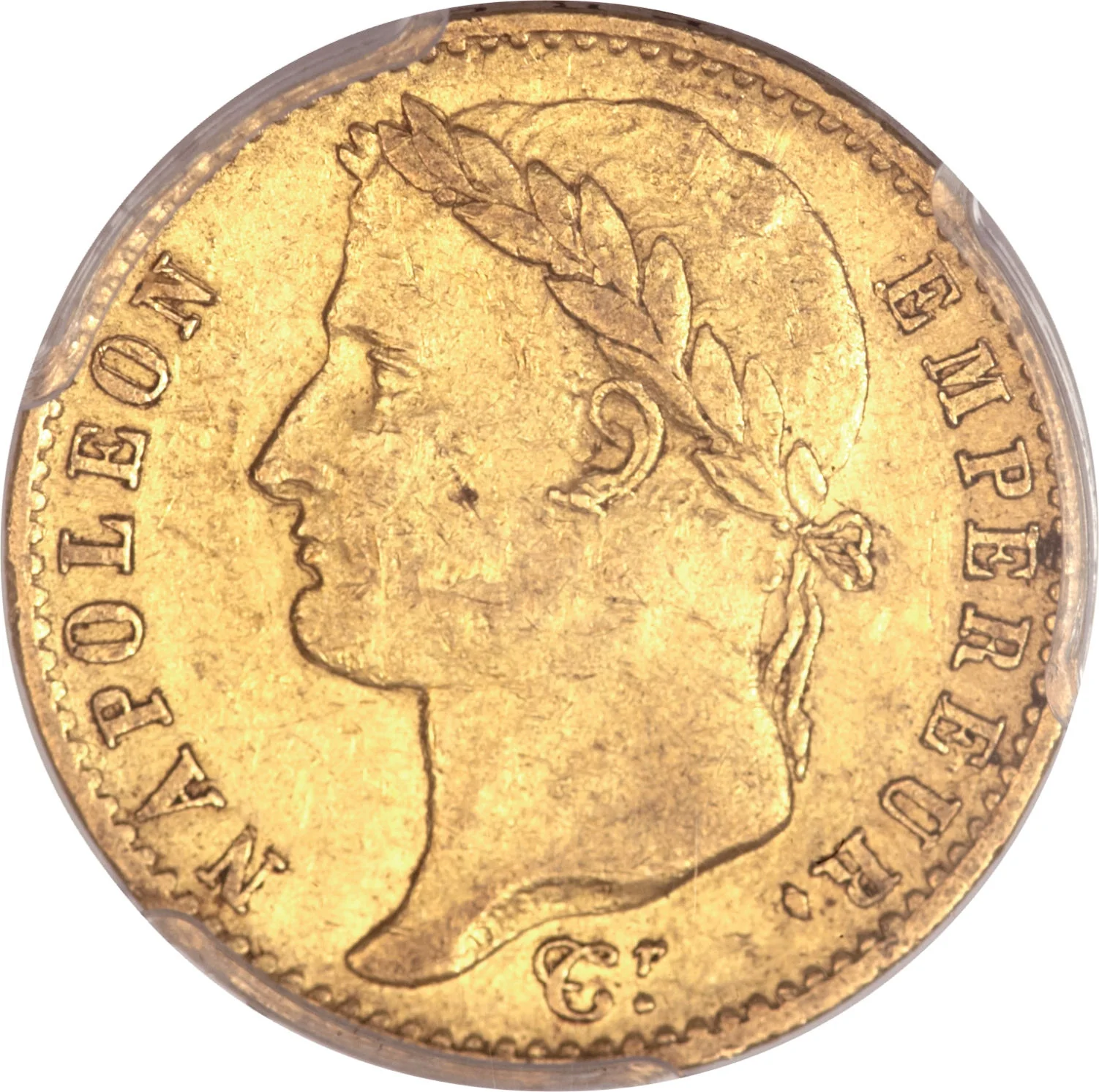
Obverse
Description:
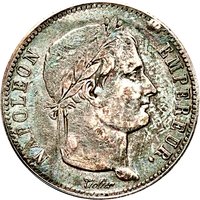
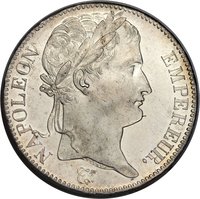
Napoleon I laureate head left; signed "DROZ F" on neck edge, "Tr." below in cursive.
Inscription:
NAPOLEON EMPEREUR.
Translation:
NAPOLEON EMPEROR.
Script: Latin
Language: French
Engravers: Jean-Pierre Droz, Pierre-Joseph Tiolier
Reverse
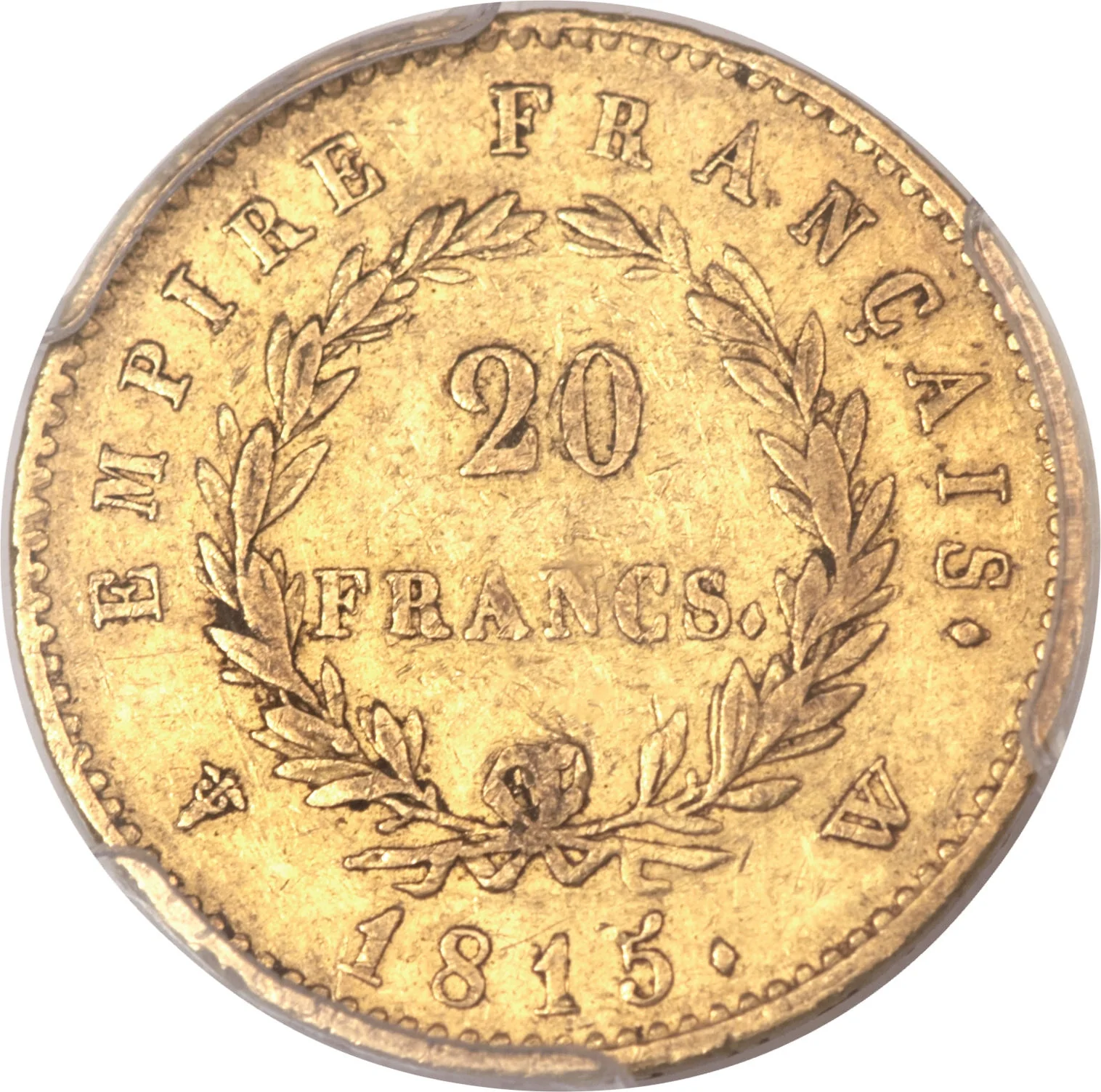
Description:
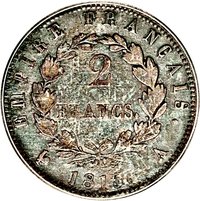
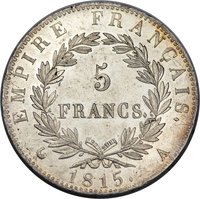
Within a laurel wreath. These coins were minted in 80 issues from April 1 to July 4, 1815. Strikes from 1815 use a slightly different matrix than those from 1809-1814.
Inscription:
EMPIRE FRANÇAIS.
20
FRANCS.
1815. A
20
FRANCS.
1815. A
Translation:
FRENCH EMPIRE.
20
FRANCS.
1815. A
20
FRANCS.
1815. A
Script: Latin
Language: French
Engravers: Jean-Pierre Droz, Pierre-Joseph Tiolier
Edge
Mints
| Name | Mark |
|---|---|
| Monnaie de Paris | A |
| Bayonne | L |
| Lille | W |
Historical background
Following the defeat of Napoleon in 1815, France faced a severe monetary crisis rooted in years of revolutionary and imperial finance. The currency system was a chaotic mix of depreciated paper assignats and mandats territoriaux from the 1790s, alongside silver and gold coinage. However, the most pressing issue was the immense public debt and a critical shortage of specie (hard currency), exacerbated by the massive war indemnities imposed by the victorious Allies at the Treaty of Paris, which demanded 700 million francs and the occupation of French territory until payment was made.
In response, King Louis XVIII's government, led by the Duc de Richelieu, prioritized monetary stabilization to restore domestic and international confidence. The monetary law of 1816 was pivotal, officially abandoning the bimetallic system in principle and establishing the franc germinal as the sole legal standard. This new franc was explicitly defined as containing 4.5 grams of fine silver, creating a stable, silver-based currency intended to be "as good as cash" and to facilitate the repayment of the war indemnity.
This return to a metallic standard, effectively a silver monometallism, successfully restored stability after decades of fluctuation. It provided the solid financial foundation necessary for the Bourbon Restoration, allowing France to raise loans and pay off its indemnity ahead of schedule, thus ending the Allied occupation by 1818. The franc germinal remained the bedrock of French monetary policy for over a century, symbolizing the post-Napoleonic drive for fiscal orthodoxy and economic recovery.
In response, King Louis XVIII's government, led by the Duc de Richelieu, prioritized monetary stabilization to restore domestic and international confidence. The monetary law of 1816 was pivotal, officially abandoning the bimetallic system in principle and establishing the franc germinal as the sole legal standard. This new franc was explicitly defined as containing 4.5 grams of fine silver, creating a stable, silver-based currency intended to be "as good as cash" and to facilitate the repayment of the war indemnity.
This return to a metallic standard, effectively a silver monometallism, successfully restored stability after decades of fluctuation. It provided the solid financial foundation necessary for the Bourbon Restoration, allowing France to raise loans and pay off its indemnity ahead of schedule, thus ending the Allied occupation by 1818. The franc germinal remained the bedrock of French monetary policy for over a century, symbolizing the post-Napoleonic drive for fiscal orthodoxy and economic recovery.
Series: 1815 France circulation coins

⭐ Rare