

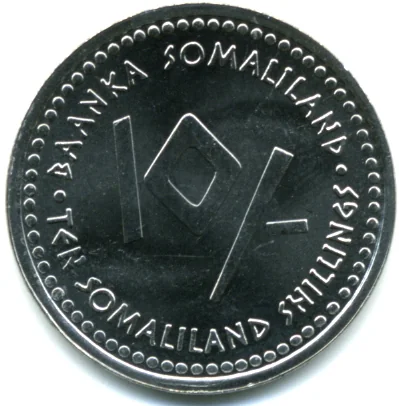
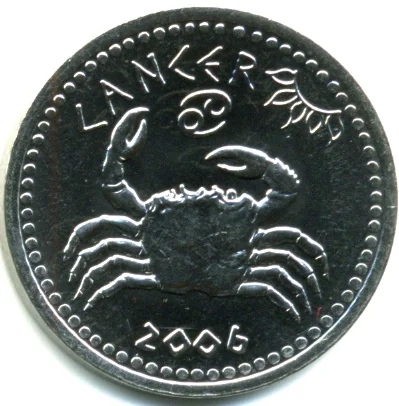
10 Shillings – Somaliland
Somalia
Context
Material
Diameter: 24.9 mm
Weight: 4.8 g
Thickness: 1.5 mm
Shape: Round
Composition: Stainless steel
Technique: Milled
Alignment: Medal alignment
flip
References
KM: #Click to copy to clipboard12
Numista: #2522
Value
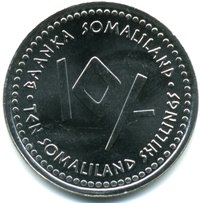
Exchange value: 10 SLS
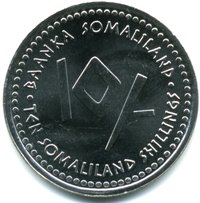
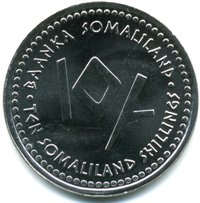
Obverse
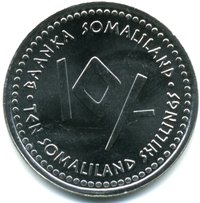
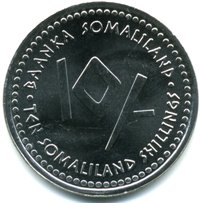
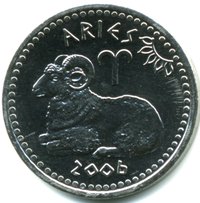
Reverse
Edge
Plain
Categories
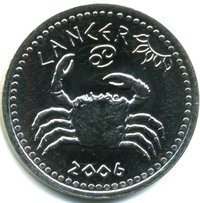
| Animal> Crustacean |
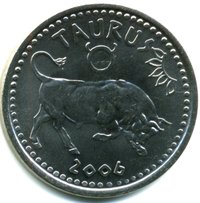
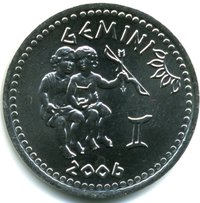
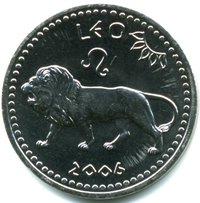
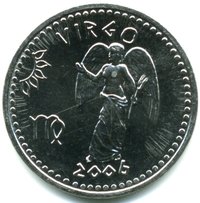
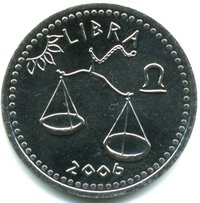
| Astrology> Western astrological sign |
Mintings
| Year | Mint Mark | Mintage | Quality | Collection |
|---|---|---|---|---|
| 2006 | — | — |
Historical background
In 2006, Somaliland's currency situation was characterized by a fragile and complex dual-system, balancing its own national ambition with harsh economic realities. The region, which had declared independence from Somalia in 1991, introduced the Somaliland shilling (SLSH) in 1994 to replace the Somali shilling and assert its sovereignty. However, by 2006, this currency was not internationally recognized and faced severe inflationary pressure due to a lack of central monetary authority, limited foreign reserves, and widespread counterfeiting. Its value was unstable and it circulated primarily in lower-denomination notes for daily small-scale transactions.
Alongside the fragile Somaliland shilling, the US dollar functioned as the de facto stable currency for large transactions, savings, and major business deals. This dollarization was a pragmatic response to the weakness of the local currency, providing a store of value and a reliable medium of exchange for imports, construction, and the thriving livestock export trade. The coexistence of the two currencies created a stratified monetary environment where public confidence in the Somaliland shilling remained low, and the dollar was essential for economic stability and any significant financial activity.
The government in Hargeisa, led by President Dahir Riyale Kahin, faced the critical challenge of legitimizing and stabilizing the Somaliland shilling without the tools of a recognized central bank. Efforts included attempting to control the money supply and periodically withdrawing counterfeit notes from circulation, but these measures had limited success. The currency situation of 6 thus encapsulated Somaliland's broader political dilemma: maintaining a functioning, separate economy while lacking the international recognition needed to secure formal financial institutions and integrate into the global monetary system.
Alongside the fragile Somaliland shilling, the US dollar functioned as the de facto stable currency for large transactions, savings, and major business deals. This dollarization was a pragmatic response to the weakness of the local currency, providing a store of value and a reliable medium of exchange for imports, construction, and the thriving livestock export trade. The coexistence of the two currencies created a stratified monetary environment where public confidence in the Somaliland shilling remained low, and the dollar was essential for economic stability and any significant financial activity.
The government in Hargeisa, led by President Dahir Riyale Kahin, faced the critical challenge of legitimizing and stabilizing the Somaliland shilling without the tools of a recognized central bank. Efforts included attempting to control the money supply and periodically withdrawing counterfeit notes from circulation, but these measures had limited success. The currency situation of 6 thus encapsulated Somaliland's broader political dilemma: maintaining a functioning, separate economy while lacking the international recognition needed to secure formal financial institutions and integrate into the global monetary system.
Series: Zodiac signs
🌱 Common