

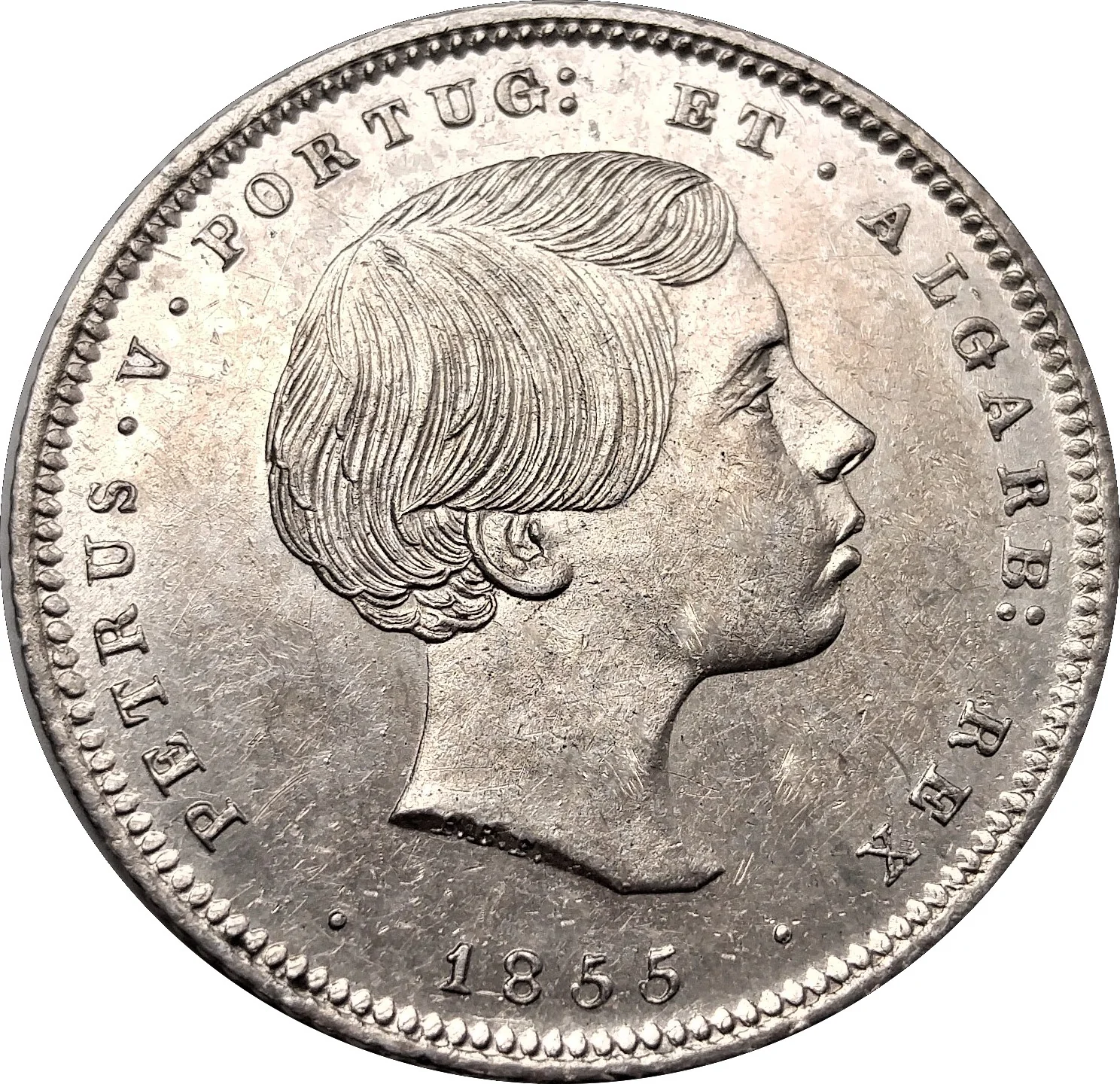
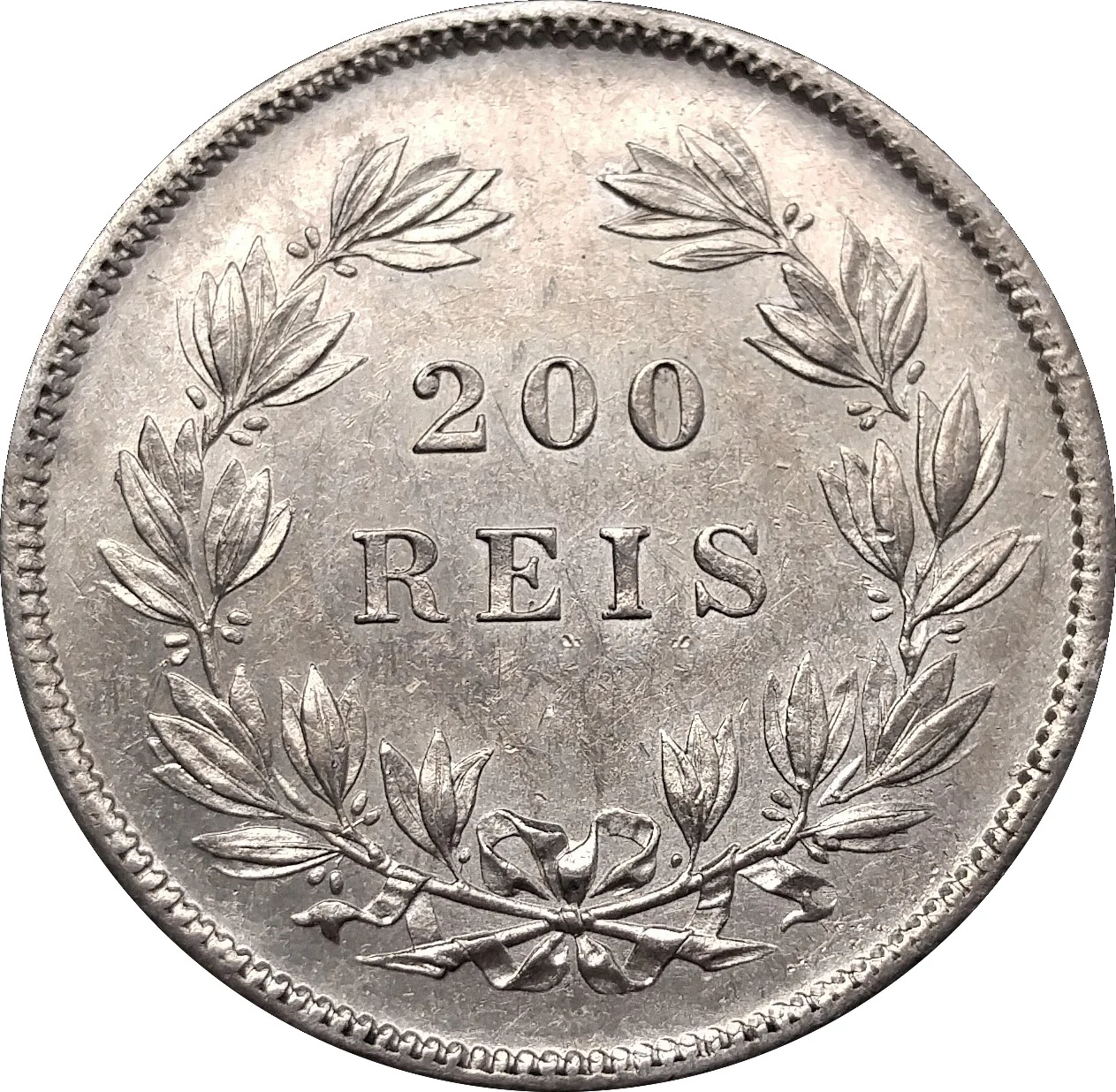
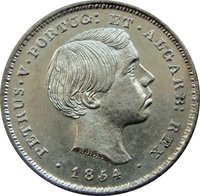
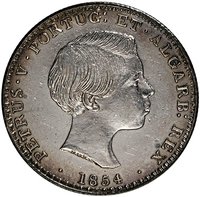
Obverse
Inscription:
PETRUS · V · PORTUG: ET · ALGARB: REX
1855
1855
Script: Latin
Edge
Reeded
Mints
| Name | Mark |
|---|---|
| Imprensa Nacional - Casa da Moeda | — |
Mintings
| Year | Mint Mark | Mintage | Quality | Collection |
|---|---|---|---|---|
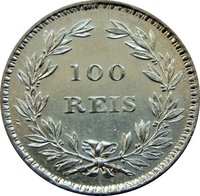
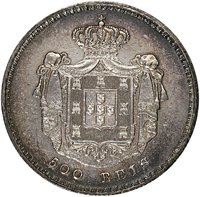
| 1854 | — | 292,000 | ||
| 1854 | — | — | Proof | |
| 1855 | — | 793,000 | ||
| 1855 | — | — | Proof |
Historical background
In 1854, Portugal stood at a pivotal moment in its monetary history, transitioning from a complex and fragmented system to a modern, decimal-based currency. The nation's economy was burdened by a chaotic circulation of both domestic and foreign coinage, including old Portuguese réis in various denominations, Spanish coins, and Brazilian gold. This multiplicity hindered commerce and state accounting, as the country lacked a uniform, nationally guaranteed standard. Furthermore, the state's finances were strained from the political turmoil of the Liberal Wars and the costly efforts to modernize infrastructure, creating a pressing need for monetary stability and control.
The key reform was the official adoption of the real (plural: réis) as the sole national currency, fully decimalized under the milréis system (1,000 réis = 1 milréis). This move was formalized by a decree on May 22, 1854, which mandated the minting of new gold and silver coins at the Lisbon Mint. The most significant practical change was the introduction of the first government-issued paper money, with the Treasury issuing notes in denominations of 10,000, 20,000, 50,000, and 100,000 réis. This marked a crucial step toward a centralized financial system, moving away from reliance on private banking notes and foreign specie.
However, this new system faced immediate challenges. Public trust in the paper currency was low, leading to widespread preference for metal coins and causing the notes to quickly trade at a discount. The scarcity of small-denomination coins for daily transactions also persisted as a practical problem. Thus, while 1854 laid the legal and structural foundation for a unified Portuguese currency, full public acceptance and smooth operation would require years of further consolidation, setting the stage for future banking reforms later in the century.
The key reform was the official adoption of the real (plural: réis) as the sole national currency, fully decimalized under the milréis system (1,000 réis = 1 milréis). This move was formalized by a decree on May 22, 1854, which mandated the minting of new gold and silver coins at the Lisbon Mint. The most significant practical change was the introduction of the first government-issued paper money, with the Treasury issuing notes in denominations of 10,000, 20,000, 50,000, and 100,000 réis. This marked a crucial step toward a centralized financial system, moving away from reliance on private banking notes and foreign specie.
However, this new system faced immediate challenges. Public trust in the paper currency was low, leading to widespread preference for metal coins and causing the notes to quickly trade at a discount. The scarcity of small-denomination coins for daily transactions also persisted as a practical problem. Thus, while 1854 laid the legal and structural foundation for a unified Portuguese currency, full public acceptance and smooth operation would require years of further consolidation, setting the stage for future banking reforms later in the century.
🌟 Limited