

20 francs – France
Add to wishlist
France
Context
Year: 1807
Issuer: France
Ruler: Napoleon I
Currency:
(1795—1959)
Demonetization: 25 June 1928
Total mintage: 594,332
Material
References
KM: #
Numista: #25113
Value
Bullion value: $893.61
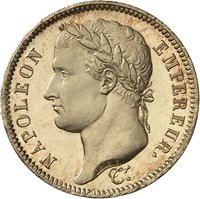
Obverse
Description:
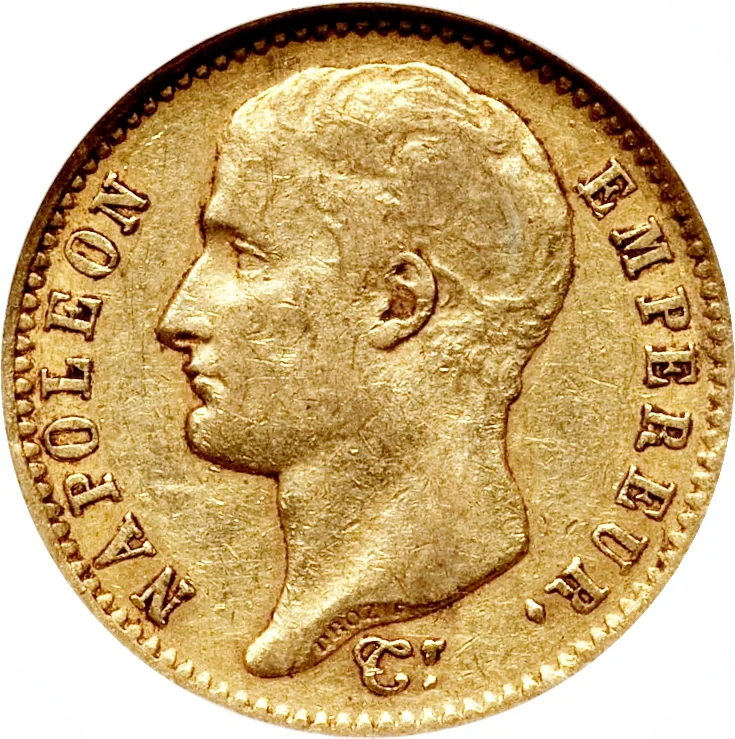
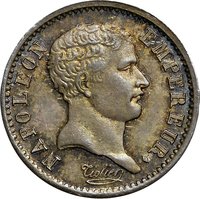
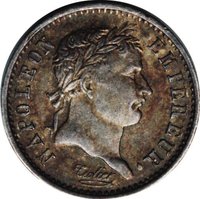
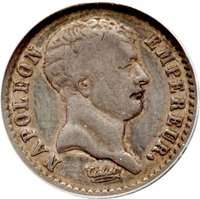
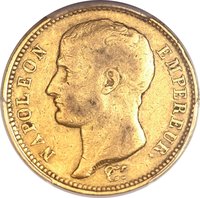
Napoleon I's bare head, left-facing. Signed "DROZ F." in the neck hollow, with cursive "Tr." below.
Inscription:
NAPOLEON EMPEREUR.
Translation:
NAPOLEON EMPEROR.
Script: Latin
Language: French
Engraver: Jean-Pierre Droz
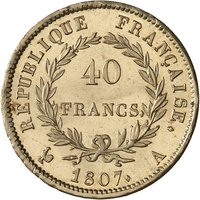
Reverse
Description:
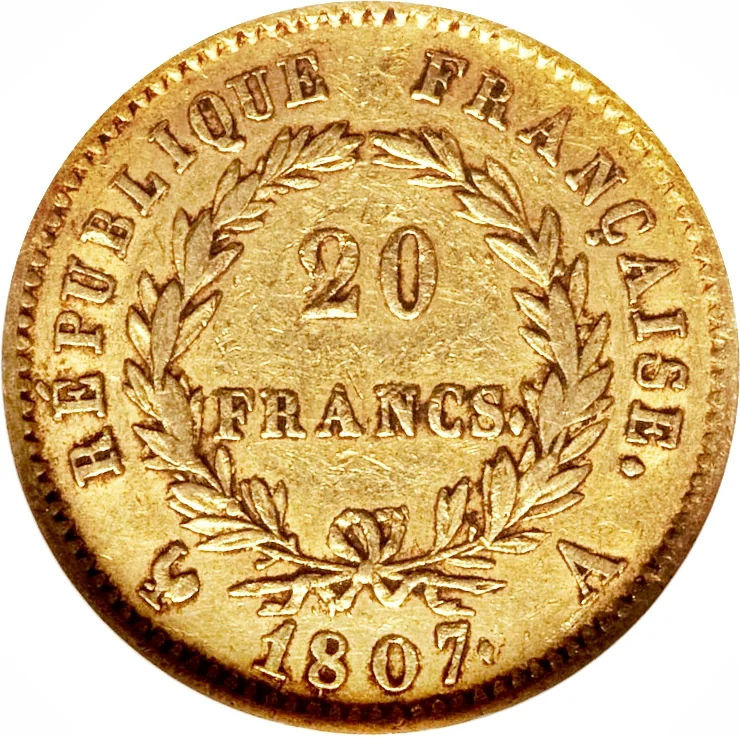
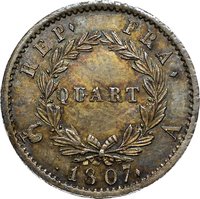
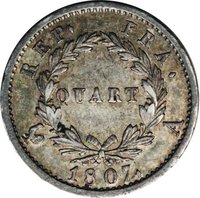
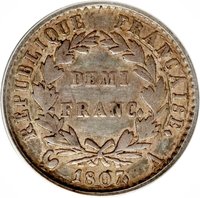
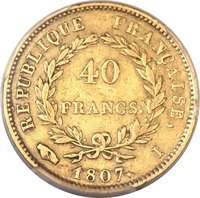
20 Francs within a laurel wreath.
Inscription:
RÉPUBLIQUE FRANÇAISE.
20
FRANCS.
1807. A
20
FRANCS.
1807. A
Translation:
FRENCH REPUBLIC.
20
FRANCS.
1807. A
20
FRANCS.
1807. A
Script: Latin
Language: French
Engraver: Jean-Pierre Droz
Edge
Mints
| Name | Mark |
|---|---|
| Monnaie de Paris | A |
| Toulouse | M |
| Turin | U |
| Lille | W |
Historical background
In 1807, France's currency situation was a complex tapestry of stability and underlying strain, masterfully managed under the Napoleonic financial reforms. The cornerstone was the franc germinal, established in 1803, which created a bimetallic system based on a fixed ratio of gold and silver. This currency, backed by substantial bullion reserves and managed by the newly founded Banque de France, provided a rare period of monetary stability and confidence after the hyperinflation of the Revolutionary assignats. The franc's reliable value facilitated commerce and was being systematically exported across the French Empire through conquest and enforced treaties.
However, this stability was fundamentally artificial and propped up by continuous warfare. The immense costs of Napoleon's campaigns, including the ongoing conflict with Britain and the maintenance of occupied territories, were primarily financed not through taxes but through war indemnities extracted from defeated nations and the systematic looting of art and treasure. This influx of foreign specie helped replenish the Bank of France's reserves and allowed the state to meet its obligations without immediately resorting to printing money, masking the true financial cost of the empire.
Consequently, the system was precarious. While the currency within France itself remained strong, the wider Continental System (the blockade against Britain) disrupted trade and caused economic hardship, creating subtle pressures. The entire edifice depended on perpetual military success to fund the state; a major reversal in fortunes would quickly expose the fragility of a system built on plunder rather than sustainable productivity. Thus, 1807 represents the apparent zenith of Napoleonic financial order, a carefully controlled stability that was, in reality, deeply vulnerable to the fortunes of war.
However, this stability was fundamentally artificial and propped up by continuous warfare. The immense costs of Napoleon's campaigns, including the ongoing conflict with Britain and the maintenance of occupied territories, were primarily financed not through taxes but through war indemnities extracted from defeated nations and the systematic looting of art and treasure. This influx of foreign specie helped replenish the Bank of France's reserves and allowed the state to meet its obligations without immediately resorting to printing money, masking the true financial cost of the empire.
Consequently, the system was precarious. While the currency within France itself remained strong, the wider Continental System (the blockade against Britain) disrupted trade and caused economic hardship, creating subtle pressures. The entire edifice depended on perpetual military success to fund the state; a major reversal in fortunes would quickly expose the fragility of a system built on plunder rather than sustainable productivity. Thus, 1807 represents the apparent zenith of Napoleonic financial order, a carefully controlled stability that was, in reality, deeply vulnerable to the fortunes of war.
Series: 1807 France circulation coins
⭐ Rare