

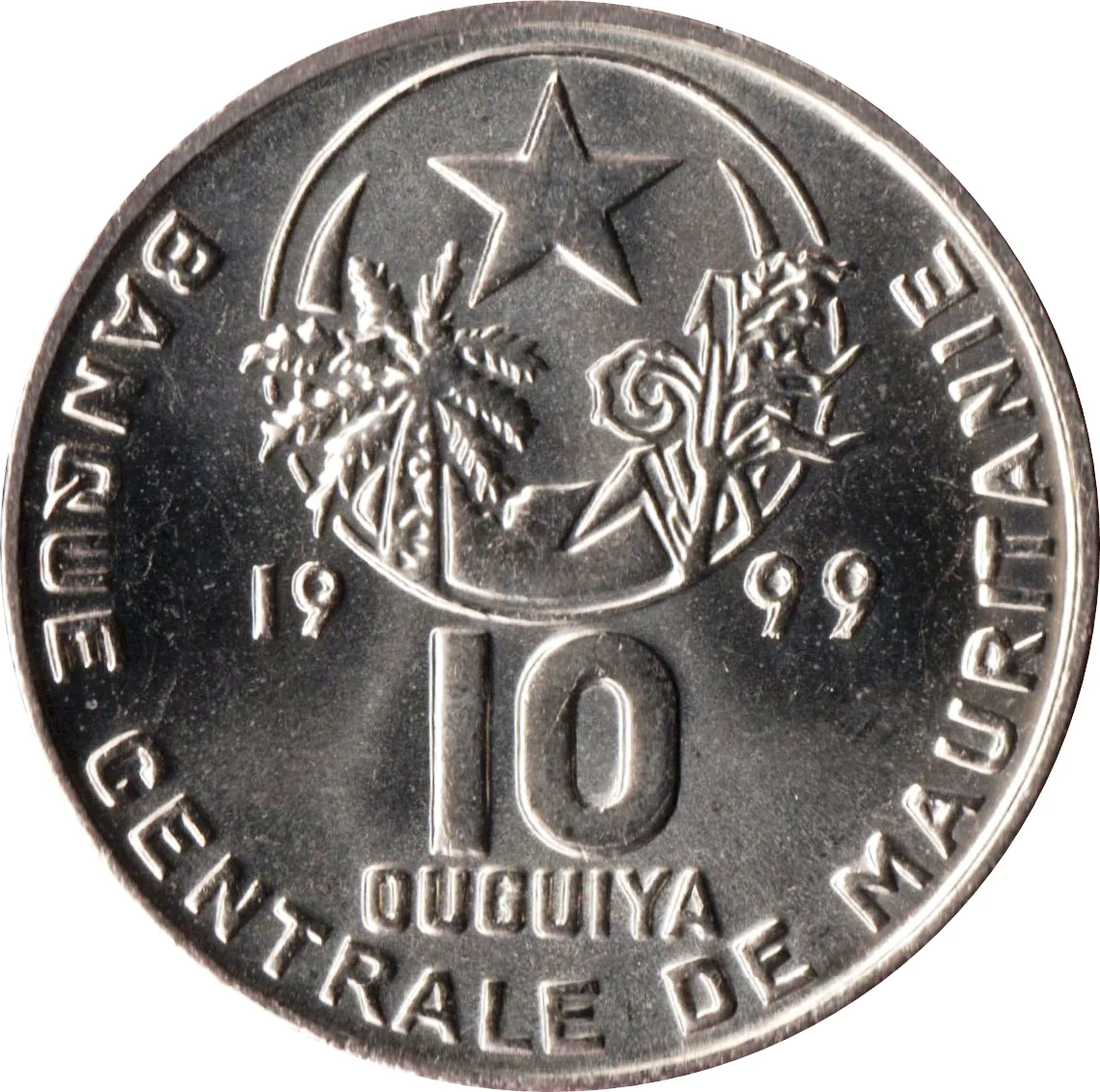
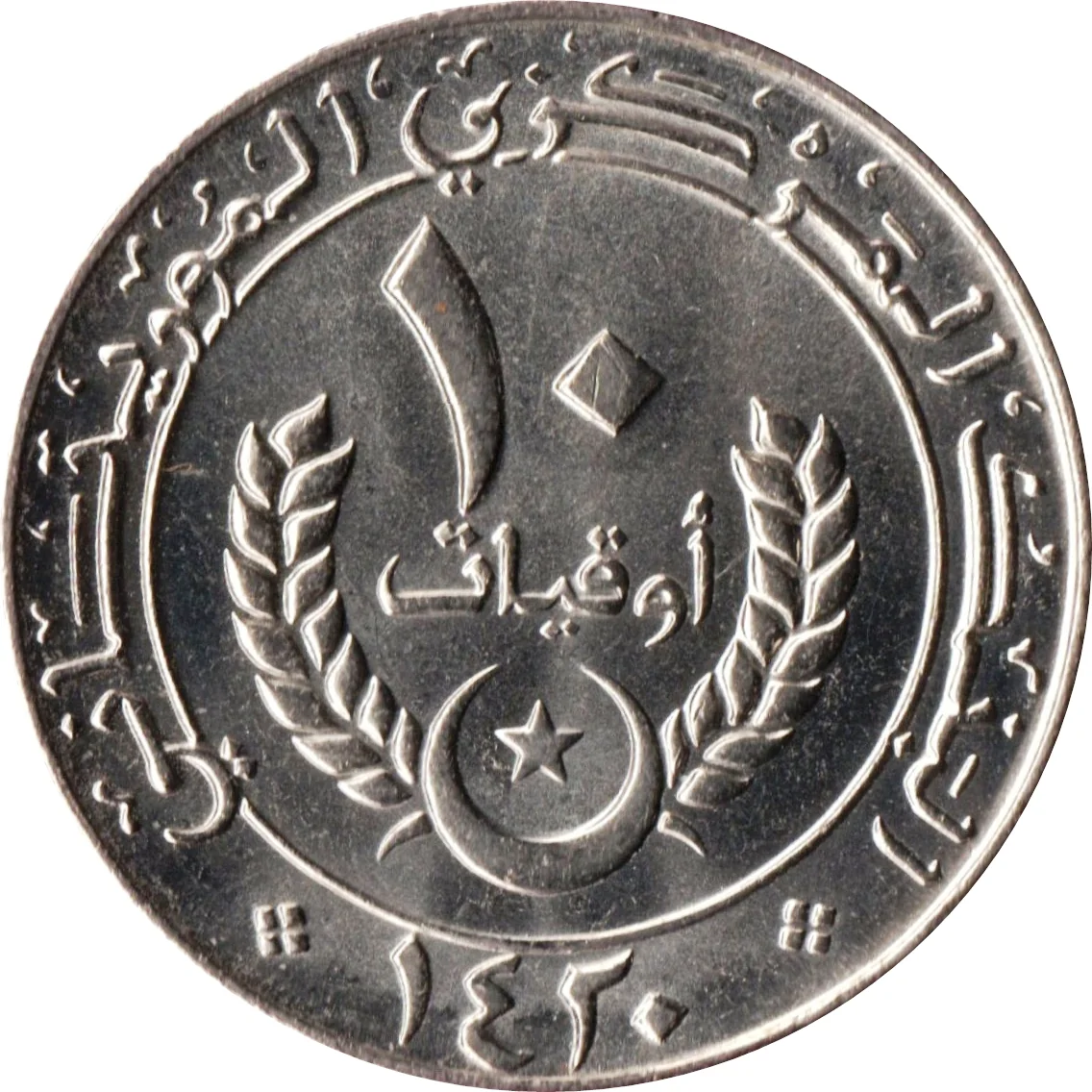
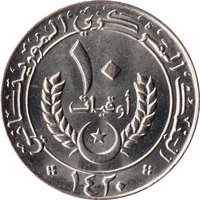
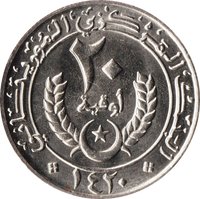
10 Ouguiya – Mauritania
Mauritania
Context
Years: 1973–2003
Issuer: Mauritania 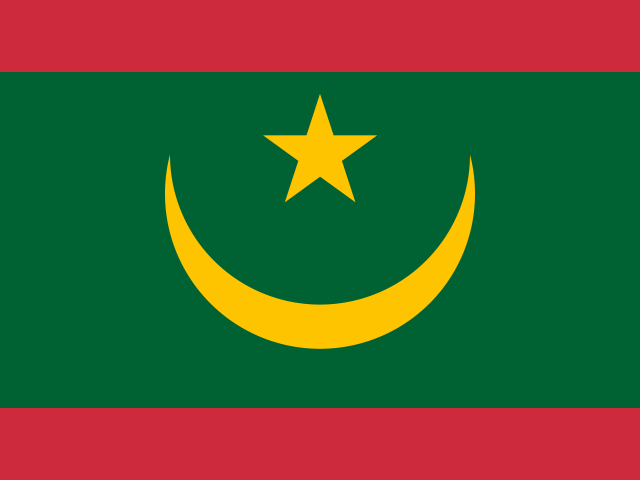
Issuing organization: Central Bank of Mauritania
Period:
(since 1960)
Currency:
(1973—2018)
Demonetization: 30 June 2018
Material
Diameter: 25 mm
Weight: 6 g
Thickness: 1.8 mm
Shape: Round
Composition: Copper-nickel
Technique: Milled
Alignment: Coin alignment
flip
References
KM: #Click to copy to clipboard4
Numista: #2509
Value
Exchange value: 10 MRO
Obverse
Reverse
Edge
Reeded
Mints
| Name | Mark |
|---|---|
| Kremnica | — |
Mintings
| Year | Mint Mark | Mintage | Quality | Collection |
|---|---|---|---|---|
| 1973 | — | — | ||
| 1974 | — | — | ||
| 1981 | — | — | ||
| 1983 | — | — | ||
| 1987 | — | — | ||
| 1990 | — | — | ||
| 1991 | — | — | ||
| 1993 | — | — | ||
| 1995 | — | — | ||
| 1997 | — | — | ||
| 1999 | — | — | ||
| 2003 | — | — |
Historical background
In 1973, Mauritania was navigating a complex monetary transition as it sought to assert greater economic sovereignty. Since gaining independence from France in 1960, the country had remained within the CFA franc zone, using the CFA franc (franc de la Coopération financière en Afrique). This currency, pegged to the French franc and guaranteed by France, provided stability but came with constraints, including pooled foreign reserves and limited independent monetary policy. By the early 1970s, a desire for greater control over national finances, coupled with the broader pan-African sentiment of the era, prompted a reevaluation of this arrangement.
Consequently, on June 29, 1973, Mauritania took the decisive step of leaving the CFA franc zone. It introduced its own national currency, the Mauritanian ouguiya (MRO), which replaced the CFA franc at par. This move was symbolically and economically significant, representing a clear break from the post-colonial monetary system and an assertion of sovereignty. The new ouguiya was subdivided into 5 khoums, a unique non-decimal system reflecting local tradition.
The transition, however, occurred amidst a challenging economic context. Mauritania's economy was heavily dependent on mining (particularly iron ore) and agriculture, sectors vulnerable to price fluctuations and drought. Establishing confidence in a new, untested currency required careful management. While the creation of the ouguiya gave the government direct control over monetary policy, it also meant assuming full responsibility for its stability without the external guarantee formerly provided by France, presenting both an opportunity and a risk for the young nation's economic future.
Consequently, on June 29, 1973, Mauritania took the decisive step of leaving the CFA franc zone. It introduced its own national currency, the Mauritanian ouguiya (MRO), which replaced the CFA franc at par. This move was symbolically and economically significant, representing a clear break from the post-colonial monetary system and an assertion of sovereignty. The new ouguiya was subdivided into 5 khoums, a unique non-decimal system reflecting local tradition.
The transition, however, occurred amidst a challenging economic context. Mauritania's economy was heavily dependent on mining (particularly iron ore) and agriculture, sectors vulnerable to price fluctuations and drought. Establishing confidence in a new, untested currency required careful management. While the creation of the ouguiya gave the government direct control over monetary policy, it also meant assuming full responsibility for its stability without the external guarantee formerly provided by France, presenting both an opportunity and a risk for the young nation's economic future.
🌱 Common