

¼ tanga – Portuguese India
Add to wishlist
Standard circulation coins
Series: 1881/88
India
Context
Years: 1881–1888
Country: India
Issuer: Portuguese India
Ruler: Louis I
Currency:
(1880—1958)
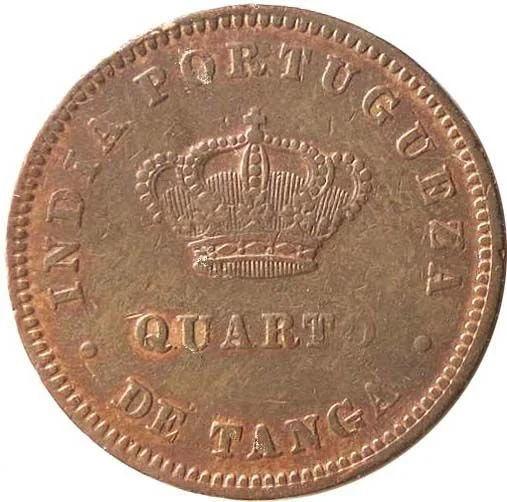
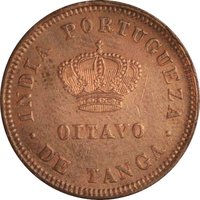
Subdivision: ¼ tanga = 3 Réis
Demonetized: Yes
Total mintage: 7,242,000
Material
References
KM: #
Numista: #24972
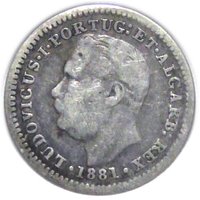
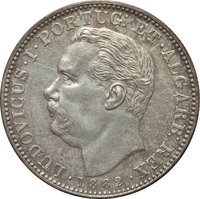
Obverse
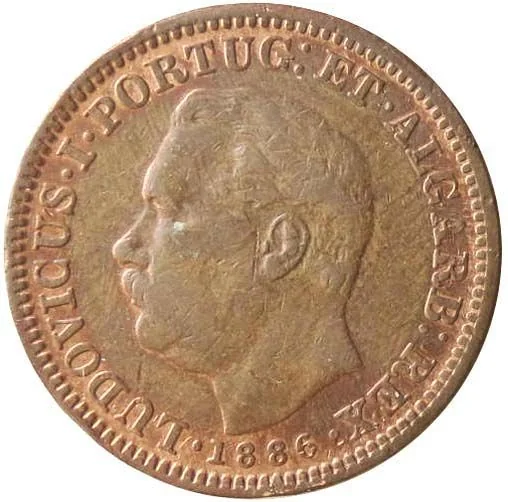
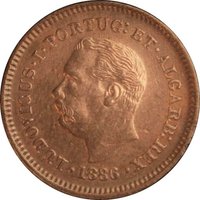
Inscription:
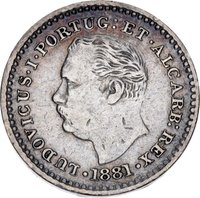
LUDOVICUS.I.PORTUG:ET.ALGARB:REX
1886
1886
Translation:
LOUIS I KING OF PORTUGAL AND THE ALGARVES
1886
1886
Script: Latin
Languages: Latin, Portuguese
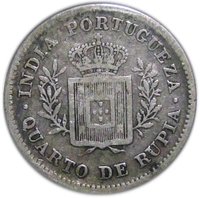
Reverse
Edge
Plain
Mints
| Name | Mark |
|---|---|
| Kolkata / Calcutta / Murshidabad | — |
Mintings
| Year | Mint Mark | Mintage | Quality | Collection |
|---|---|---|---|---|
| 1881 | — | 7,242,000 | ||
| 1884 | — | — | ||
| 1886 | — | — | ||
| 1888 | — | — |
Historical background
In 1881, the currency situation in Portuguese India (Goa, Daman, and Diu) was characterized by a complex and often chaotic multiplicity of circulating coins, reflecting its position at the intersection of Portuguese colonial administration, regional Indian economies, and international trade. The official currency was the Portuguese Indian Rupia, introduced in the late 18th century to replace the Xerafim, and theoretically divided into 16 tangas or 960 réis. However, in practice, a vast array of other coins remained in vigorous circulation, including older Portuguese issues, British Indian rupees and annas, and even gold moidores and silver coins from other European powers. This created a persistent problem of exchange rate fluctuations and calculation difficulties for daily commerce.
The Portuguese administration struggled to impose monetary uniformity. A key decree in 1859 had attempted to demonetize foreign coins, but it was largely ineffective due to the deeply entrenched trade links with British India and the local population's preference for the more stable and widely accepted British Indian rupee. Consequently, by 1881, the British rupee continued to circulate as a de facto parallel currency, especially for larger transactions and external trade, while smaller Portuguese Indian silver and copper coins serviced local markets. This duality undermined the sovereign monetary authority of the colonial state and caused recurring budgetary complications.
Ultimately, the monetary landscape of 1881 was one of transitional instability, caught between Lisbon's desire for a distinct colonial currency and the economic gravity of the British Indian Empire. The persistent circulation of multiple coinages not only inconvenienced trade but also symbolized the broader challenges of Portuguese colonial governance in an era of declining economic influence. This unresolved situation would eventually lead to the significant monetary reform of 1882, which aimed to finally standardize the currency by introducing a new rupee pegged directly to the British Indian standard.
The Portuguese administration struggled to impose monetary uniformity. A key decree in 1859 had attempted to demonetize foreign coins, but it was largely ineffective due to the deeply entrenched trade links with British India and the local population's preference for the more stable and widely accepted British Indian rupee. Consequently, by 1881, the British rupee continued to circulate as a de facto parallel currency, especially for larger transactions and external trade, while smaller Portuguese Indian silver and copper coins serviced local markets. This duality undermined the sovereign monetary authority of the colonial state and caused recurring budgetary complications.
Ultimately, the monetary landscape of 1881 was one of transitional instability, caught between Lisbon's desire for a distinct colonial currency and the economic gravity of the British Indian Empire. The persistent circulation of multiple coinages not only inconvenienced trade but also symbolized the broader challenges of Portuguese colonial governance in an era of declining economic influence. This unresolved situation would eventually lead to the significant monetary reform of 1882, which aimed to finally standardize the currency by introducing a new rupee pegged directly to the British Indian standard.
Series: 1881/88
🌱 Common