

5 centimes – Monaco
Add to wishlist
Monaco
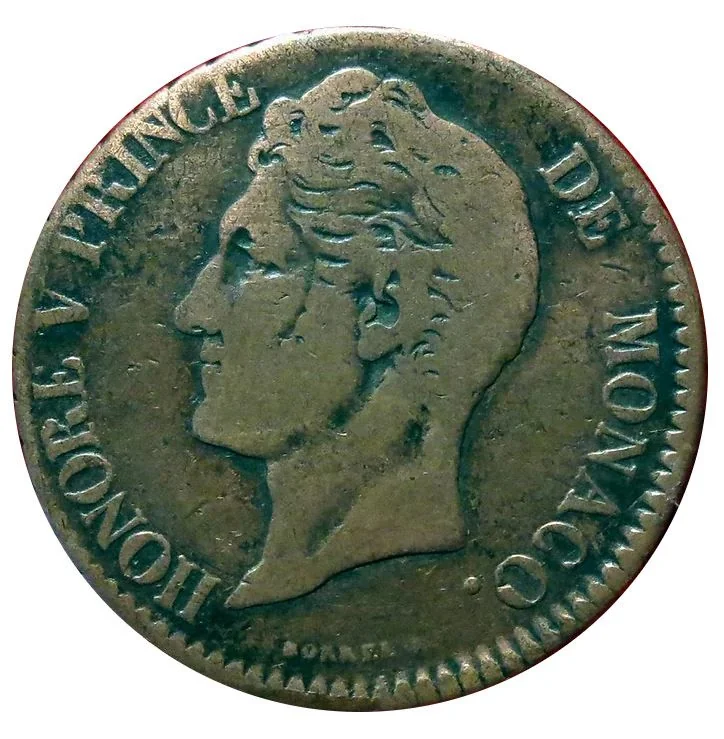
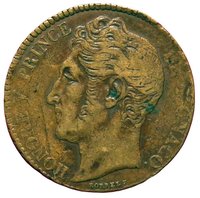
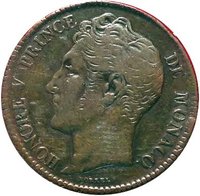
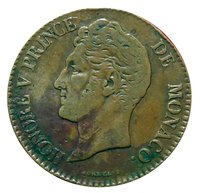
Obverse
Description:
"Feсit" means "made by."
Inscription:
HONORE V PRINCE DE MONACO
BORREL F.
BORREL F.
Translation:
In honor of Prince V of Monaco
BORREL F.
BORREL F.
Script: Latin
Language: French
Engraver: Maurice Borrel
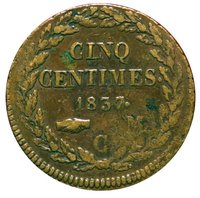
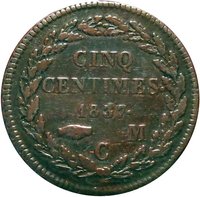
Reverse
Description:
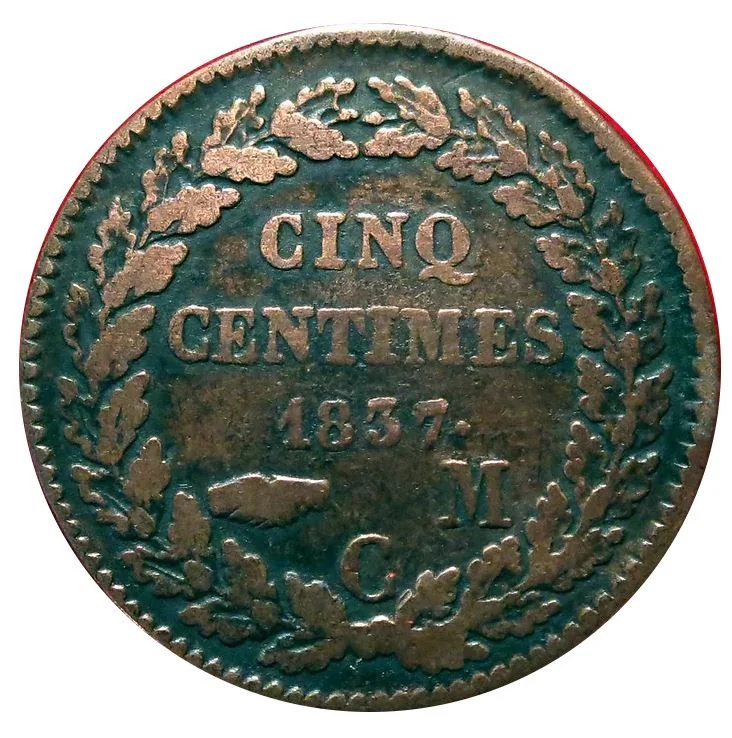
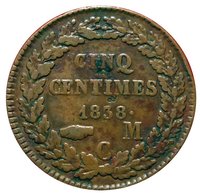
1837 or 1838 5 Cents. Clasped hands, oak wreath, "M C".
Inscription:
CINQ
CENTIMES
1837.
M
C
CENTIMES
1837.
M
C
Script: Latin
Engraver: Maurice Borrel
Edge
Chevronnée
Mints
| Name | Mark |
|---|---|
| Monaco | MC |
Mintings
| Year | Mint Mark | Mintage | Quality | Collection |
|---|---|---|---|---|
| 1837 | M | — | ||
| 1837 | MC | — | ||
| 1838 | M | — |
Historical background
In 1837, Monaco existed as a sovereign principality under the rule of Prince Honoré V, but its monetary system was entirely dominated by its powerful neighbor, France. Following the upheavals of the French Revolution and Napoleonic Wars, the region had stabilized under French economic hegemony. The French Franc, established as a stable decimal currency, was the de facto and de jure legal tender in the principality. Monaco had no independent minting authority and relied entirely on the influx of French coinage for its daily transactions, effectively placing its monetary policy and stability in the hands of the French government.
This integration was formalized through a customs union with France, established in the early 19th century and solidified under the Treaty of 1865. While 1837 predates that specific treaty, the economic reality was one of deep dependency. The Principality's small size and lack of natural resources made it impractical to sustain an independent currency. Consequently, the local economy—centered on modest agriculture, fishing, and the beginnings of the spa business in Monaco-Ville—operated seamlessly with French coins, with prices and wages pegged to the franc.
Therefore, the "currency situation" in Monaco in 1837 was notably uncomplicated: it was a satellite of the French monetary zone. There was no monetary crisis or unique local coinage to speak of; the financial landscape was characterized by stability imported from Paris. This arrangement laid the groundwork for the later, more formal monetary agreements that would continue to bind Monaco's currency to France's for centuries, ultimately leading to its adoption of the Euro in 2002.
This integration was formalized through a customs union with France, established in the early 19th century and solidified under the Treaty of 1865. While 1837 predates that specific treaty, the economic reality was one of deep dependency. The Principality's small size and lack of natural resources made it impractical to sustain an independent currency. Consequently, the local economy—centered on modest agriculture, fishing, and the beginnings of the spa business in Monaco-Ville—operated seamlessly with French coins, with prices and wages pegged to the franc.
Therefore, the "currency situation" in Monaco in 1837 was notably uncomplicated: it was a satellite of the French monetary zone. There was no monetary crisis or unique local coinage to speak of; the financial landscape was characterized by stability imported from Paris. This arrangement laid the groundwork for the later, more formal monetary agreements that would continue to bind Monaco's currency to France's for centuries, ultimately leading to its adoption of the Euro in 2002.
Series: 1837 Monaco circulation coins
🌱 Fairly Common