

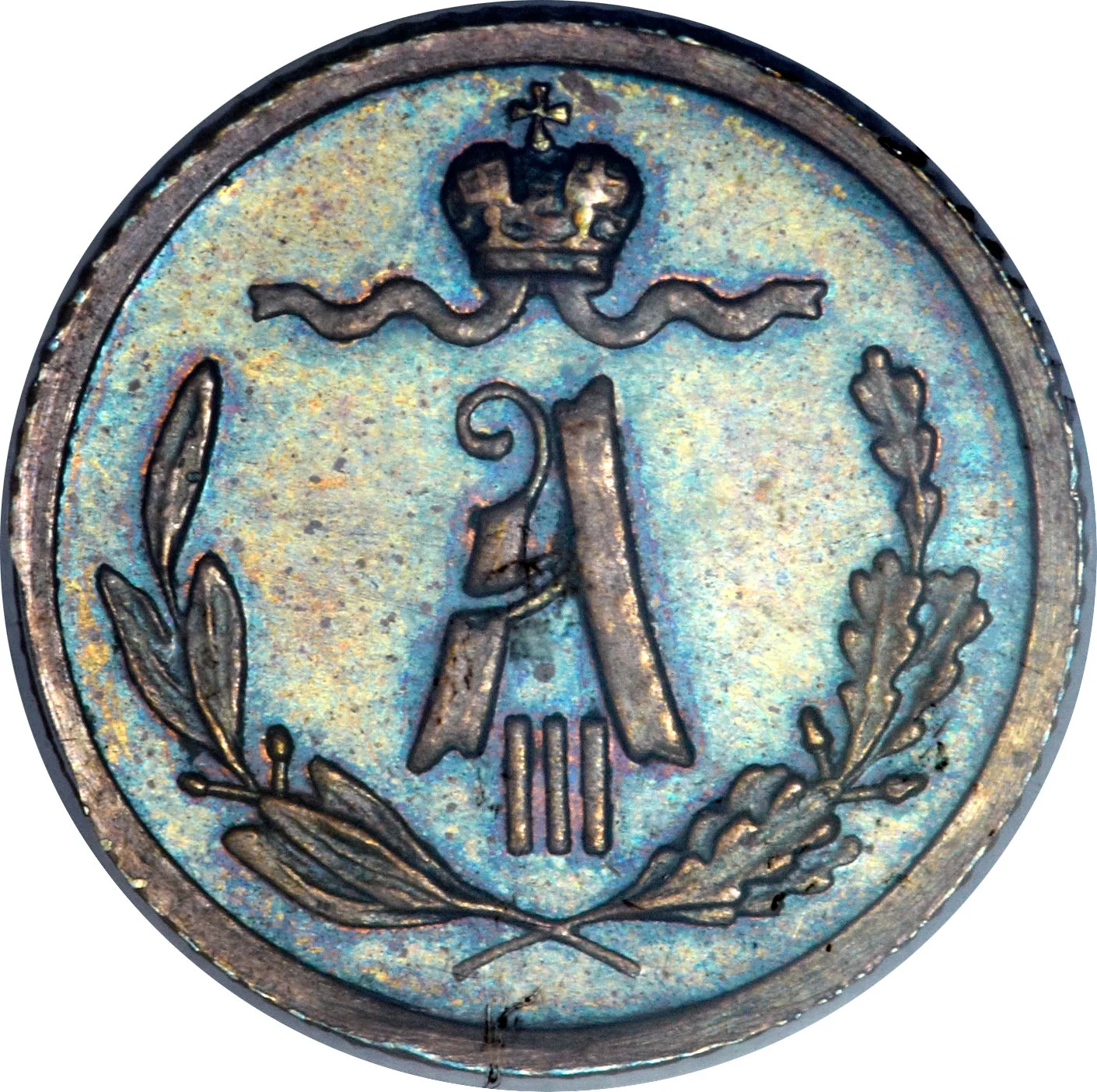
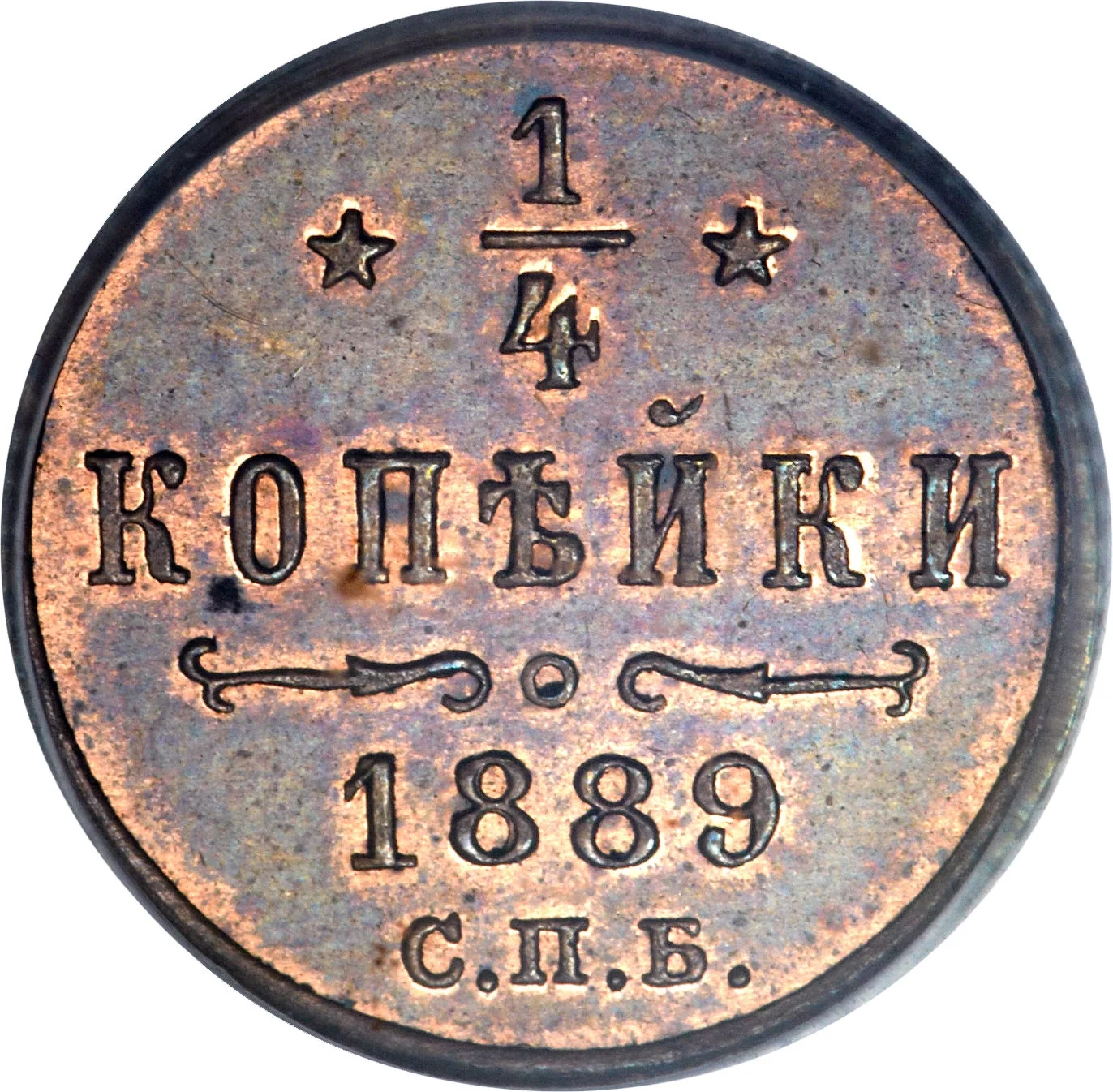
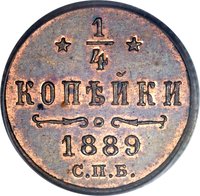
¼ Kopeck – Russian Empire
Russia
Context
Years: 1881–1893
Country: Russia 
Issuer: Russian Empire
Ruler: Alexander III
Currency:
(1700—1917)
Demonetized: Yes
Total mintage: 5,619,000
Material
References
Y: #Click to copy to clipboard29
Numista: #24910
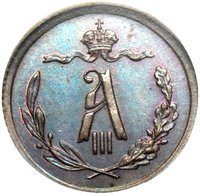
Obverse
Reverse
Edge
Reeded
Mints
| Name | Mark |
|---|---|
| Saint Petersburg | С.П.Б. |
Mintings
Historical background
By 1881, the Russian Empire's currency situation was defined by the aftermath of the Great Reforms and the fiscal strains of the Russo-Turkish War (1877-1878). Since the monetary reform of 1839-1843, Russia had operated on a silver standard, with the silver ruble as the primary monetary unit and paper credit notes (kreditnye bilety) theoretically convertible into silver. However, the massive cost of the war forced the government to finance its efforts through extensive borrowing and the uncontrolled printing of paper currency, severing the link between the paper ruble and its silver backing. This led to a sharp depreciation of the paper ruble, creating a dual-currency system where "silver rubles" and much cheaper "credit rubles" circulated simultaneously, causing confusion and economic instability.
The situation presented a critical challenge for the new Tsar, Alexander III, who ascended the throne in March 1881 following the assassination of his father. His government, particularly under the influence of Finance Minister Nikolai Bunge, recognized that a stable, unified currency was essential for economic modernization, attracting foreign investment, and restoring fiscal order. The immediate goal was to end the fluctuating exchange rate between metal and paper and return to a firm metallic standard, though a debate persisted within government circles between advocates for a return to silver and those favoring the emerging international gold standard.
Consequently, the early 1880s became a period of preparation for a major monetary reform. Bunge's ministry began accumulating gold reserves and stabilizing finances, aiming to establish confidence and lay the groundwork for convertibility. These efforts would culminate over a decade later under Minister Sergei Witte with the historic reform of 1897, which formally placed Russia on the gold standard. Thus, in 1881, the Empire was at a pivotal juncture—grappling with the legacy of wartime inflation while consciously steering toward the monetary stability considered fundamental for its great-power ambitions.
The situation presented a critical challenge for the new Tsar, Alexander III, who ascended the throne in March 1881 following the assassination of his father. His government, particularly under the influence of Finance Minister Nikolai Bunge, recognized that a stable, unified currency was essential for economic modernization, attracting foreign investment, and restoring fiscal order. The immediate goal was to end the fluctuating exchange rate between metal and paper and return to a firm metallic standard, though a debate persisted within government circles between advocates for a return to silver and those favoring the emerging international gold standard.
Consequently, the early 1880s became a period of preparation for a major monetary reform. Bunge's ministry began accumulating gold reserves and stabilizing finances, aiming to establish confidence and lay the groundwork for convertibility. These efforts would culminate over a decade later under Minister Sergei Witte with the historic reform of 1897, which formally placed Russia on the gold standard. Thus, in 1881, the Empire was at a pivotal juncture—grappling with the legacy of wartime inflation while consciously steering toward the monetary stability considered fundamental for its great-power ambitions.
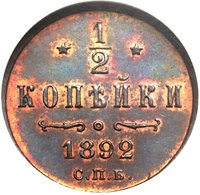
⭐ Somewhat Rare