

10 Centavos – Mexico
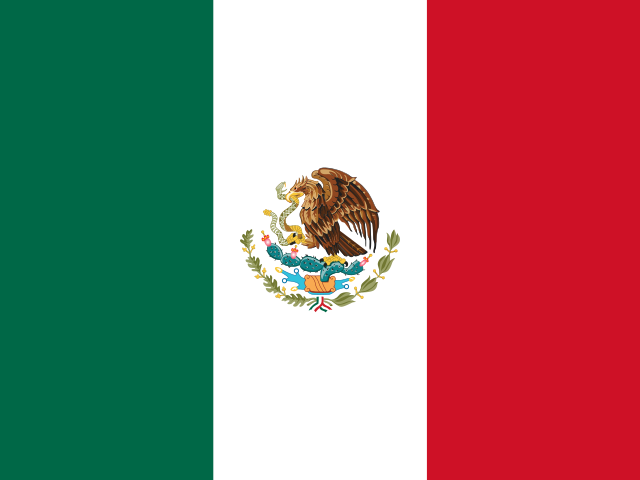
Mexico
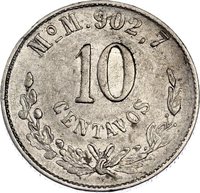
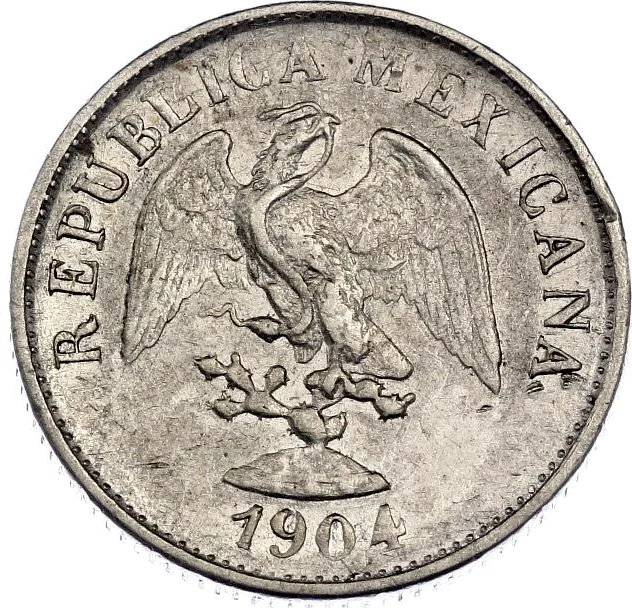
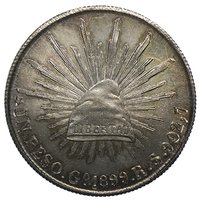
Obverse
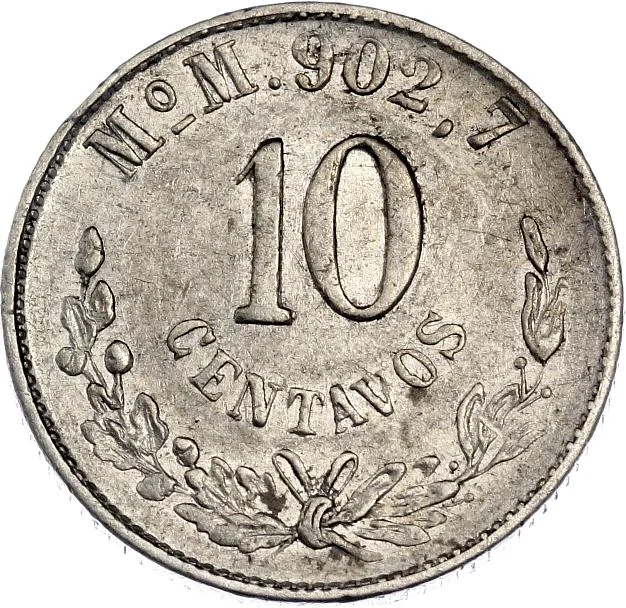
Reverse
Description:
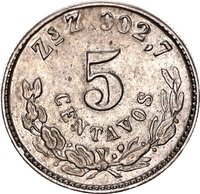
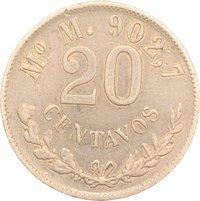
Half wreath value, mint, assayer initials, purity. Mints: . Culiacan, .1 Guanajuato, .2 Mexico City, .3 Zacatecas.
Inscription:
Cn V 902,7
10 CENTAVOS
10 CENTAVOS
Script: Latin
Edge
Reeded
Mintings
| Year | Mint Mark | Mintage | Quality | Collection |
|---|---|---|---|---|
| 1898 | Cn | 9,870 | ||
| 1898 | Go | 435,000 | ||
| 1898 | Mo | 130,000 | ||
| 1898 | Zs | 240,000 | ||
| 1899 | Cn | — | ||
| 1899 | Go | 270,000 | ||
| 1899 | Mo | 190,000 | ||
| 1899 | Zs | 105,000 | ||
| 1900 | Zs | 219,000 | ||
| 1900 | Cn | 160,000 | ||
| 1900 | Go | 130,000 | ||
| 1900 | Mo | 190,000 | ||
| 1901 | Cn | 235,000 | ||
| 1901 | Mo | 80,000 | ||
| 1901 | Zs | 70,000 | ||
| 1902 | Cn | 186,000 | ||
| 1902 | Mo | 181,000 | ||
| 1902 | Zs | 120,000 | ||
| 1903 | Mo | 581,000 | ||
| 1903 | Zs | 228,000 | ||
| 1903 | Cn | 256,000 | ||
| 1904 | Cn | 307,000 | ||
| 1904 | Mo | 1,266,000 | ||
| 1904 | Zs | — | ||
| 1905 | Mo | 266,000 | ||
| 1905 | Zs | 66,000 |
Historical background
In 1898, Mexico's currency situation was defined by the complex and often unstable legacy of the bimetallic "peso fuerte" and the widespread circulation of foreign coins, particularly U.S. dollars and Spanish colonial pieces. The official currency was the silver peso, but the government, under the Porfirio Díaz regime (the Porfiriato), was in the midst of a deliberate shift toward the gold standard as part of its broader modernization and foreign investment drive. This created a dual system where both gold and silver were legal tender, but their values fluctuated based on the volatile global price of silver, which had plummeted in the decades following the 1870s.
The period was marked by the Law of Monetary Reform of 1905, which was in its planning stages by 1898. The key problem was the depreciation of silver, which caused the silver peso's value to fall against gold-backed currencies like the U.S. dollar. This instability was detrimental to foreign capitalists, whose investments Díaz actively courted. Consequently, while the silver peso remained the everyday currency for most of the population, international trade and large financial transactions were increasingly conducted in gold or gold-backed notes. The Banco de México, as a central bank, did not yet exist; instead, a system of concessionary banks issued their own notes, adding another layer of complexity and occasional inconsistency to the money supply.
Thus, 1898 represents a pivotal moment of transition within the Porfiriato. The economy was growing rapidly due to industrialization and exports, but the currency system was a patchwork awaiting reform. The government's clear intent was to abandon silver monometallism, stabilize the exchange rate, and fully integrate Mexico into the international gold-standard system—a goal that would be formally enacted with the 1905 law, which introduced the gold peso and began the process of retiring the old silver coins from circulation.
The period was marked by the Law of Monetary Reform of 1905, which was in its planning stages by 1898. The key problem was the depreciation of silver, which caused the silver peso's value to fall against gold-backed currencies like the U.S. dollar. This instability was detrimental to foreign capitalists, whose investments Díaz actively courted. Consequently, while the silver peso remained the everyday currency for most of the population, international trade and large financial transactions were increasingly conducted in gold or gold-backed notes. The Banco de México, as a central bank, did not yet exist; instead, a system of concessionary banks issued their own notes, adding another layer of complexity and occasional inconsistency to the money supply.
Thus, 1898 represents a pivotal moment of transition within the Porfiriato. The economy was growing rapidly due to industrialization and exports, but the currency system was a patchwork awaiting reform. The government's clear intent was to abandon silver monometallism, stabilize the exchange rate, and fully integrate Mexico into the international gold-standard system—a goal that would be formally enacted with the 1905 law, which introduced the gold peso and began the process of retiring the old silver coins from circulation.
Series: 1898 Mexico circulation coins
🌱 Fairly Common