

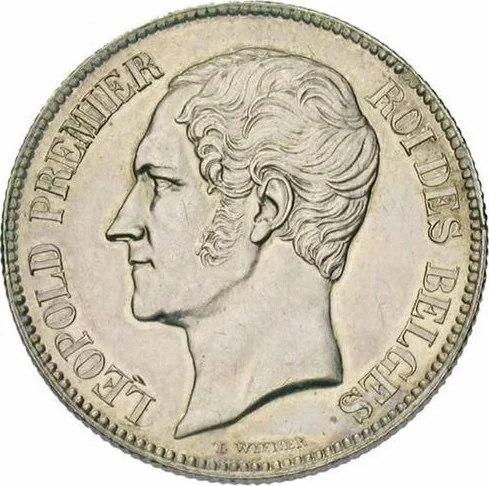

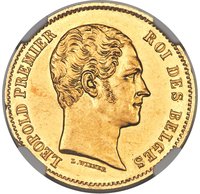
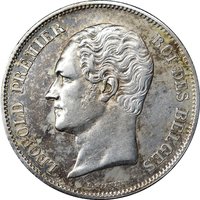
Obverse
Description:
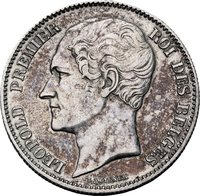
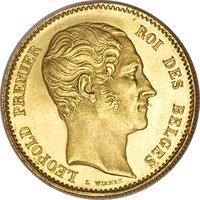
Leopold I of Belgium in left profile, encircled by a French legend.
Inscription:
LEOPOLD PREMIER ROI DES BELGES
L WIENER
L WIENER
Translation:
Leopold the First King of the Belgians
L Wiener
L Wiener
Script: Latin
Language: French
Engraver: Léopold Wiener
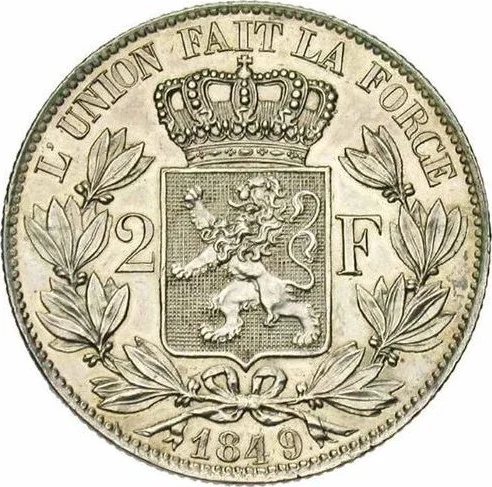
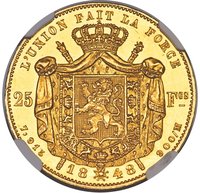
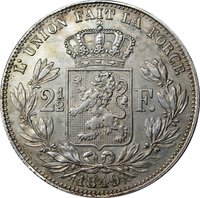
Reverse
Description:
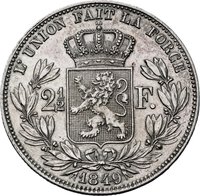
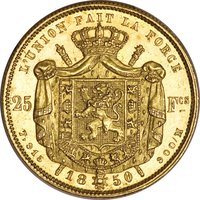
Coat of arms in wreath divides value. French motto above, year below.
Inscription:
L'UNION FAIT LA FORCE
2 F
1849
2 F
1849
Translation:
Union makes strength
2 Francs
1849
2 Francs
1849
Script: Latin
Language: French
Engraver: Léopold Wiener
Edge
Reeded
Mints
| Name | Mark |
|---|---|
| Royal Mint of Belgium | — |
Mintings
| Year | Mint Mark | Mintage | Quality | Collection |
|---|---|---|---|---|
| 1848 | — | — | ||
| 1849 | — | — | ||
| 1865 | — | — |
Historical background
In 1848, Belgium's currency situation was defined by its adherence to a bimetallic standard, a system it shared with neighbouring France through the Latin Monetary Union. This framework legally fixed the value of silver and gold coins in a specific ratio (15.5:1), with the Belgian franc fully interchangeable with the French franc. While this union facilitated trade, it left the Belgian monetary system vulnerable to international fluctuations in the relative market prices of the two metals, a persistent challenge of bimetallism.
The year 1848 itself was a moment of acute crisis across Europe, marked by revolutions and financial panic. While Belgium remained politically stable, it could not escape the continent-wide economic shockwaves. A severe loss of public confidence triggered a widespread hoarding of specie (gold and silver coins), leading to a drastic shortage of physical money in circulation. This liquidity crisis threatened to paralyze commerce and the daily economy, forcing the government to take emergency measures.
In response, the Belgian parliament passed a law on June 9, 1848, authorizing the temporary issuance of forced-course paper money. These state notes, in denominations as low as 20 francs, were made legal tender to alleviate the coin shortage. This was a significant, albeit provisional, departure from the strict metallic standard. The crisis measures proved effective in restoring monetary circulation, and confidence gradually returned. The paper notes were successfully withdrawn from circulation over the following years, allowing Belgium to return to its full bimetallic system by the mid-1850s, its pre-1848 currency orthodoxy restored but having proven its capacity for flexible crisis management.
The year 1848 itself was a moment of acute crisis across Europe, marked by revolutions and financial panic. While Belgium remained politically stable, it could not escape the continent-wide economic shockwaves. A severe loss of public confidence triggered a widespread hoarding of specie (gold and silver coins), leading to a drastic shortage of physical money in circulation. This liquidity crisis threatened to paralyze commerce and the daily economy, forcing the government to take emergency measures.
In response, the Belgian parliament passed a law on June 9, 1848, authorizing the temporary issuance of forced-course paper money. These state notes, in denominations as low as 20 francs, were made legal tender to alleviate the coin shortage. This was a significant, albeit provisional, departure from the strict metallic standard. The crisis measures proved effective in restoring monetary circulation, and confidence gradually returned. The paper notes were successfully withdrawn from circulation over the following years, allowing Belgium to return to its full bimetallic system by the mid-1850s, its pre-1848 currency orthodoxy restored but having proven its capacity for flexible crisis management.
Series: 1848 Belgium circulation coins
💎 Extremely Rare