

Obverse
Description:
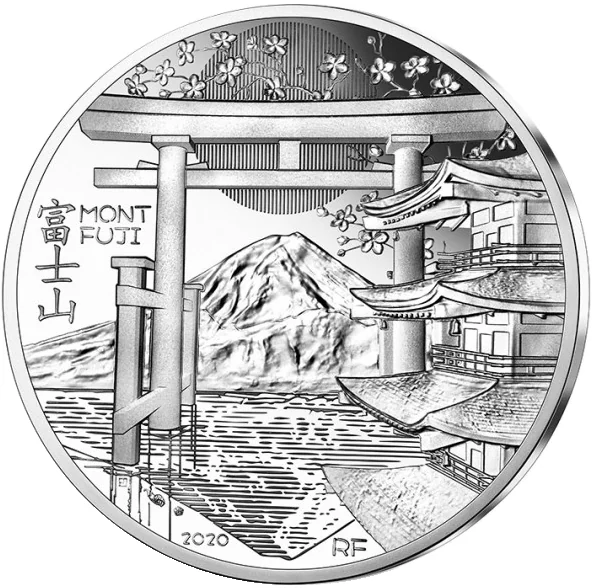
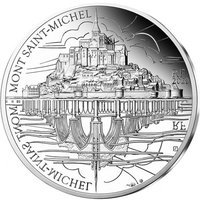
Foreground right: the Chureito pagoda overlooking Mount Fuji. A cherry blossom branch arches above. Center: a torii gate in water, framing Mount Fuji and its lake reflection. The Japanese sun symbol is at the top.
Inscription:
富士山 MONT FUJI
2020 RF
2020 RF
Translation:
Mount Fuji MONT FUJI
2020 RF
2020 RF
Script: Latin
Reverse
Description:
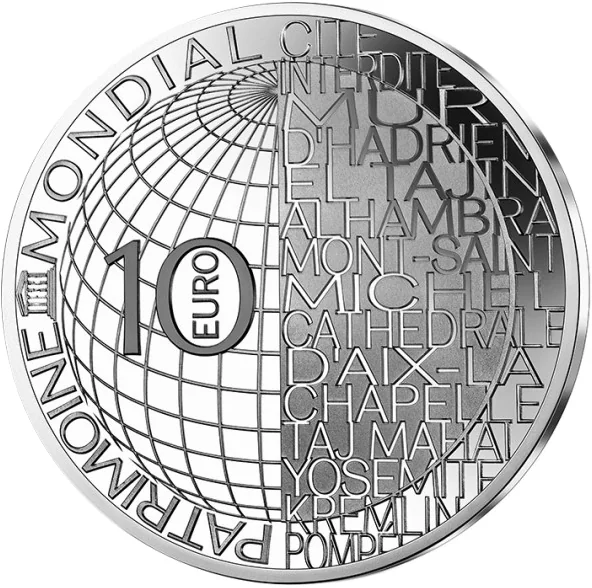
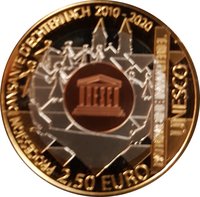
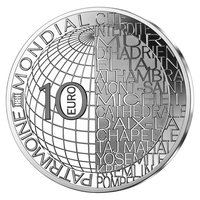
A UNESCO World Heritage globe, with site names on the right, the UNESCO logo on the left, and the face value inside. The reverse is a common design for the series.
Inscription:
PATRIMOINE MONDIAL
UNESCO
10 EURO
CITE INTERDITE
MUR D'HADRIEN
EL TAJIN
ALHAMBRA
MONT SAINT-MICHEL
CATHEDRALE D'AIX-LA-CHAPELLE
TAJ MAHAL
YOSEMITE
KREMLIN
POMPEI
UNESCO
10 EURO
CITE INTERDITE
MUR D'HADRIEN
EL TAJIN
ALHAMBRA
MONT SAINT-MICHEL
CATHEDRALE D'AIX-LA-CHAPELLE
TAJ MAHAL
YOSEMITE
KREMLIN
POMPEI
Script: Latin
Edge
Plain.
Mints
| Name | Mark |
|---|---|
| Monnaie de Paris | — |
Mintings
| Year | Mint Mark | Mintage | Quality | Collection |
|---|---|---|---|---|
| 2020 | — | 3,000 | Proof |
Historical background
In 2020, France's currency situation was fundamentally defined by its membership in the Eurozone, using the euro (€) as its sole legal tender. The year was dominated by the profound economic shock of the COVID-19 pandemic, which triggered a severe recession. The French government responded with massive fiscal support, including furlough schemes and state-guaranteed loans, leading to a sharp increase in public debt, which exceeded 115% of GDP. However, monetary policy was not set nationally but by the European Central Bank (ECB), which launched an unprecedented €1.35 trillion Pandemic Emergency Purchase Programme (PEPP) to stabilize the euro area, ensuring favorable borrowing conditions for France and keeping the euro stable against major currencies.
Domestically, the pandemic accelerated existing trends in payment methods. The use of cash declined significantly due to hygiene concerns and increased online shopping, while contactless card payments saw a surge, with the transaction limit raised from €30 to €50 in May to facilitate safer purchases. This shift reinforced France's position as a leader in Europe for card-based transactions. Concurrently, the Banque de France continued its active role in the digital euro project launched by the ECB, positioning itself at the forefront of exploring a potential central bank digital currency (CBDC) for the retail market.
Overall, France's 2020 currency landscape was one of stability in the monetary unit itself, shielded by collective Eurozone action, but marked by dramatic changes in how money was used. The year highlighted the dual reality of French monetary policy: national fiscal sovereignty exercised through debt-financed emergency spending, coupled with a reliance on supranational ECB mechanisms to maintain monetary stability and liquidity. This framework left France navigating the crisis without the tool of devaluation, instead depending on European solidarity and the ECB's bond-buying firepower to manage the economic fallout.
Domestically, the pandemic accelerated existing trends in payment methods. The use of cash declined significantly due to hygiene concerns and increased online shopping, while contactless card payments saw a surge, with the transaction limit raised from €30 to €50 in May to facilitate safer purchases. This shift reinforced France's position as a leader in Europe for card-based transactions. Concurrently, the Banque de France continued its active role in the digital euro project launched by the ECB, positioning itself at the forefront of exploring a potential central bank digital currency (CBDC) for the retail market.
Overall, France's 2020 currency landscape was one of stability in the monetary unit itself, shielded by collective Eurozone action, but marked by dramatic changes in how money was used. The year highlighted the dual reality of French monetary policy: national fiscal sovereignty exercised through debt-financed emergency spending, coupled with a reliance on supranational ECB mechanisms to maintain monetary stability and liquidity. This framework left France navigating the crisis without the tool of devaluation, instead depending on European solidarity and the ECB's bond-buying firepower to manage the economic fallout.
Series: UNESCO World Heritage








💎 Extremely Rare