

30 euro – Spain
Add to wishlist
Spain
Context
Material
References
KM: #
Numista: #245791
Value
Exchange value: 30 EUR
Bullion value: $41.79
Inflation-adjusted value: 35.96 EUR
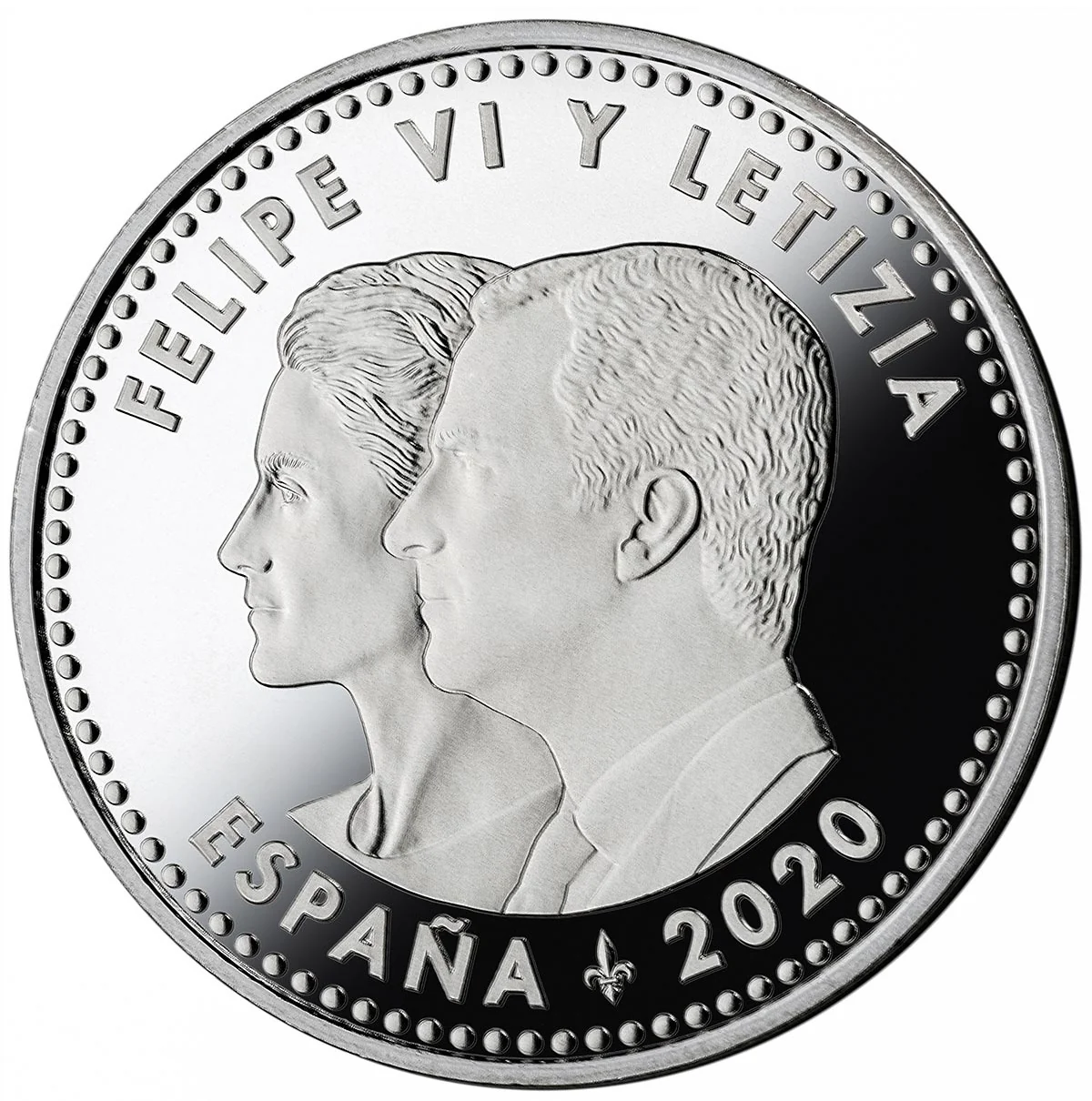
Obverse
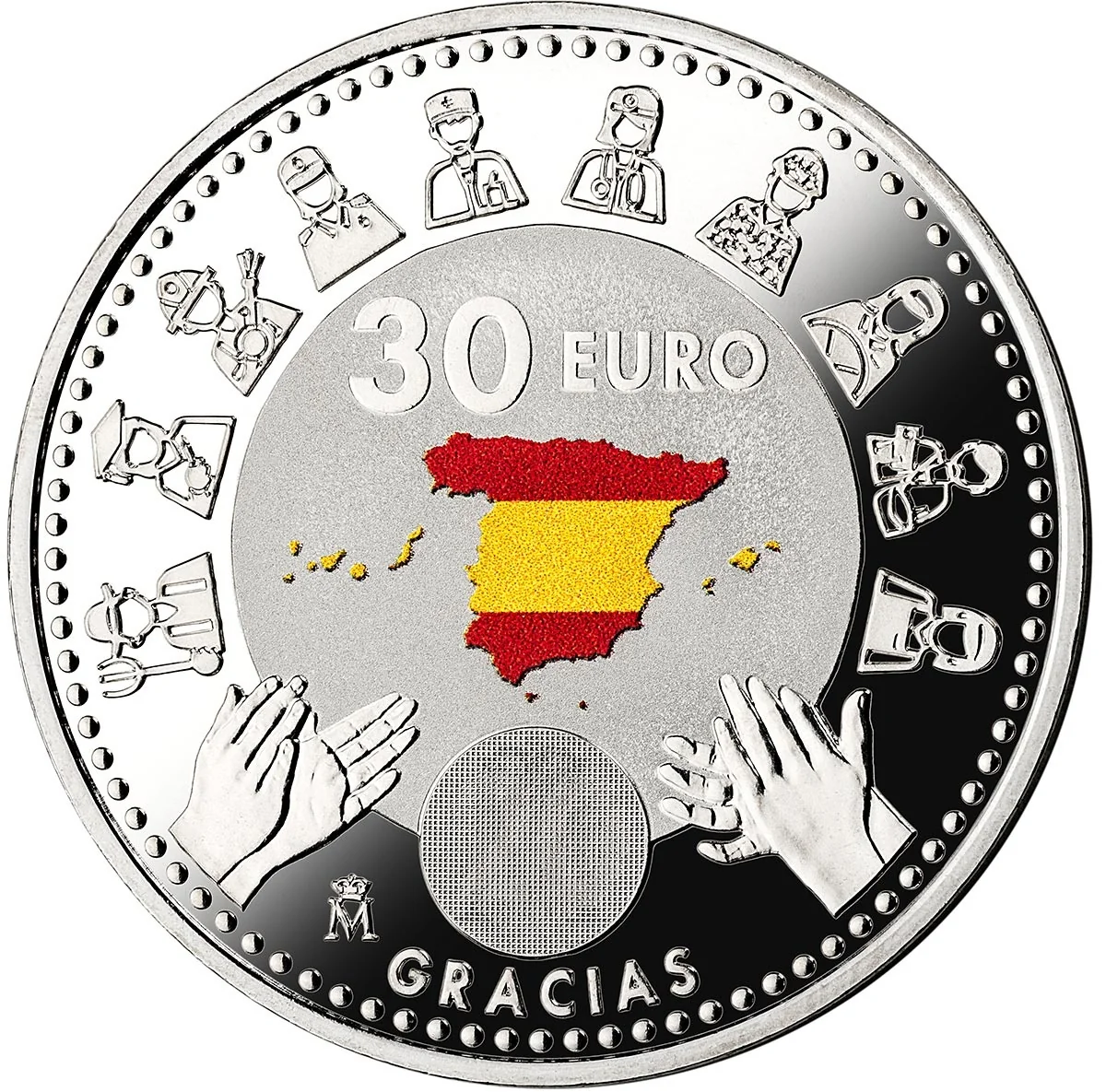
Reverse
Description:
A map of Spain in the flag's colors. Within a central circle, a quadruple latent image shows the COVID-19 virus, the mint mark, two clapping hands, and the year "2020." It is surrounded by ten pictograms honoring essential workers. At the bottom, two pairs of hands clapping.
Inscription:
30 EURO
M
GRACIAS
M
GRACIAS
Translation:
Thank you.
Script: Latin
Edge
Plain
Mints
| Name | Mark |
|---|---|
| Royal Mint of Madrid | (M) |
Mintings
| Year | Mint Mark | Mintage | Quality | Collection |
|---|---|---|---|---|
| 2020 | M | 369,600 | ||
| 2020 | M | 5,000 | In sets |
Historical background
In 2020, Spain, as a member of the Eurozone, used the euro (€) as its official currency, a status it had maintained since the currency's physical introduction in 2002. This meant that Spain's monetary policy was not set domestically but by the European Central Bank (ECB) in Frankfurt, which focused on the economic conditions of the entire currency bloc. The primary currency situation for Spain in 2020 was therefore defined by the ECB's aggressive response to the COVID-19 pandemic, which included massive asset-purchase programs and historically low interest rates to ensure liquidity and stabilize the Eurozone economy. These measures were crucial for Spain, preventing a deeper financial crisis but also highlighting its lack of independent monetary tools to address a national economic shock.
The year was dominated by the severe economic impact of the pandemic, which triggered a deep recession in Spain, with GDP contracting by nearly 11%—one of the sharpest declines in Europe. This crisis put significant strain on public finances, leading to a surge in public debt towards 120% of GDP. While not a currency crisis in the traditional sense, there was underlying market and political concern about the sustainability of Spain's debt within the common currency framework, reviving debates about Eurozone solidarity and risk-sharing. The Spanish government, led by Pedro Sánchez, strongly advocated for a collective European response, which culminated in the landmark agreement on the EU's Next Generation recovery fund, financed by common debt issuance.
Consequently, the currency "situation" was less about the euro's day-to-day stability and more about its institutional future and Spain's position within it. The successful negotiation of the recovery fund, which would channel substantial grants and loans to Spain, was seen as a pivotal moment for the euro's architecture, mutualizing risk to an unprecedented degree. Domestically, the focus was on utilizing these European funds for digital and green transitions to modernize the economy. Thus, in 2020, Spain's currency context was one of relying on and reinforcing the European project to navigate an unprecedented economic collapse, with the euro acting as both a shield and a framework for collective survival.
The year was dominated by the severe economic impact of the pandemic, which triggered a deep recession in Spain, with GDP contracting by nearly 11%—one of the sharpest declines in Europe. This crisis put significant strain on public finances, leading to a surge in public debt towards 120% of GDP. While not a currency crisis in the traditional sense, there was underlying market and political concern about the sustainability of Spain's debt within the common currency framework, reviving debates about Eurozone solidarity and risk-sharing. The Spanish government, led by Pedro Sánchez, strongly advocated for a collective European response, which culminated in the landmark agreement on the EU's Next Generation recovery fund, financed by common debt issuance.
Consequently, the currency "situation" was less about the euro's day-to-day stability and more about its institutional future and Spain's position within it. The successful negotiation of the recovery fund, which would channel substantial grants and loans to Spain, was seen as a pivotal moment for the euro's architecture, mutualizing risk to an unprecedented degree. Domestically, the focus was on utilizing these European funds for digital and green transitions to modernize the economy. Thus, in 2020, Spain's currency context was one of relying on and reinforcing the European project to navigate an unprecedented economic collapse, with the euro acting as both a shield and a framework for collective survival.
Series: Face Value Exchange Series

🌟 Uncommon