

10 rubles (Supreme Council) – Transnistria
Add to wishlist
Non-circulating coins
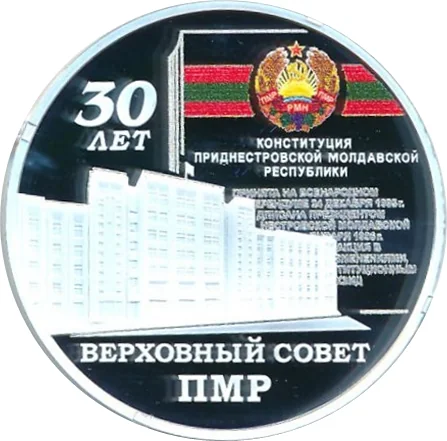
Commemoration: 30th Anniversary of the Supreme Council
Series: Statehood of Transnistria
Moldova
Context
Year: 2020
Country: Moldova
Issuer: Transnistria
Issuing organization: Transnistrian Republican Bank
Period:
(since 1990)
Currency:
(since 2000)
Total mintage: 400
Material
Diameter: 33 mm
Weight: 15.55 g
Silver Weight:: 14.38 g
Shape: Round
Composition: 92.5% Silver
Standard: Silver half ounce
Magnetic: No
Alignment: Medal alignment
flip
References
KM: #
Numista: #245771
Value
Exchange value: 10 PRB
Bullion value: $36.04
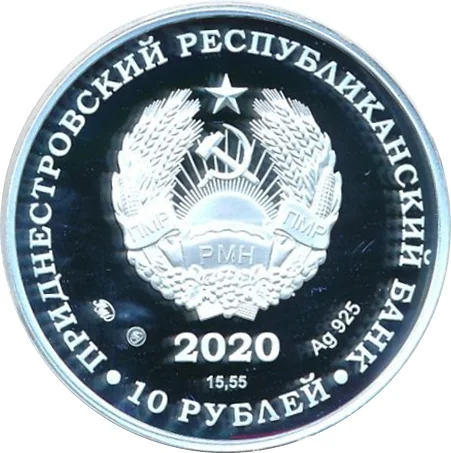
Obverse
Description:
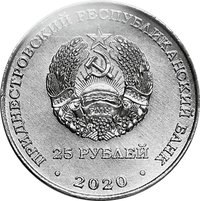
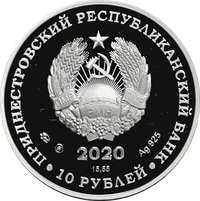
National emblem above value and date, surrounded by lettering.
Inscription:
ПРИДНЕСТРОВСКИЙ РЕСПУБЛИКАНСКИЙ БАНК
ПМР РМН ПМР
ММД Ag 925
2020
15,55
• 10 РУБЛЕЙ •
ПМР РМН ПМР
ММД Ag 925
2020
15,55
• 10 РУБЛЕЙ •
Translation:
TRANSDNIESTRIAN REPUBLICAN BANK
PMR RMN PMR
Moscow Mint Silver 925
2020
15.55
• 10 ROUBLES •
PMR RMN PMR
Moscow Mint Silver 925
2020
15.55
• 10 ROUBLES •
Script: Cyrillic
Language: Russian
Reverse
Edge
Plain
Mints
| Name | Mark |
|---|---|
| Moscow Mint | (ММД) |
Mintings
| Year | Mint Mark | Mintage | Quality | Collection |
|---|---|---|---|---|
| 2020 | ММД | 200 | Prooflike | |
| 2020 | ММД | 200 | Proof |
Historical background
In 2020, Transnistria, the unrecognized breakaway region of Moldova, continued to operate with a unique and complex multi-currency system. The de facto authorities in Tiraspol maintained the Transnistrian ruble (PRB) as the official legal tender for everyday transactions, pensions, and salaries within the region. However, this currency is non-convertible outside of Transnistria and is not recognized internationally, leading to a reliance on stronger foreign currencies for significant economic activity and savings.
The economy was fundamentally "euroized" and "dollarized," with the euro, US dollar, and Moldovan leu widely used alongside the local ruble. Major purchases, real estate transactions, and business contracts were predominantly conducted in these foreign currencies, as they provided stability and a store of value that the volatile Transnistrian ruble could not. This multi-currency reality was a direct result of the region's political isolation, which prevented it from accessing international financial markets or having a central bank capable of ensuring monetary stability.
The year 2020 intensified these existing pressures due to the COVID-19 pandemic. Border restrictions and reduced trade disrupted the flow of goods and remittances, a critical source of foreign currency from the diaspora. While the Transnistrian ruble experienced controlled devaluation by the local "central bank," the pandemic highlighted the fragility of an economic model dependent on external currencies and the patronage of its primary political and economic supporter, Russia, which provides crucial budgetary aid and gas subsidies to sustain the region's economy.
The economy was fundamentally "euroized" and "dollarized," with the euro, US dollar, and Moldovan leu widely used alongside the local ruble. Major purchases, real estate transactions, and business contracts were predominantly conducted in these foreign currencies, as they provided stability and a store of value that the volatile Transnistrian ruble could not. This multi-currency reality was a direct result of the region's political isolation, which prevented it from accessing international financial markets or having a central bank capable of ensuring monetary stability.
The year 2020 intensified these existing pressures due to the COVID-19 pandemic. Border restrictions and reduced trade disrupted the flow of goods and remittances, a critical source of foreign currency from the diaspora. While the Transnistrian ruble experienced controlled devaluation by the local "central bank," the pandemic highlighted the fragility of an economic model dependent on external currencies and the patronage of its primary political and economic supporter, Russia, which provides crucial budgetary aid and gas subsidies to sustain the region's economy.
Series: Statehood of Transnistria
✨ Legendary