

5 euro – Lithuania
Add to wishlist
Non-circulating coins
Commemoration: Agricultural Sciences (from the series “Lithuanian Science“)
Series: Lithuanian Science
Lithuania
Context
Year: 2020
Issuer: Lithuania
Issuing organization: Bank of Lithuania
Period:
(1918—1940)
Currency:
(since 2015)
Total mintage: 2,500
Material
References
KM: #
Numista: #245678
Value
Exchange value: 5 EUR
Bullion value: $188.86
Inflation-adjusted value: 7.02 EUR
Obverse
Description:
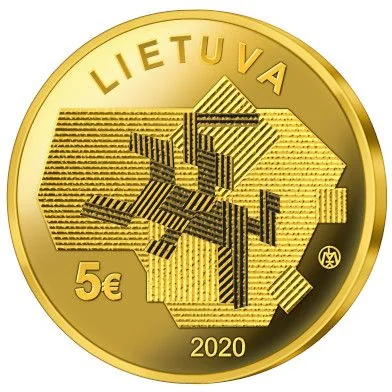
The coin's obverse depicts Lithuania's outline and the Vytis coat of arms, crafted from a motif of farmland. It includes the inscription LIETUVA, the €5 denomination, the year 2020, and the Lithuanian Mint mark.
Inscription:
LIETUVA
5€
LMK
2020
5€
LMK
2020
Translation:
LITHUANIA
5€
LMK
2020
5€
LMK
2020
Script: Latin
Designer: Rytas Jonas Belevičius
Reverse
Description:
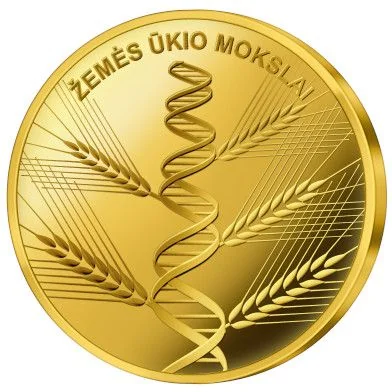
The reverse shows a World Tree motif woven from DNA strands and grain stalks, with the inscription ŽEMĖS ŪKIO MOKSLAI (AGRICULTURAL SCIENCES) above.
Inscription:
ŽEMĖS ŪKIO MOKSLAI
Translation:
Agricultural Sciences
Script: Latin
Language: Lithuanian
Designer: Rytas Jonas Belevičius
Edge
Plain
Categories
| Agriculture |
| Map |
| Science |
Mints
| Name | Mark |
|---|---|
| Lithuanian Mint | (LMK) |
Mintings
| Year | Mint Mark | Mintage | Quality | Collection |
|---|---|---|---|---|
| 2020 | LMK | 2,500 | Proof |
Historical background
In 2020, Lithuania's currency situation was defined by its well-established membership in the Eurozone, having adopted the euro on 1 January 2015. Therefore, the national currency was the euro (€), and monetary policy was set by the European Central Bank (ECB), not by Lithuanian authorities. This provided stability and eliminated exchange rate risk within the Eurozone, which was particularly valuable during the economic turbulence of that year. The primary focus for Lithuania was not on currency management but on navigating the broader economic fallout of the COVID-19 pandemic within the constraints and support mechanisms of the single currency area.
The year was dominated by the severe economic shock caused by the global pandemic. Lithuania's economy, heavily reliant on exports and services, contracted sharply in the second quarter. The government responded with significant fiscal stimulus packages to support businesses and households, leading to a widened budget deficit. From a currency perspective, the euro provided a shield against potential speculative attacks or liquidity crises that might have affected a smaller, independent currency, and ensured continued access to ECB support measures like the Pandemic Emergency Purchase Programme (PEPP).
Consequently, domestic economic discussions in 2020 centered on fiscal policy, healthcare, and sectoral support, not on exchange rates or independent monetary tools. The stability of the euro allowed the government to focus its response entirely on budgetary measures. By the end of 2020, as the initial shock subsided, Lithuania's economy showed signs of a faster-than-expected recovery compared to some Eurozone peers, though the year concluded with the currency's role as a bedrock of macroeconomic stability largely unquestioned in the national debate.
The year was dominated by the severe economic shock caused by the global pandemic. Lithuania's economy, heavily reliant on exports and services, contracted sharply in the second quarter. The government responded with significant fiscal stimulus packages to support businesses and households, leading to a widened budget deficit. From a currency perspective, the euro provided a shield against potential speculative attacks or liquidity crises that might have affected a smaller, independent currency, and ensured continued access to ECB support measures like the Pandemic Emergency Purchase Programme (PEPP).
Consequently, domestic economic discussions in 2020 centered on fiscal policy, healthcare, and sectoral support, not on exchange rates or independent monetary tools. The stability of the euro allowed the government to focus its response entirely on budgetary measures. By the end of 2020, as the initial shock subsided, Lithuania's economy showed signs of a faster-than-expected recovery compared to some Eurozone peers, though the year concluded with the currency's role as a bedrock of macroeconomic stability largely unquestioned in the national debate.
Series: Lithuanian Science



💎 Extremely Rare