

Obverse
Description:
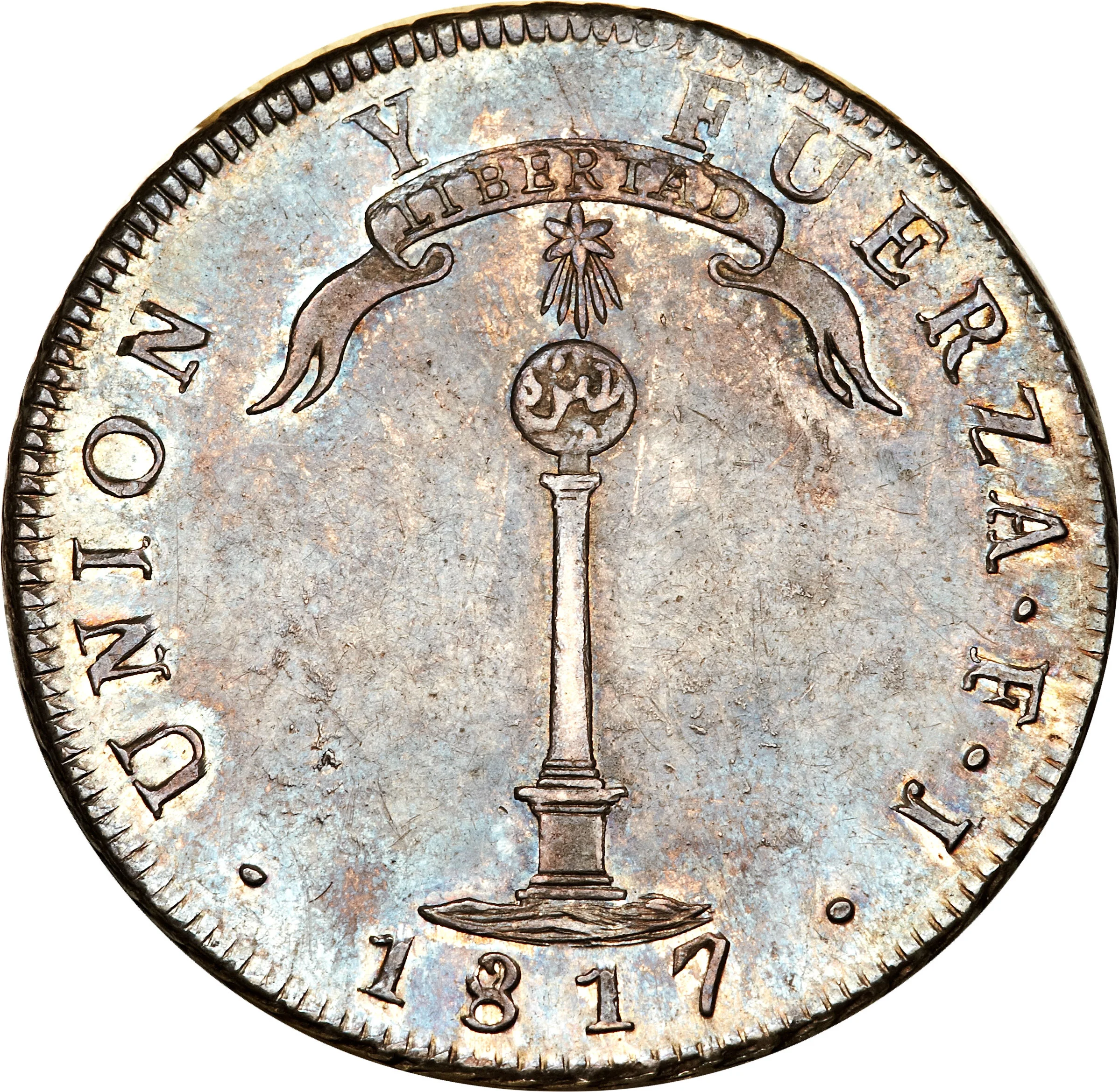
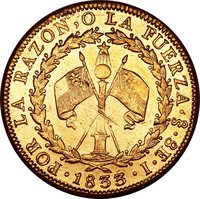
Globe-topped pillar beneath a star and ribbon.
Inscription:
UNION Y FUERZA F·J
LIBERTAD
· 1817 ·
LIBERTAD
· 1817 ·
Script: Latin
Reverse
Description:
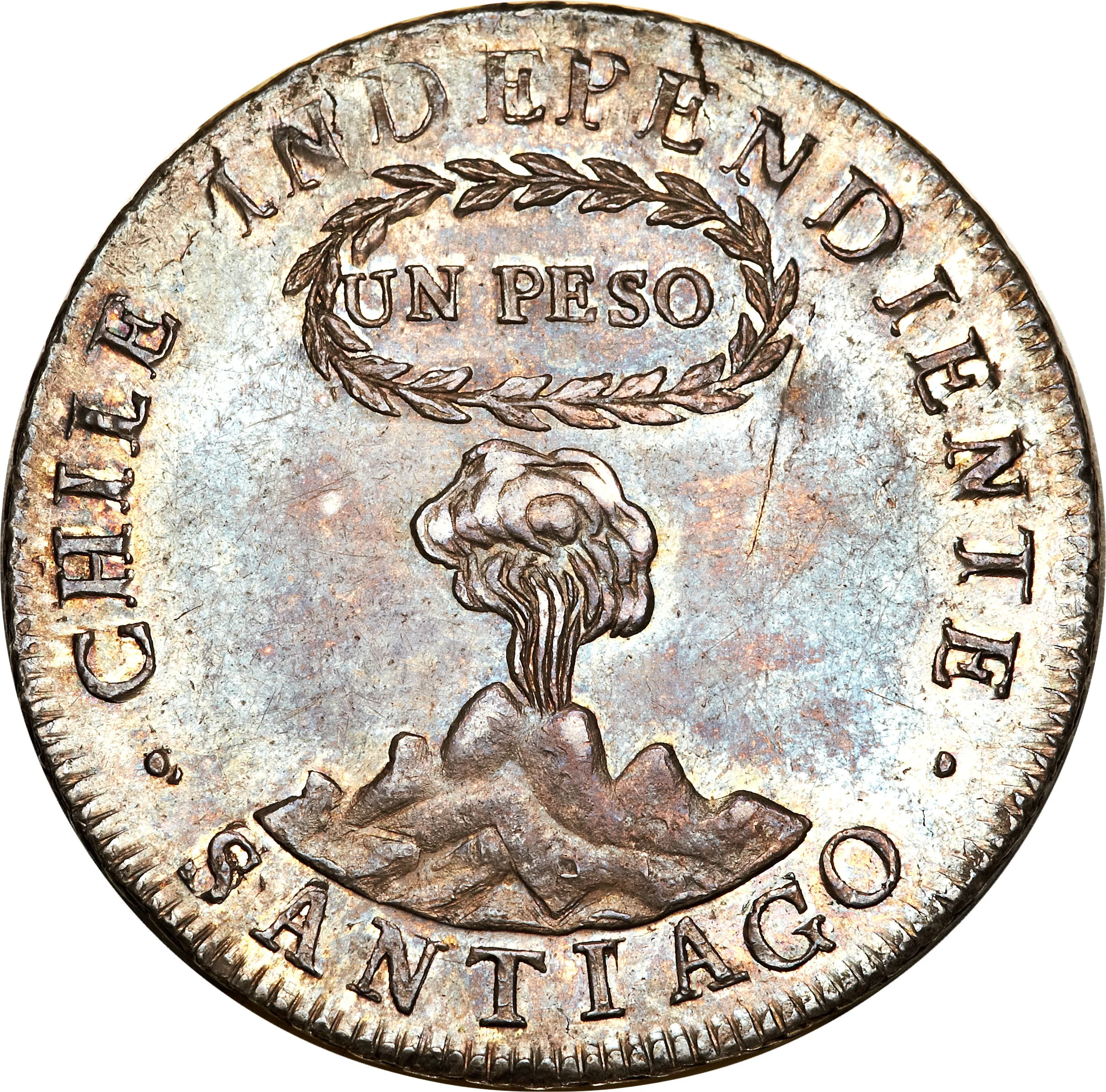
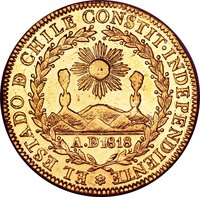
Volcano erupting beneath wreath.
Inscription:
CHILE INDEPENDIENTE
UN PESO
·SANTIAGO·
UN PESO
·SANTIAGO·
Script: Latin
Edge
Mints
| Name | Mark |
|---|---|
| Casa de Moneda de Chile | — |
Mintings
| Year | Mint Mark | Mintage | Quality | Collection |
|---|---|---|---|---|
| 1817 | — | — | ||
| 1817 | FD | — | ||
| 1817 | FJ | — | ||
| 1818 | FD | 371,000 | ||
| 1819 | FD | 236,000 | ||
| 1820 | FD | 116,000 | ||
| 1821 | FD | 126,000 | ||
| 1822 | FI | 148,000 | ||
| 1823 | FI | 45,000 | ||
| 1824 | I | 11,000 | ||
| 1825 | I | 3,400 | ||
| 1826 | I | 6,111 | ||
| 1830 | I | 6,868 | ||
| 1831 | I | 51,000 | ||
| 1832 | I | 40,000 | ||
| 1833 | I | 88,000 | ||
| 1834 | I | 43,000 | ||
| 1834 | IJ | — |
Historical background
Following Chile's declaration of independence in 1810, the period known as the Patria Vieja was marked by intense warfare against royalist forces. This conflict, culminating in the Spanish reconquest at the Battle of Rancagua in 1814, devastated the nascent nation's economy and shattered its financial system. The royalist government that followed reinstated Spanish currency, but the broader economic disruption, including the destruction of mines and haciendas, created a severe shortage of circulating coinage for daily transactions, setting the stage for a monetary crisis.
By 1817, the situation was one of profound transition and scarcity. The Army of the Andes, led by Generals José de San Martín and Bernardo O'Higgins, had just secured a decisive victory at the Battle of Chacabuco in February, liberating Santiago and re-establishing an independent Chilean government. However, the treasury was virtually empty, and the war was far from over, with strong royalist forces still holding southern Chile. In this vacuum, a chaotic mix of currencies circulated: worn Spanish and colonial coins, occasional foreign silver (like Peruvian pesos), and a proliferation of crude, privately minted copper tokens issued by merchants and hacienda owners out of necessity to pay workers and facilitate local trade.
Recognizing that a stable currency was essential for national sovereignty and economic recovery, the new government under Director Bernardo O'Higgins took immediate action. One of its first financial decrees in 1817 was to authorize the minting of Chile's first independent coinage. These provisional silver and gold coins, minted in Santiago, bore the national crest and the inscription "CHILE INDEPENDIENTE," providing a powerful symbolic and practical tool to assert sovereignty. This marked the crucial first step in replacing the fragmented monetary system with a unified, national currency, although the full stabilization of Chile's money would remain a challenge for years to come.
By 1817, the situation was one of profound transition and scarcity. The Army of the Andes, led by Generals José de San Martín and Bernardo O'Higgins, had just secured a decisive victory at the Battle of Chacabuco in February, liberating Santiago and re-establishing an independent Chilean government. However, the treasury was virtually empty, and the war was far from over, with strong royalist forces still holding southern Chile. In this vacuum, a chaotic mix of currencies circulated: worn Spanish and colonial coins, occasional foreign silver (like Peruvian pesos), and a proliferation of crude, privately minted copper tokens issued by merchants and hacienda owners out of necessity to pay workers and facilitate local trade.
Recognizing that a stable currency was essential for national sovereignty and economic recovery, the new government under Director Bernardo O'Higgins took immediate action. One of its first financial decrees in 1817 was to authorize the minting of Chile's first independent coinage. These provisional silver and gold coins, minted in Santiago, bore the national crest and the inscription "CHILE INDEPENDIENTE," providing a powerful symbolic and practical tool to assert sovereignty. This marked the crucial first step in replacing the fragmented monetary system with a unified, national currency, although the full stabilization of Chile's money would remain a challenge for years to come.
💎 Very Rare