

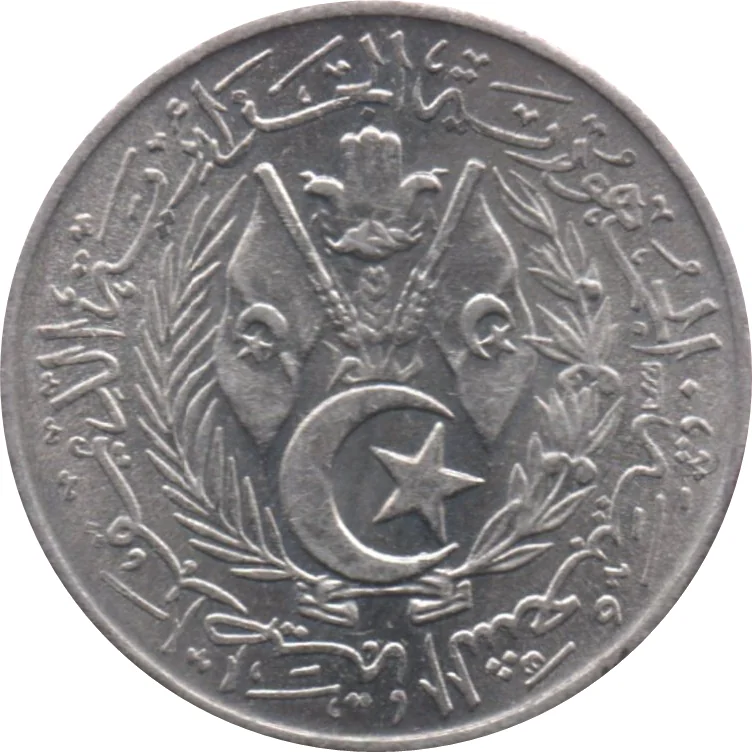
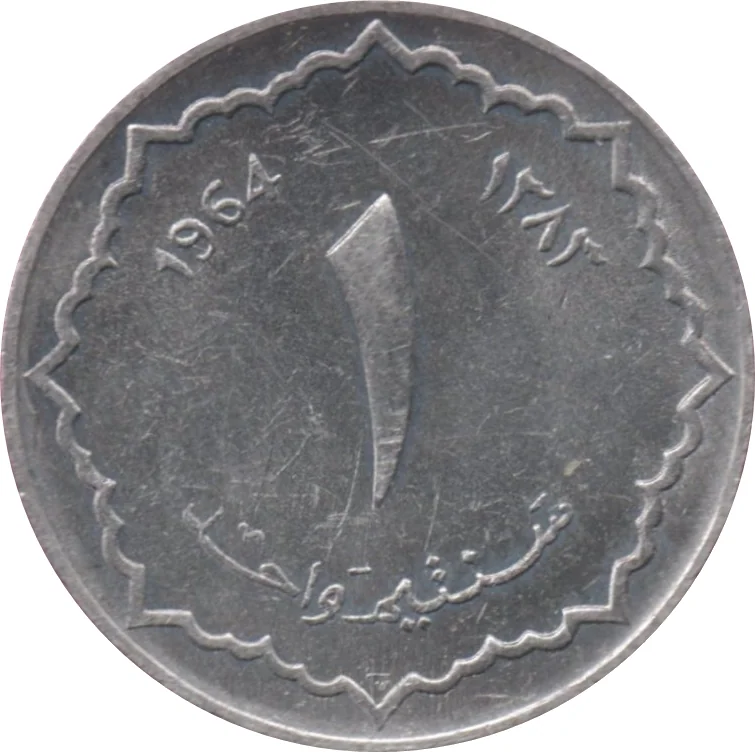
1 centime – Algeria
Add to wishlist
Algeria
Context
Year: 1964
Islamic (Hijri) Year:: 1383
Issuer: Algeria
Period:
(since 1962)
Currency:
(since 1964)
Demonetized: Yes
Total mintage: 35,000,000
Material
References
KM: #
Numista: #2452
Value
Exchange value: 0.01 DZD
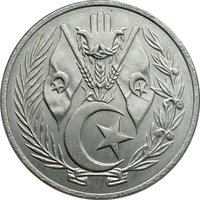
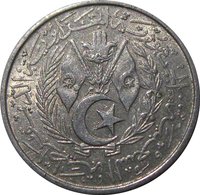
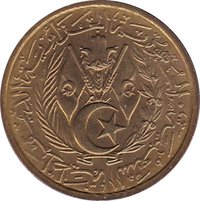
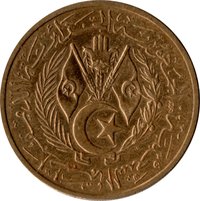
Obverse
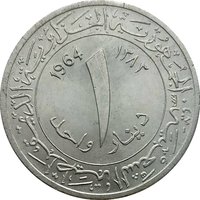
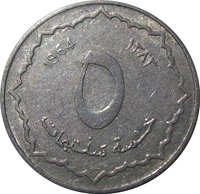
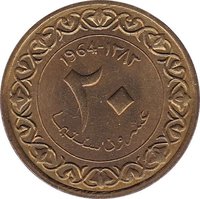
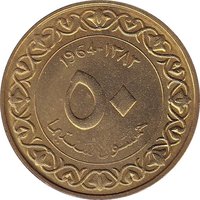
Reverse
Edge
Plain
Categories
| Symbol> Flag |
| Symbols> Coat of Arms |
Mints
| Name | Mark |
|---|---|
| Heaton and Sons / The Mint Birmingham | — |
Mintings
| Year | Mint Mark | Mintage | Quality | Collection |
|---|---|---|---|---|
| 1964 | — | 35,000,000 |
Historical background
In 1964, Algeria's currency situation was fundamentally shaped by its recent independence from France in 1962. The new nation inherited the Algerian new franc, which remained pegged to the French franc and was part of the Franc Zone. This arrangement ensured monetary stability and facilitated crucial trade with France, but it also symbolized a continued economic dependence that conflicted with the revolutionary government's desire for full sovereignty. President Ahmed Ben Bella's administration faced the difficult task of balancing the practical need for financial continuity with the political imperative to assert economic independence.
Domestically, the currency system operated within a challenging economic context. The legacy of the devastating war for independence, the exodus of European settlers and administrators, and a largely agrarian economy strained the country's financial foundations. While the peg to the French franc provided external stability, internal pressures were mounting. The government's socialist-oriented policies, including major nationalizations of former French lands and industries, created a need for greater control over monetary policy to fund reconstruction and development, a flexibility limited by the Franc Zone's rules.
Consequently, 1964 was a year of transition and mounting pressure for change. The existing currency arrangement was increasingly viewed as a temporary necessity. Behind the scenes, planning likely began for a decisive break, which would materialize just a few years later. In 1964, the Algerian dinar was introduced as a unit of account, and by 1970, Algeria would formally exit the Franc Zone and launch the Algerian dinar as a fully independent, non-convertible national currency, marking the culmination of the sovereign monetary path envisioned during this period.
Domestically, the currency system operated within a challenging economic context. The legacy of the devastating war for independence, the exodus of European settlers and administrators, and a largely agrarian economy strained the country's financial foundations. While the peg to the French franc provided external stability, internal pressures were mounting. The government's socialist-oriented policies, including major nationalizations of former French lands and industries, created a need for greater control over monetary policy to fund reconstruction and development, a flexibility limited by the Franc Zone's rules.
Consequently, 1964 was a year of transition and mounting pressure for change. The existing currency arrangement was increasingly viewed as a temporary necessity. Behind the scenes, planning likely began for a decisive break, which would materialize just a few years later. In 1964, the Algerian dinar was introduced as a unit of account, and by 1970, Algeria would formally exit the Franc Zone and launch the Algerian dinar as a fully independent, non-convertible national currency, marking the culmination of the sovereign monetary path envisioned during this period.
Series: 1964 Algeria circulation coins
🌱 Very Common