

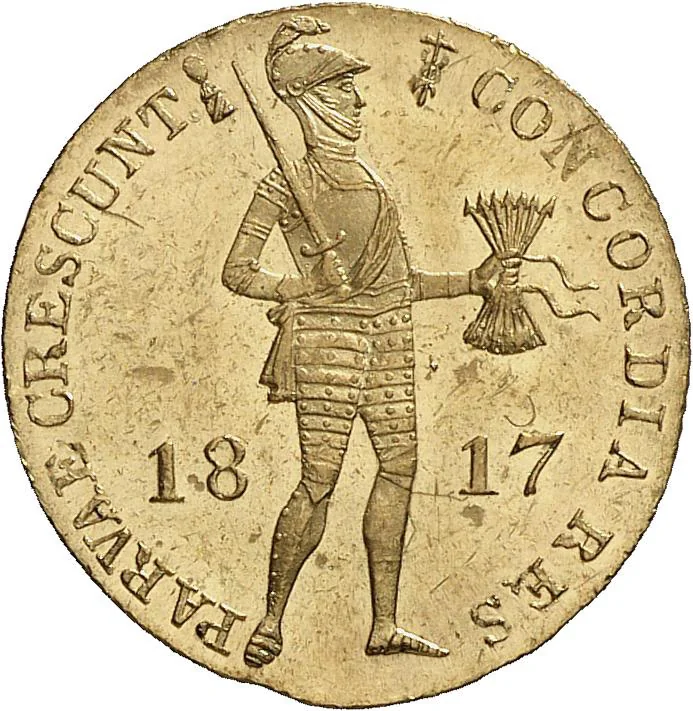
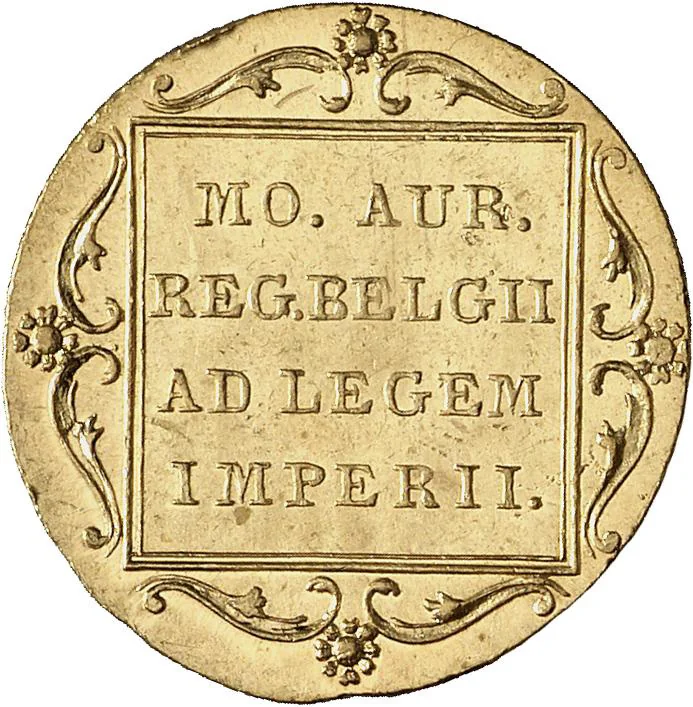
1 ducat – Netherlands
Add to wishlist
Netherlands
Context
Years: 1817–1840
Issuer: Netherlands
Ruler: William I
Currency:
(1817—2001)
Demonetized: Yes
Total mintage: 10,519,314
Material
References
KM: #
Numista: #24443
Value
Exchange value: 17⁄3 NLG
Bullion value: $529.62
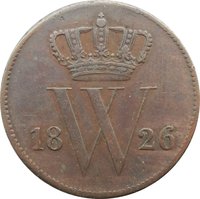
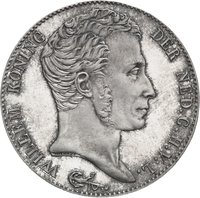
Obverse
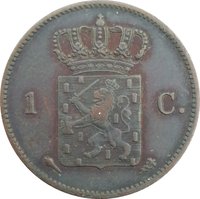
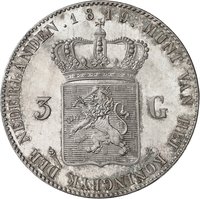
Reverse
Edge
Slant-reeded
Categories
| Object> Armour |
| Object> Cold weapons |
Mints
| Name | Mark |
|---|---|
| Royal Dutch Mint | — |
| Royal Mint of Belgium | B |
Mintings
| Year | Mint Mark | Mintage | Quality | Collection |
|---|---|---|---|---|
| 1817 | — | 495,110 | ||
| 1818 | — | 1,561,407 | ||
| 1819 | — | 110,670 | ||
| 1820 | — | 10,419 | ||
| 1821 | — | 15,073 | ||
| 1822 | — | 11,971 | ||
| 1824 | B | 8,000 | ||
| 1825 | B | 48,003 | ||
| 1825 | — | 119,276 | ||
| 1827 | — | 138,110 | ||
| 1827 | B | 27,032 | ||
| 1828 | — | 631,800 | ||
| 1828 | B | 454,114 | ||
| 1829 | — | — | ||
| 1829 | B | 247,000 | ||
| 1830 | — | 2,000,000 | ||
| 1830 | B | 11,186 | ||
| 1831 | — | 410,915 | ||
| 1832 | — | 1,000,000 | ||
| 1833 | — | 247,303 | ||
| 1834 | — | 150,000 | ||
| 1835 | — | — | ||
| 1836 | — | — | ||
| 1837 | — | 1,400,000 | ||
| 1838 | — | 1,200,000 | ||
| 1839 | — | 118,604 | ||
| 1840 | — | 103,321 |
Historical background
Following the Napoleonic Wars and the establishment of the Kingdom of the Netherlands in 1815, the nation faced a complex and fragmented currency situation. The economy was burdened by a chaotic mix of old Dutch guilders, French francs (from the period of French annexation), and various foreign coins, all circulating with unstable values. This monetary disarray hindered trade, state finance, and economic recovery, creating an urgent need for a uniform and stable national currency to solidify the new kingdom's economic foundation.
In response, King William I enacted the Monetary Law of 1817, which established the Dutch guilder (or gulden) as the sole legal tender. The new system was deliberately bimetallic, based on both silver and gold. The guilder was formally defined as containing 9.613 grams of fine silver, while a ten-guilder piece was minted in gold. This law aimed to create confidence by pegging the currency to precious metals and centralizing coinage under state control, thereby driving out the myriad of foreign and obsolete coins from circulation.
However, the 1817 system soon encountered difficulties. The fixed legal ratio between gold and silver values did not align with shifting market prices, leading to the practical disappearance of one metal from circulation as it was hoarded or exported—a classic consequence of Gresham's Law. Thus, while the 1817 reform successfully created a unified national currency and ended the immediate post-war chaos, it planted the seeds for future monetary adjustments, as the Netherlands struggled with the inherent instabilities of a bimetallic standard in a changing international economy.
In response, King William I enacted the Monetary Law of 1817, which established the Dutch guilder (or gulden) as the sole legal tender. The new system was deliberately bimetallic, based on both silver and gold. The guilder was formally defined as containing 9.613 grams of fine silver, while a ten-guilder piece was minted in gold. This law aimed to create confidence by pegging the currency to precious metals and centralizing coinage under state control, thereby driving out the myriad of foreign and obsolete coins from circulation.
However, the 1817 system soon encountered difficulties. The fixed legal ratio between gold and silver values did not align with shifting market prices, leading to the practical disappearance of one metal from circulation as it was hoarded or exported—a classic consequence of Gresham's Law. Thus, while the 1817 reform successfully created a unified national currency and ended the immediate post-war chaos, it planted the seeds for future monetary adjustments, as the Netherlands struggled with the inherent instabilities of a bimetallic standard in a changing international economy.
💎 Very Rare