

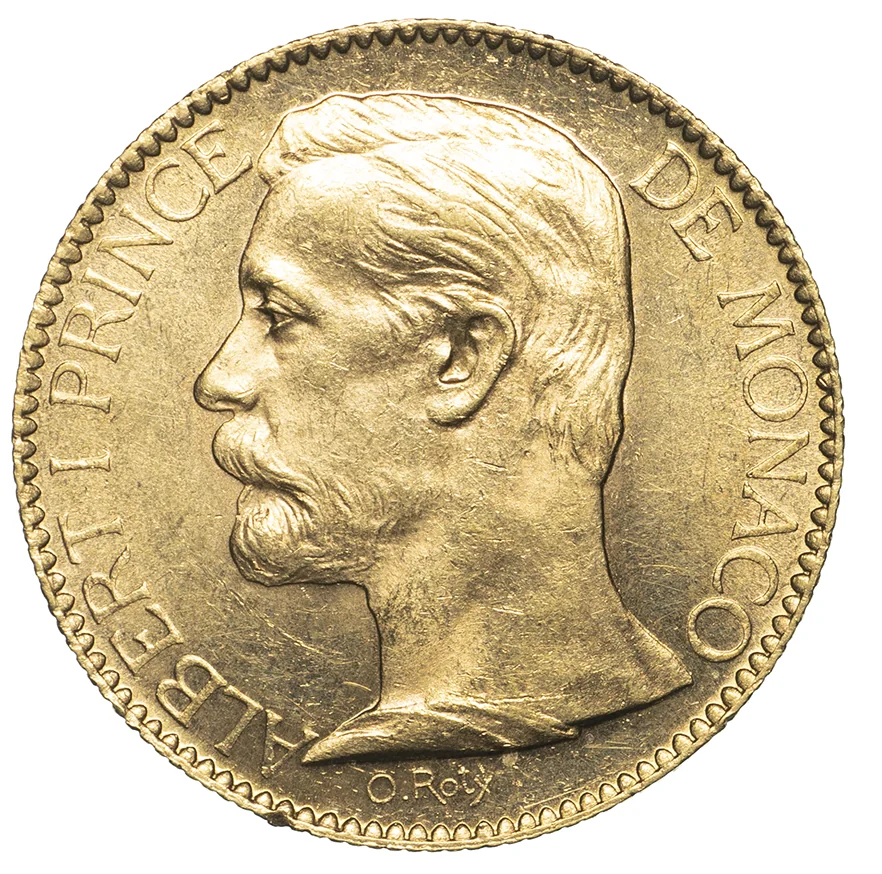
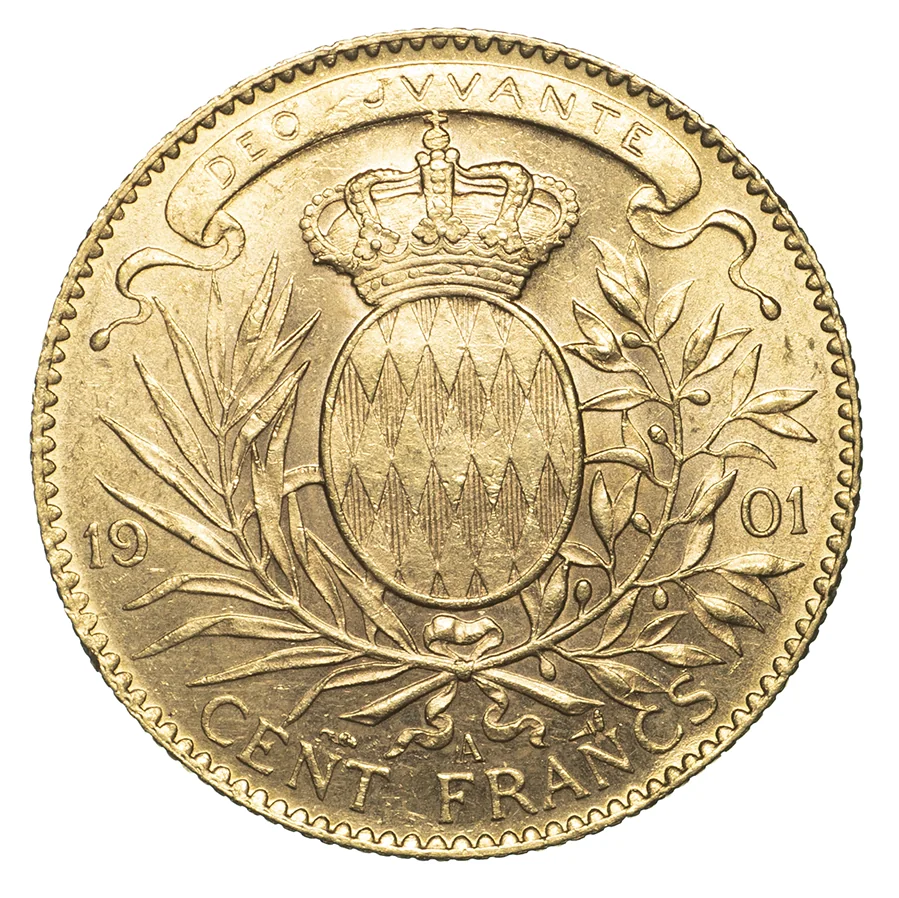
100 francs – Monaco
Add to wishlist
Monaco
Obverse
Description:
Prince Albert I bust, left.
Inscription:
ALBERT I PRINCE DE MONACO
O. Roty
O. Roty
Translation:
Albert I Prince of Monaco
O. Roty
O. Roty
Script: Latin
Language: French
Engraver: Louis-Oscar Roty
Reverse
Description:
Monaco's crowned coat of arms flanked by a laurel branch and an olive branch.
Inscription:
DEO JUVANTE
19 01
CENT FRANCS
19 01
CENT FRANCS
Script: Latin
Engraver: Louis-Oscar Roty
Edge
Reeded
Mints
| Name | Mark |
|---|---|
| Monnaie de Paris | — |
Mintings
| Year | Mint Mark | Mintage | Quality | Collection |
|---|---|---|---|---|
| 1891 | A | 20,000 | ||
| 1895 | A | 20,000 | ||
| 1896 | A | 20,000 | ||
| 1901 | A | 15,000 | ||
| 1904 | A | 10,000 |
Historical background
In 1891, the Principality of Monaco operated under a complex and de facto shared currency regime, lacking the authority to issue its own legal tender. As a result, the Monégasque economy was dominated by the French franc, a consequence of the customs union established with France in 1865. French coins and banknotes circulated freely and were used for all major transactions and state finances, making the franc the unofficial but unquestioned currency of daily life.
However, this French dominance existed alongside the lingering presence of older, regional currencies. Notably, the Sardinian scudo and the lira of the former Kingdom of Sardinia (which had ruled Monaco until 1860) could still occasionally be found in circulation, particularly among older residents or in small, private transactions. These coins were remnants of Monaco's pre-French alignment and were accepted at fluctuating market rates, adding a layer of informal complexity to the monetary system.
The year 1891 fell within a period of monetary stability under the reign of Prince Albert I, but it also highlighted Monaco's dependency on French monetary policy. The principality had no central bank and its economy was entirely subject to decisions made in Paris. This arrangement was formalized two decades later with the signing of the 1918 Franco-Monégasque Treaty, which legally cemented the French franc as Monaco's official currency, a situation that would persist until the adoption of the Euro.
However, this French dominance existed alongside the lingering presence of older, regional currencies. Notably, the Sardinian scudo and the lira of the former Kingdom of Sardinia (which had ruled Monaco until 1860) could still occasionally be found in circulation, particularly among older residents or in small, private transactions. These coins were remnants of Monaco's pre-French alignment and were accepted at fluctuating market rates, adding a layer of informal complexity to the monetary system.
The year 1891 fell within a period of monetary stability under the reign of Prince Albert I, but it also highlighted Monaco's dependency on French monetary policy. The principality had no central bank and its economy was entirely subject to decisions made in Paris. This arrangement was formalized two decades later with the signing of the 1918 Franco-Monégasque Treaty, which legally cemented the French franc as Monaco's official currency, a situation that would persist until the adoption of the Euro.
⭐ Rare