

100 francs – Monaco
Add to wishlist
Monaco
Context
Years: 1877–1886
Issuer: Monaco
Ruler: Charles III
Currency:
(1837—1960)
Demonetized: Yes
Total mintage: 35,000
Material
References
KM: #
Numista: #24360
Value
Bullion value: $4452.46
Obverse
Description:
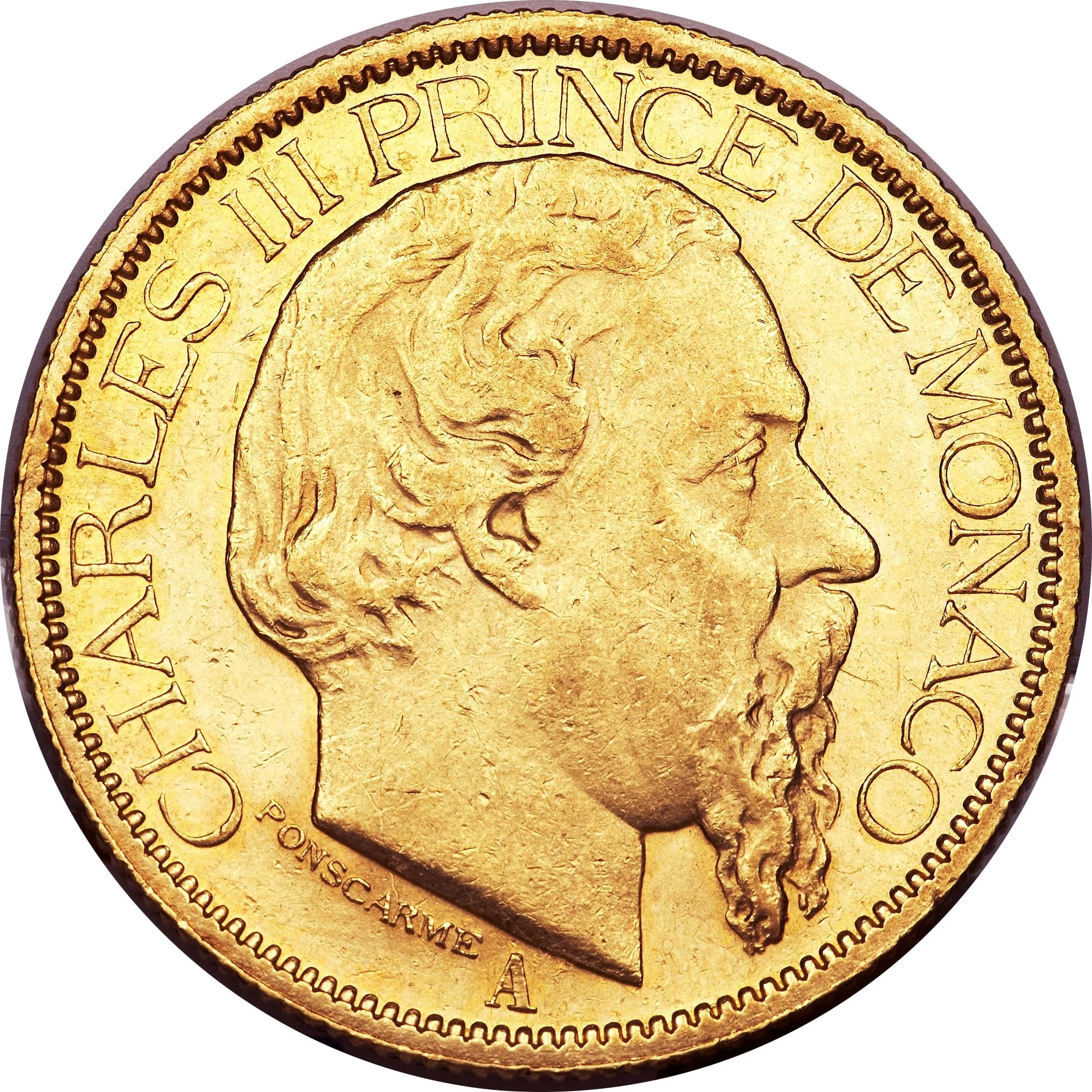
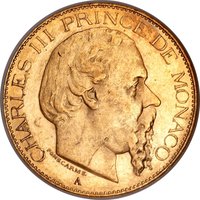
Bust of Charles III, right.
Inscription:
CHARLES III PRINCE DE MONACO
PONSCARME
A
PONSCARME
A
Translation:
CHARLES III PRINCE OF MONACO
PONSCARME
PONSCARME
Script: Latin
Language: French
Engraver: Hubert Ponscarme
Reverse
Description:
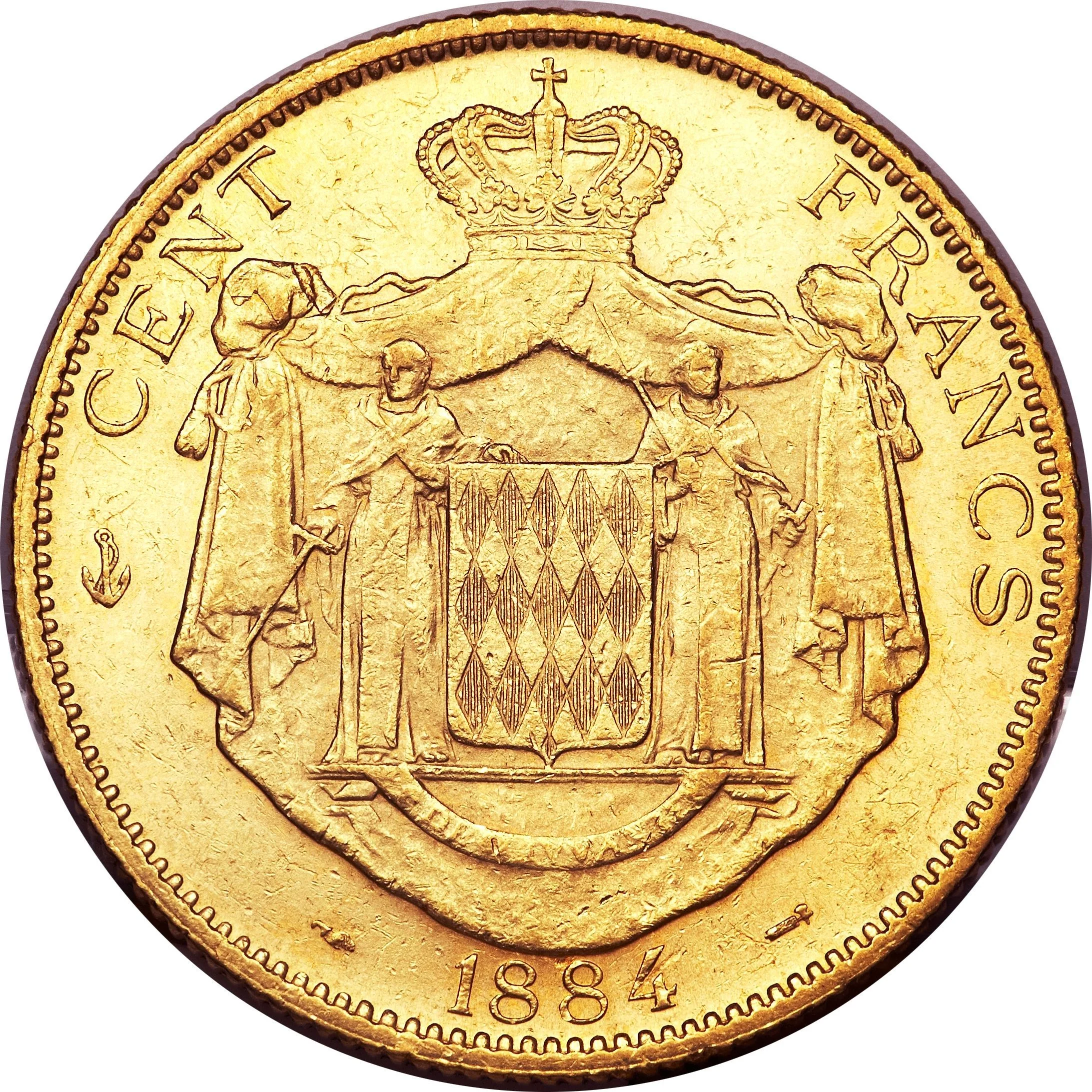
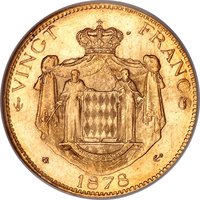
Monaco's coat of arms.
Inscription:
CENT FRANCS
1884
1884
Script: Latin
Engraver: Hubert Ponscarme
Edge
Reeded
Mints
| Name | Mark |
|---|---|
| Monnaie de Paris | — |
Mintings
| Year | Mint Mark | Mintage | Quality | Collection |
|---|---|---|---|---|
| 1877 | — | — | ||
| 1881 | — | — | ||
| 1882 | A | 5,000 | ||
| 1884 | A | 15,000 | ||
| 1886 | A | 15,000 |
Historical background
In 1877, Monaco's currency situation was intrinsically tied to that of France, operating under the framework of the Latin Monetary Union (LMU). Established in 1865, the LMU was a pioneering attempt at European monetary standardization, which Monaco had joined by a specific convention with France in 1865. This meant that the French franc was legal tender in the Principality, and Monegasque coins (struck at the Paris Mint) were minted to identical specifications in gold and silver, circulating interchangeably with French currency. The system was bimetallic, based on fixed ratios between gold and silver.
However, by 1877, the LMU was under significant strain. The discovery of vast silver deposits in the Americas had caused the market value of silver to fall sharply against gold, leading to the problematic arbitrage of undervalued silver coins. To protect their gold reserves, member states, including France, had begun to limit the minting of silver five-franc pieces. For Monaco, this meant its monetary policy was entirely reactive to decisions made in Paris. The Principality had no independent central bank or authority to deviate from the French-led response to the crisis.
Consequently, daily commerce in Monaco in 1877 would have seen a seamless circulation of French and Monegasque coinage, but within a system that was increasingly moving towards a de facto gold standard. The stability of the currency itself was unquestioned locally, as it was backed by the French economy, but the underlying supranational agreement that authorized it was beginning to falter. The situation underscored Monaco's deep economic and monetary dependence on its powerful neighbour, a relationship that would be formally cemented by the treaty of 1861 and remain a cornerstone of its financial system.
However, by 1877, the LMU was under significant strain. The discovery of vast silver deposits in the Americas had caused the market value of silver to fall sharply against gold, leading to the problematic arbitrage of undervalued silver coins. To protect their gold reserves, member states, including France, had begun to limit the minting of silver five-franc pieces. For Monaco, this meant its monetary policy was entirely reactive to decisions made in Paris. The Principality had no independent central bank or authority to deviate from the French-led response to the crisis.
Consequently, daily commerce in Monaco in 1877 would have seen a seamless circulation of French and Monegasque coinage, but within a system that was increasingly moving towards a de facto gold standard. The stability of the currency itself was unquestioned locally, as it was backed by the French economy, but the underlying supranational agreement that authorized it was beginning to falter. The situation underscored Monaco's deep economic and monetary dependence on its powerful neighbour, a relationship that would be formally cemented by the treaty of 1861 and remain a cornerstone of its financial system.
💎 Very Rare