

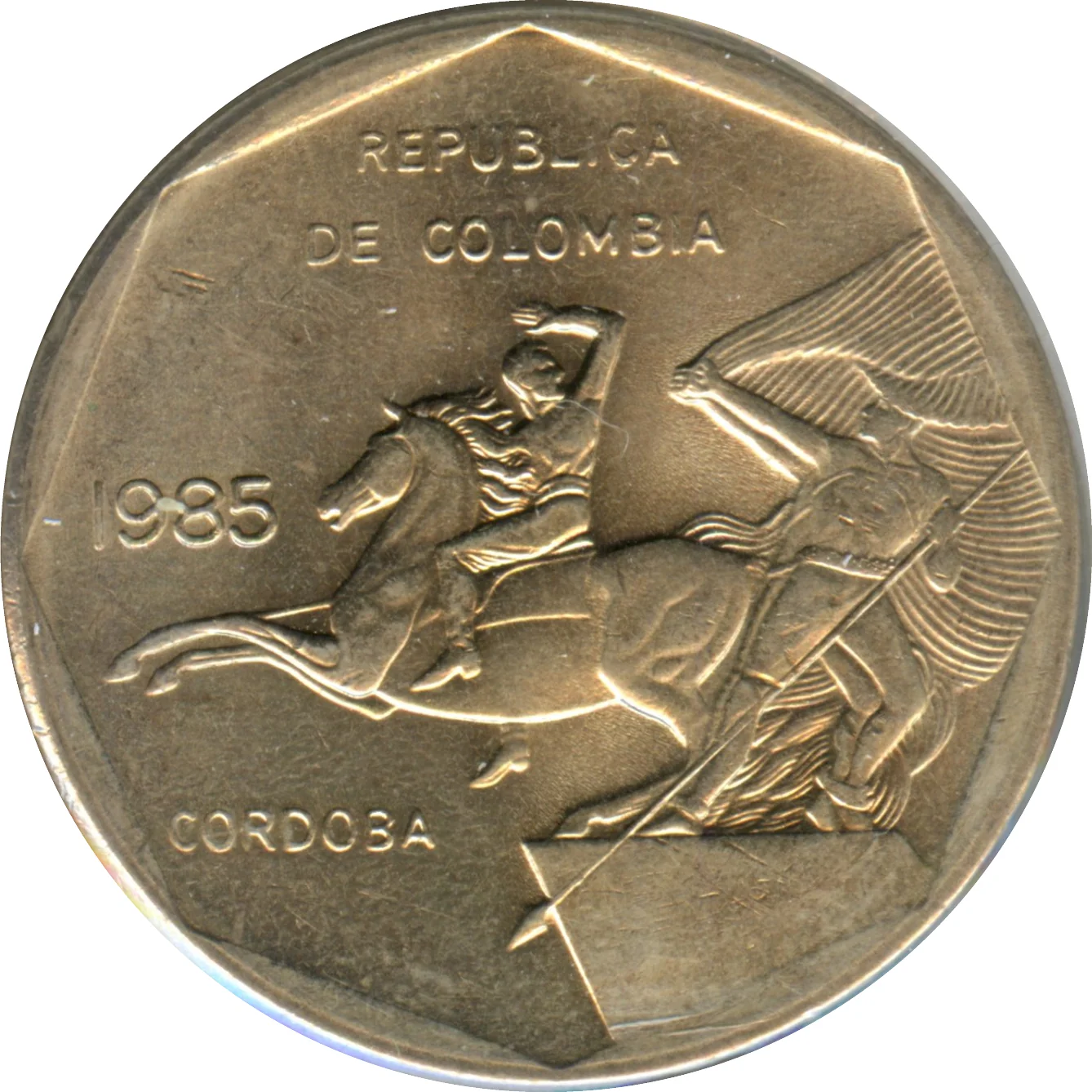
Obverse
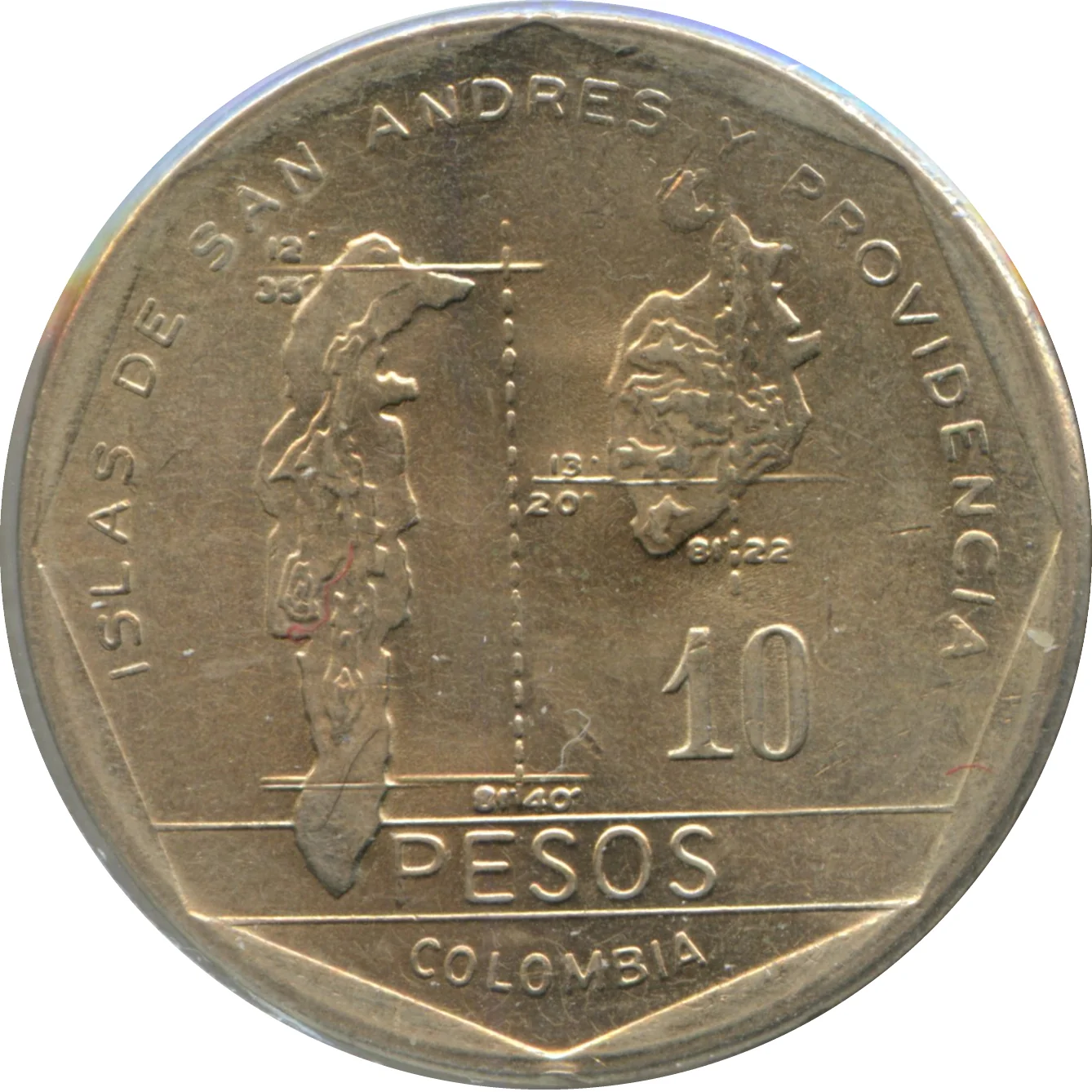
Reverse
Description:
Map of Colombia's San Andrés and Providencia archipelago, located in the Caribbean Sea about 700 km northwest of the mainland. Providencia Island is at 13°20'N 81°22'O. The coral reef east of San Andrés is at 81°40'W.
Inscription:
ISLAS DE SAN ANDRES Y PROVIDENCIA
13°20 81°22
81°40
10 PESOS COLOMBIA
13°20 81°22
81°40
10 PESOS COLOMBIA
Translation:
ISLANDS OF SAN ANDRES AND PROVIDENCIA
13°20 81°22
81°40
10 PESOS COLOMBIA
13°20 81°22
81°40
10 PESOS COLOMBIA
Script: Latin
Language: Spanish
Edge
Plain
Mints
| Name | Mark |
|---|---|
| Bogota Mint | — |
Mintings
| Year | Mint Mark | Mintage | Quality | Collection |
|---|---|---|---|---|
| 1981 | — | 104,554,000 | ||
| 1982 | — | 83,605,000 | ||
| 1983 | — | 104,051,000 | ||
| 1985 | — | 80,000,000 | ||
| 1988 | — | 50,704,091 | ||
| 1989 | — | 26,012,000 |
Historical background
In 1981, Colombia's currency situation was characterized by a managed exchange rate system under significant strain. The country operated a "crawling peg" regime, where the Colombian peso was devalued against the US dollar at a pre-announced, gradual rate intended to maintain export competitiveness and control inflation. This system had provided relative stability through the 1970s, shielded somewhat from regional volatility by conservative fiscal policies and a diverse, less debt-dependent economy. However, by 1981, external pressures were mounting, primarily from a global recession, falling commodity prices, and rising international interest rates.
The core challenge was a deteriorating balance of payments. Colombia's key exports—coffee, oil, and coal—faced weakening global demand and prices, leading to a shrinking trade surplus. Simultaneously, the cost of servicing foreign debt was rising sharply due to global interest rate hikes led by the US Federal Reserve. These factors put intense downward pressure on the peso, forcing the Banco de la República to frequently intervene in foreign exchange markets, depleting international reserves to defend the established parity. Inflation, though lower than many Latin American neighbors, remained stubbornly high, creating a tension between the devaluation policy aimed at exports and the need for price stability.
Consequently, 1981 marked the beginning of the end for the existing exchange rate stability. The authorities were compelled to accelerate the pace of devaluation beyond initial targets, and the gap between the official rate and the black-market rate widened noticeably. This period set the stage for a more profound economic crisis later in the decade, as the persistent drain on reserves and growing external imbalances proved unsustainable, eventually leading to a more drastic policy shift and a major devaluation in the mid-1980s.
The core challenge was a deteriorating balance of payments. Colombia's key exports—coffee, oil, and coal—faced weakening global demand and prices, leading to a shrinking trade surplus. Simultaneously, the cost of servicing foreign debt was rising sharply due to global interest rate hikes led by the US Federal Reserve. These factors put intense downward pressure on the peso, forcing the Banco de la República to frequently intervene in foreign exchange markets, depleting international reserves to defend the established parity. Inflation, though lower than many Latin American neighbors, remained stubbornly high, creating a tension between the devaluation policy aimed at exports and the need for price stability.
Consequently, 1981 marked the beginning of the end for the existing exchange rate stability. The authorities were compelled to accelerate the pace of devaluation beyond initial targets, and the gap between the official rate and the black-market rate widened noticeably. This period set the stage for a more profound economic crisis later in the decade, as the persistent drain on reserves and growing external imbalances proved unsustainable, eventually leading to a more drastic policy shift and a major devaluation in the mid-1980s.
🌱 Very Common