

20 franga ari – Albania
Add to wishlist
Albania
Obverse
Description:
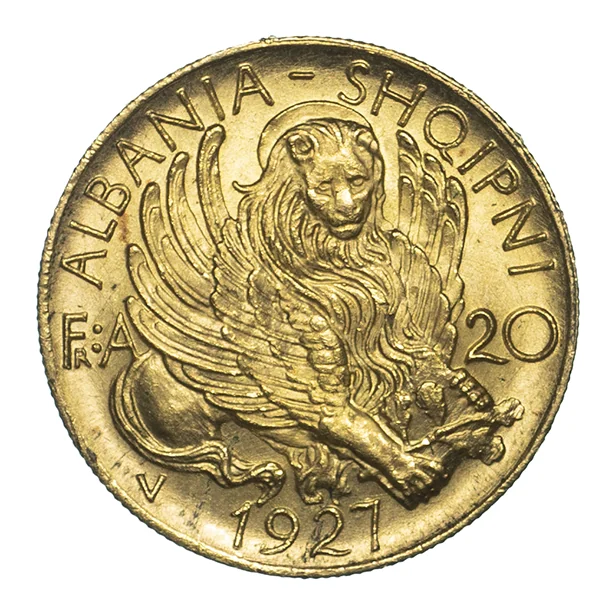
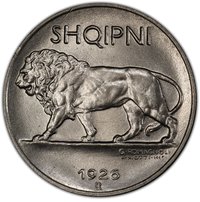
Venice's winged lion.
Inscription:
ALBANIA - SHQIPNI
Fr:A 20
V 1927
Fr:A 20
V 1927
Translation:
Albania - Albania
20 Francs
1927
20 Francs
1927
Script: Latin
Engraver: Giuseppe Romagnoli
Reverse
Description:
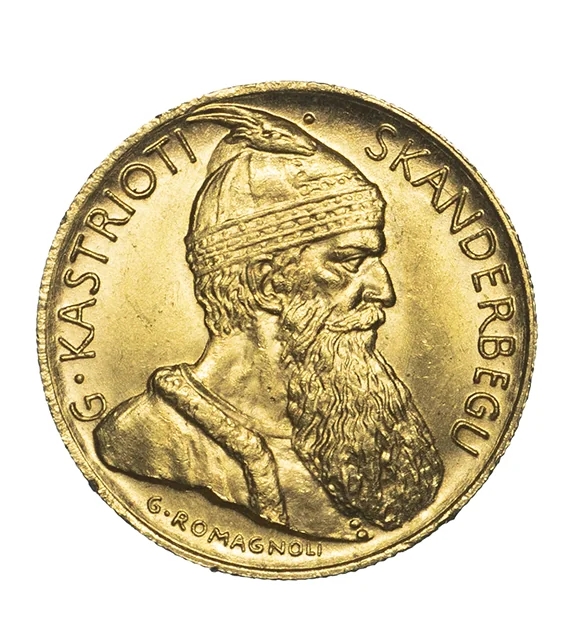
Skanderbeg in profile.
Inscription:
G·KASTRIOTI · SKANDERBEGU
G·Romagnoli
G·Romagnoli
Script: Latin
Engraver: Giuseppe Romagnoli
Edge
Reeded
Categories
| Animal> Feline |
| Mythology> Fantastic animal |
| Person> Military leader |
Mints
| Name | Mark |
|---|---|
| Rome | R |
| Münze Österreich | V |
Historical background
In 1926, Albania's currency situation was characterized by instability and foreign dependence, a legacy of its turbulent emergence as an independent state following the collapse of the Ottoman Empire. The country lacked a unified national currency, and its monetary system was a chaotic mix of foreign coins and notes. The Ottoman gold lira, the French gold franc, the Italian lira, and the Greek drachma all circulated concurrently, with their values fluctuating based on weight and international exchange rates rather than a fixed standard. This monetary fragmentation hampered trade, state revenue collection, and economic development, as the government had little control over its own money supply.
The dominant foreign influence in this period was Italy, which was increasingly asserting its economic and political control over Albania. While the National Bank of Albania, established in 1925 with significant Italian capital, was tasked with issuing a national currency, it had not yet done so by 1926. Instead, the bank began to consolidate monetary control by introducing the Albanian franc (Franga) as a unit of account, pegged at par to the French gold franc. However, physical currency in circulation remained predominantly foreign, with Italian influence growing through loans and trade agreements that further tied the Albanian economy to Rome.
Consequently, the currency situation in 1926 was a transitional but precarious one. The framework for a modern, national currency was being built under the auspices of the Italian-backed National Bank, aiming to replace the anarchy of competing foreign monies. Yet, the tangible reality for most Albanians was still a confusing system of metal and paper from various nations, symbolizing the country's broader struggles with sovereignty and state-building. This instability would only be partially resolved with the eventual introduction of the first Albanian notes in 1926, which were themselves backed by and dependent on Italian reserves.
The dominant foreign influence in this period was Italy, which was increasingly asserting its economic and political control over Albania. While the National Bank of Albania, established in 1925 with significant Italian capital, was tasked with issuing a national currency, it had not yet done so by 1926. Instead, the bank began to consolidate monetary control by introducing the Albanian franc (Franga) as a unit of account, pegged at par to the French gold franc. However, physical currency in circulation remained predominantly foreign, with Italian influence growing through loans and trade agreements that further tied the Albanian economy to Rome.
Consequently, the currency situation in 1926 was a transitional but precarious one. The framework for a modern, national currency was being built under the auspices of the Italian-backed National Bank, aiming to replace the anarchy of competing foreign monies. Yet, the tangible reality for most Albanians was still a confusing system of metal and paper from various nations, symbolizing the country's broader struggles with sovereignty and state-building. This instability would only be partially resolved with the eventual introduction of the first Albanian notes in 1926, which were themselves backed by and dependent on Italian reserves.
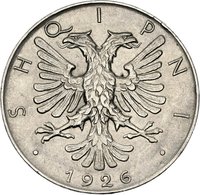
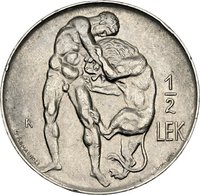
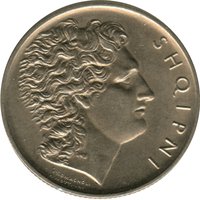
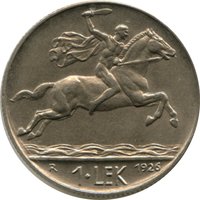
Series: 1926 Albania circulation coins
💎 Very Rare